[00:00:01] Speaker A: Hello, I'm Jeremy Rivera, your unscripted podcast host. I'm here with Brittany Trafis of Saurian Digital, who's going to introduce herself to us and focus on the things she has done previously before this, that built the expertise, experience, authority and trust that should make us trust her as she says what she's going to say about digital marketing.
[00:00:30] Speaker B: Thank you for having me, Jeremy. It's great to be here on the show today.
[00:00:34] Speaker A: My pleasure. So where have you been and what did it teach you as you kind of jump into this digital marketing world?
[00:00:43] Speaker B: Yeah, so I have always been involved in marketing in some point, whether it was I was a graphic artist making flyers for a food safety distributor to the intern who was running and setting up conference booths.
And as I look back, you know, even it starts when my first job was working at Chi Chi's. I don't even if you remember Chi Chi's, but working as a hostess there and helping greet and seat people, before there was technology that could tell you just what table to go, put them at you or trying to arrange them there. And so as I look at just like where I've come from, you know, you know, from working in restaurants as a hostess to moving into really graphic design, understanding trade show booth design, that all then moved me into starting to understand like what's this difference between branding, what's this difference between lead generation awareness and these new phrases that like you learn in college and until you're actually in it, you're like, oh, this is what I'm doing. I'm actually creating awareness that's going to generate leads, that's going to create revenue, but where it really all came together for me as each of those pieces really leading to understand the startup world and going from corporate to startup world and working hands on. I worked at a company that was growing their own email platform and this was early mid 2000s when like ESPs were just blowing up everywhere. If you were an entrepreneur, you were creating an email platform just kind of like people today in a high honestly.
And so working hands on there, really starting to understand that from the customer facing perspective of engaging with people, learning with people, then that eventually started to move into, well, how's that transport. Transport into platform and having relationships with people from an account management perspective to then strategy and understanding how all this data that we're collecting can now inform what you should be doing as a company. And then this new thing, measurement, I can track across websites now. And so all of these elements starting to really build together and then the last 10 years I spent helping lead a leading digital marketing agency.
And then AI hit. And as I looked at AI hitting and where we're at today, it all came together. My passions, I didn't realize it until these two letters really came into the world that, you know, as I look back at where I've been and what I've really been learning is it comes back to solving problems and seeing what that gap is and helping people fill that gap. And to fill that gap, I always compare it to, you know, you see firefighters and they, you know, the house is on fire and people are running out and they're running in. Very few people want to run in and actually dive head first in to fill that gap and figure out what the solution is. A lot of people are just like, let me know once you get some learnings and let's figure it out. And that's where it's like, wow. Like, my experience in technology and marketing and digital and just overall customer relationships has really built me for this moment to help solve those challenges.
[00:04:21] Speaker A: So would you say for your Fursonian digital, like, what's your usp? When you're talking to your clients, somebody steps into that elevator, you've got 60 seconds to say, this is what we are, this is what we do, and this is what makes us unique. You got 60 seconds on the clock. Go.
[00:04:42] Speaker B: Let's go. So Sorian Digital, we're an AI native marketing agency and we help companies adapt to the shift in search engines. Search has changed and we're here to help you show up in AI search engines. So generated results, not just in traditional search like Google.
[00:05:01] Speaker A: What is your take or understanding of what needs to adapt from a fully traditional, you know, SEO stack or process to adapt to, you know, add, you know, some reality for these new systems that have come in. Like, what has been your angle on that of adaptation? You know, let's say that the small business does understand.
We're writing four blog posts and we're building four to eight backlinks and that's our SEO program. So how does that change shift, adapt within AI native agency?
[00:05:48] Speaker B: Yeah, so lots to unpack there. The number one piece I say is AI search is not SEO 2.0.
And so SEO as a foundation is still important. Like you outlined your backlinks, your keywords, that strategy still exists. And a lot of that is a foundation for AI search. So your technical components. What's my keywords that I have? What's the content that I'm creating around these keywords? Where I want to show up. But what really has changed is the important elements within your technical setup of your website.
Things that 20 years ago were so important from an SEO perspective. Words like schema and meta tags and descriptions like this all was talked about all the time and then started to get a little bit more quieter. And now adjusting your schema can really improve your citation rates very quickly within AI search. And so it's really helping us change and adapt to thinking about it differently.
And that's where, as I look at it, in terms of what that approach is, you still need SEO, but you have to treat AI search as that new channel and think of your strategy differently. It would almost be like when Facebook ads came out if you were to say, oh, I'm just going to run it like Google Ads. Well, that wouldn't work. And that's the same thing between AI search and SEO.
[00:07:15] Speaker A: I'm curious, because optimization in SEO has, you know, has turned these specific corners where the technical perfection of implementation would matter a lot when it comes to actually seeing results. Like, you know, if you added schema but it didn't validate properly, then you might as well have not done it.
I think, and I'd like to know if you get this feeling too, that it's almost not about the schema being technically perfect. It's not reading the schema within the schema, but it's reading the schema to understand the semantic elements, but not in the the hardcore programmatic way that Google was forcing people to play in this particular way. You do it this way or our system just won't recognize it. But with the squishy sort of LLM friendly nature, maybe it's just more about a second document on top of the page clarifying what things are about.
[00:08:22] Speaker B: Exactly.
Google is very rigid. Right. And it they're going to stick. And they've trained us for years like you follow these Google standards. I mean, that's where even how long a title tag that's set by Google and we follow it where you know, the you have to set up your schema correctly. But what the LLM cares about is what is that schema telling me? Like, you think about a FAQ schema.
They love it. They love it. It's like you're going to tell me the question and the answer and I can just grab that from your schema and I don't have to go any further. Great. Because they're trying to do it so quickly compared to where Google's doing more of the rankings, the LLMs, they're looking for the right response to the question that they have and they're moving very quickly. And so that's where why that technical element is so important. Now, if your schema is not set up correctly and it's timing out, then it's going to move on and it's going to ignore you, but it is going to be looking for that surface level content first.
[00:09:25] Speaker A: One of my favorite interviews was with Jason Bernard of Kalicube, who has been an entity first optimization SEO expert for a long time.
He said that there's kind of a useful way to understand LLMs is that there's the training data set and then their retrieval process of if it's not in that data set, they'll use Google searches and be like a fancy wrapper for Google to augment their training data.
If that is true, if you agree with that framework, which of those two places is it most important in your opinion to start to build visibility for your brand or is it possible to distinguish from those two arenas?
[00:10:19] Speaker B: I agree with his structure on that. That's absolutely what's happening.
There's this new industry stat, I forgot who it was from, but they said that 50% of content being served within LL is less than 13 weeks old.
So when you hear that, it's really a combination of the two that you were just mentioning. Like you want to get in to the overall knowledge that's trained on, but from a retrieval perspective you have to be showing up there too because there's only so much that it's going to maintain. And like as you're putting out the new information, you want to show up for the retrieval. So you really do have to be in both. It's a bit hard to know where you're at. What I can tell you is as we're monitoring clients websites and we're seeing agents crawl them within hours of something new being published where Google you're still in six to eight weeks that you're waiting for them to even index and recognize your changes. And so if you want to be able to move quickly and see those results fast, that's where you'll start to see it on the AI side.
[00:11:29] Speaker A: So adversity breeds innovation.
People were concerned about AI data centers chewing up power and so they've now got behind the grid, LNG power that's off the grid to fill on the back end.
What are some of the innovations that you're seeing in the industry or adaptations that you're seeing that are that are a response to the challenge brought to the market by AI tooling.
[00:12:04] Speaker B: That's a, that's a great question. I'm here in Ohio, so we have these, the data centers are just popping up like wild here. It's a very hot topic.
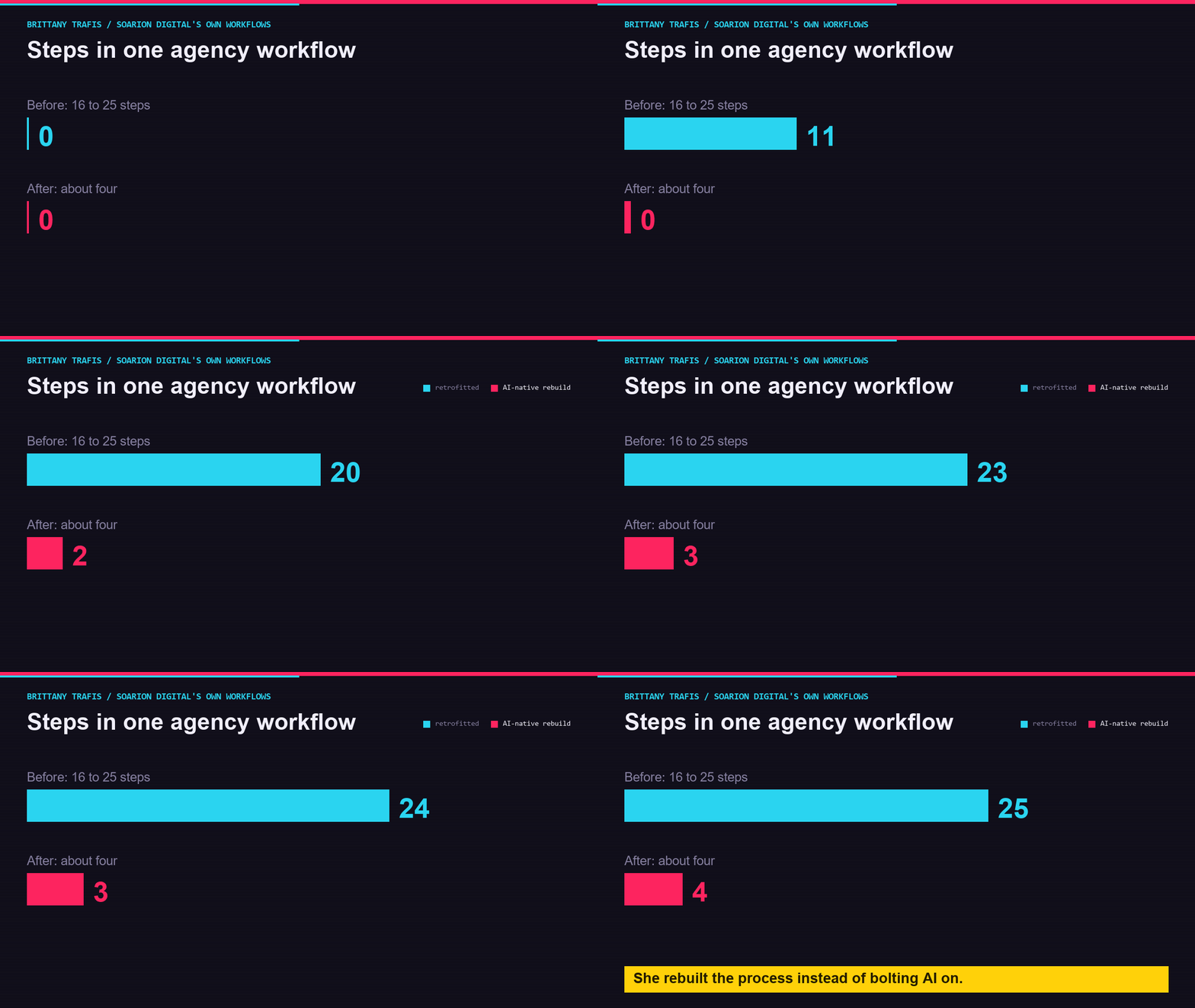
I mean, in terms of innovation, there's a few different pieces. I look at one for myself, for Soarian Digital. We're an AI native agency. So I've ran traditional agencies and just saw how much change was going to come and disruption that AI was going to bring forward and really took a step back and thought, what's this look like? If I build AI first and then people next? There's still room for people, we still need the expertise. But it completely changed our processes and workflows. Workflows that used to have 16 to 25 steps now have like four.
And it's because you have to reimagine and open your mindset and you can see that across the board as people are starting to innovate and think differently. And those are where I'm seeing the people lead, is where they stop and they think, what should it be instead? What has it always been?
The other piece that I'd say that we're seeing this really change. Innovation is even just from the consumer side. Like, did you Google today or did you Claude or ChatGPT today?
Ask Claude. Exactly, exactly.
I saw that Ask Jeeves was officially sunset today, which I didn't even know was still running.
And I made a joke. I'm like, well, Jeeves had a grandson Claude. Because I just asked Claude everything now.
But from our consumer behavior perspective, it's just completely changed. Even from an innovation perspective, we're getting so used to just asking there instead of doing our own searches where we have to click links and go to websites. Who wants to do that?
[00:13:50] Speaker A: I know that I, I, I got a bug in my head. I'm like, hey, I don't think I've done any internal linking on my podcast. And I asked Claude, I'm like, hey, what would be a good way to, you know, add internal links? And so you should add a call out for a related article, you know, at least to the previous one. And then we can categorize your articles based off of the primary themes and then for any that are in that theme, make a hub page and then cross link to each other. I'm like, okay. And then I just added the Royal MCP plugin for WordPress.
So now I can actually push updates directly from Claude Desktop, not from mobile, which I figured out won't see the connection.
That is, there's it's funny, there's always these two steps forward and back, but yeah, I was able to, you know, add an internal link, call out that for each episode, pointing to the previous episode with rich anchor text. I was able to create a hub page with quotes and a summary of each of the articles in that article or in that. That vein or theme that that was identified, and then internal links to it and from it. And I just, I. I was thinking about, okay, this would have been at least a week's worth of work, hands on, you know, just opening up, like the individual WordPress page to Futz around with it, you know, with, with Gutenberg, like, if you're ready for it. There's some of these things where if you take your traditional tooling and find a way to connect it, there's so much more creativity that you can apply without the restrictions of, oh, but that would take so much time.
[00:15:48] Speaker B: Right? The, the hardest part is making the time to then figure out how you can relieve the time for yourself.
Yes, exactly.
Right. I mean, I'm the same way. I have a long list of all these things that I want to test. I'm like, but I have to make the time to do it. But when you do make that first step to your point of like, let me just go have the conversation with Claude. Once you're in there and you start clicking around, you start to quickly adapt to it. But how it can just change the work that you're doing. And I think just both personal and in business. Right. It has that impact in both places.
But as you're making those changes, really starting to understand, wait, this can be freeing to me and I can actually spend more time on the human elements that I like to do instead of these tedious, mundane pieces.
Like, I use an example of, I'm really bad at managing my inbox. But Claude now every morning sends me a digest and says, you need to do these things today. Make sure you do this. This is still on your to do list. And it's. All of a sudden, it's managing my whole inbox for me. I'm like, well, this is like if I had a personal assistant.
But now it's just Claude that's doing it for me.
[00:17:02] Speaker A: I did think about that. I had dipped my toe into trying to get a virtual assistant to help with the post processing on some of the podcast stuff. And I realized, you know what?
It didn't work because I hadn't taken the time to like, work out with Claude first all of the steps, because I know that I can process.
I knew what, I knew what my prompts were that would make the output that I wanted. But also that kind of sniff test of, no, that's not right, you know, like.
But I didn't know how to like, quantify it. So I ended up wasting that time until my last interview with Mason McCumber, who is also an AI automation specialist.
And he said, you keep putting in prompts, but you need to make these as skills in Claude so they're repeatable because you aren't realizing the temperature. I'm like, what's temperature? Oh, that's if you put into that box where the chat is, it's ready for anything. And so it's going to be highly responsive and variable. But you don't want variable, you know, when you want the same outcome. So you need to add these as permanent skills so that you can reference it and then you can stack your skills and have your, your agents execute skills in a sequence. I'm like, oh my gosh, this just, this just totally saved me, you know, 20 minutes per podcast interview, getting everything processed.
[00:18:39] Speaker B: Yeah, absolutely. And that's an area like when we were talking a little bit ago, like the retrieval and like the knowledge base of it.
A lot of this now we can train ourselves.
So it does know what I'm looking for or, you know, what my style is or what type of things I'm interested in. As it starts to, you give it those specific skills, it stays more trained. The amount of time it takes you, it starts to reduce too. Again, take the time to make the time to relieve the time. But, you know, each of those components are things that we just even see from like what people are starting to prompt and have those conversations with AI
[00:19:18] Speaker A: on Google, I think it was about a year ago, messed with the rank tracker industry by removing results of 100 at a time.
And it was notable because impressions dramatically dropped in Google Search Console. And that's because, you know, we had become accustomed to an infrastructure and ecosystem of data and attribution where we had, you know, ahrefs, semrush data for SEO, all of these data aggregators going out there and tolling Google again and again just to build their databases daily for, for that information.
I'm curious, from your perspective, are we looking at a similar problem when it comes to all of these tools that are trying to get information about your brand visibility, that, you know, that, that tolling that it's a snake eating its own tail? It's not real. It's just more and more tools asking queries is, is that how much of a concern is that? How much of a reality is that and is there any way around that? With the unique response nature of, of digital chat programs and feeding information back to, to users.
[00:20:48] Speaker B: It is the wild wild west right now. And we are watching this channel be born and start to. And we're still trying to settle on a name, right? You still hear I call it AI search as a whole but you hear AEO Geo AIO AI Search. Like they're constantly like we haven't settled on a name yet.
And so you think about as a new channel not even having a name yet. And then you layer on.
The biggest challenge right now is you can't get, you don't get that data out. We have been trained by Google and by HubSpot and all these different marketing tools. They give us the data, we have the data. We want to know who clicked, we can know who clicks, we want to know where we were served, we can show where we're served.
That's not coming out of any of these LLMs right now. They're a black box.
They're not giving you that data. And so the biggest challenge is you have some groups that'll say oh, I'm getting data but really it's just from the monitoring of it. And then you have others where to your point where a lot of these companies are popping up right now of monitoring tools and that's them prompting the LLMs to see what comes back. And then they say here's what it's showing now. Even that I always like huge asterisk. It is a monitoring tool, it is directional. Do not think this data is Google search counsel level data. It is nowhere close, right? Like we don't know what people are searching. And the LLMs are so highly personalized that if you and I did a search at the same time right now, we would get two completely different results.
And so you need the monitoring data right now to give you a signal. It's a signal for your strategy, but it's not hardcore data.
And that's a big, big challenge. And will that get figured out eventually? I anticipate that they'll start to roll out some dashboards and they'll give you the.
But honestly, LLMs you think about like ChatGPT and Gemini and Claude, like they're all figuring it out as they're going too.
And so they're just, I mean they're trying to figure out ads, they're trying to figure out how they can keep it private. And in this black box of a LLM but also give you that insights and so I think we'll just continue to see that really evolve. And the thing that I always, always encourage our clients or anybody that I'm talking to is look at your web analytics as your final source. What was that AI referral traffic to your site.
You can see that that means they actually found you and they actually hit your page. That's the soundest data point that you can get at this point. Coming from the LLMs would note I
[00:23:45] Speaker A: did just see, I didn't dig into it or check it out. I know that copilot added in Bing Webmaster Tools some data and I saw an announcement from Fabrice Chanel yesterday that they're adding even more additional metrics and data.
Unfortunately none of the projects that I they're, they're not like for if you've got a, a home builder in Cookeville, Tennessee. I'm sorry to say from personal experience they're not really giving you any useful LLM based data. But I look forward to like I'm starting a new project this month with something that's got some national brand behind it in a boring niche. But still, you know, it's very likely to be mentioned on the news on Bloomberg. So I'm curious to follow and see what visibility and metrics they would give because quite frankly they've always been a more transparent with their data than Google has been.
So if anybody's going give us a dashboard it's it it is likely to be copilot in Bing.
I would have thought that when they were serving up ads and creating an ad ad program for its GPT right. They're doing the ads experience.
Not anthropic, not Claude, it's chatgpt.
I would have thought that paid marketers would have demanded some sort of metrics. Is that, is that not true? Have they not given any sort of data volume or metrics? Because that's, that's the whole reason that we have search volume at all for the SEO industry is because that's what they sell pay per click, you know, with these volume labels and through those APIs. So did they not, did they just skip that step and say trust us?
[00:25:48] Speaker B: So I'm not part of the pilot. So you had to be a nationally recognized in the top to be able to be part of the pilot. So this is just from what I've read and I've heard across the network is they gave you limited data but there wasn't like where you could go into like a and see your audiences and be able to actually manipulate who you're serving to. What I did read though is last week they're starting to put similar to the metapixel they've created to be able to track their ads now. And so as they move into the next round of testing that they were going to be testing this new pixel that could be put on websites to help identify so they were able to get limited data in terms of if people were clicking and going to the site, but it stayed there. From what I've been able to read and hear about
[00:26:42] Speaker A: what's from your perspective as an AI first marketing agency, I'm going to give you a moment to stand on a soapbox and shout at business owners, at your prospective clients of the biggest mistake that they're committing and stop. Just stop this. What is your hottest take?
[00:27:09] Speaker B: Oh, this is so hard. I have many soapbox. So my hottest thing that I'm hitting right now is quit treating AI search as SEO. Stop. Stop doing it. If you keep treating it like just keywords and rankings, you're going to get keywords and rankings. You will get keywords and rankings in Google. If you're trying to show up in ChatGPT and Claude and perplexity. We're where people are more engaged and want that information.
You're not going to see it. And so you have to stop treating it as the, as the same channel. And if your agency, if your SEO agency says we got it, we're doing aeo, we're doing AI search. Really lean in, ask like three more questions deeper and I think you'll find out that they're just treating it like SEO.
[00:28:05] Speaker A: What, what do you wish that small business owners knew knew about AI visibility that we haven't covered yet?
[00:28:19] Speaker B: I love AI search for small businesses because it is a new channel. It put us all at the starting line together. How many times have you worked with a small business? And it's like, I'm never going to get in the first ranking. I'm not. I don't have millions of dollars to throw at ads. I can't beat my large competitors. Like, I don't stand a chance. Guess where you do stand a chance in AI. In AI Search, you stand a chance. We are working with brands who have a quarter of the budget of their big competitors in paid advertising. But now within AI search, they're starting to show up and have a higher presence than their larger brands. And it's because they're putting a strategy behind it and, and small businesses can move A lot faster than these large organizations. So just because you're small, don't put yourself out of the race. You're actually already in the race and could be ahead of these larger guys.
[00:29:16] Speaker A: Yeah.
Jason Wade, previous guest, said that AI search is now table stakes.
You know, so if you're not sitting down at the table, you're missing out
[00:29:29] Speaker B: and there's somebody else that's willingly showing up in place of you.
[00:29:37] Speaker A: So I guess that helps if you're in a boring industry because I was talking with Matt Brooks of SEO Tarek about how do you deal with marketing for a company that doesn't do sexy stuff? Oh, they install concrete walls. That's as interesting as watching paint dry. But how do you approach the interest level angle of if somebody. It's very interesting if you are the one that's looking to put those that concrete fence in your backyard, then it doesn't matter if it's not a Maserati because it's personally important to you.
What's your steps to kind of leverage AI to craft deeper responses, better content, more fulfilling content for your users when the subject matter expertise tends to be a little more dry but more valuable for its esoteric nature?
[00:30:42] Speaker B: Yeah, absolutely. There's a few components there. So yes, it's boring and so it's not going to be this beautiful ad or anything. But within AI search, to your point, the person who needs to put the brick wall or cement wall in their backyard, they care and they're coming in and they might not even know you exist and they're starting to have that conversation. So what we always encourage our clients and others is really start thinking about what that like, longer form content is. So break it down. What are those structured components within that content?
The definitions, like that's the first piece, comparisons, pros and cons, and then point of view go through the thought process of somebody who might have the problem and is now starting to solve it and have multiple pieces of content that can fit there, but have them structured very cleanly so that the AI can pull that and then serve you as that answer. Because as they're going through that and they start seeing your name and they start seeing that content and they're building that trust. They're building. You've built that credibility with them before they've even clicked on your website because you've met them with where that content needs to be. And it really starts with the structure.
[00:31:56] Speaker A: I just published my interview with Nick Eubanks, longtime SEO professional, and we were talking about how some people are Using AI capabilities in the wrong place in their workflow. And his example was we put them in charge of creating the content brief instead of fulfilling the content brief because we need that human and then you need a human editor afterwards.
How do you design your stack to make sure that you're not falling prey to that?
The plague, I think it was called the hive mind result.
You know, because they did a test in AI, there's this set of creative writing prompts that for humans always creates vastly different stories. And because of the training database nature of all of these tools, even different models all came up with surprisingly similar stories to these prompts. And there's kind of this hive mind problem.
What's some of the tooling, some of the processes that you add or suggestions to make sure that as you integrate AI that you're not just you know, copying and pasting and replacing what otherwise would have been a robust, you know, human perspective, but instead becomes same samey.
[00:33:37] Speaker B: I am a firm believer that some of our greatest strengths as human marketers are in creativity and strategy and our domain expertise. Our domain expertise growing. First question you ask, like tell me about where you came from. How did that all come together? Your domain expertise really informs how you think creatively and strategically and you bring that together.
And so I, you know, in terms of how we work is our human is understanding what you need as a business and starting to really digest here are these components. Well then we have the AI look at the data and give us some insights and then the human can piece that together and that starts to form what your strategy is overall that then the AI can start to write content on and then have the human in the loop at the end who's reviewing it. And so the really leaning in and any, whether it's in marketing or whichever industry you're in, really laying out what your workflow is and then identify, okay, here's the steps that we need. But where do you need that human strength at? Where do you actually need the human creativity strategy and domain knowledge and plug them in and don't move that step like that step is locked in. As easy as it might be to put AI in that place, do not lose those human centric pieces and then let AI automate on those other pieces where a human can get in at the end in the loop and make any of those final changes
[00:35:05] Speaker A: as a kind of wrap up here. Tell the people where they can find you, connect with your company and if you're on a particular social media channel and also if you have anything interesting Coming up, books, tours, resources that you've crafted and made available.
[00:35:21] Speaker B: Yeah, so you can find
[email protected] so we'll make sure that that's linked. And also I'm pretty active on LinkedIn, so you can follow me. Brittany Trafis on LinkedIn or Sorian Digital is also on LinkedIn.
We have quite a few different events. I'm actually going to be at CMO Huddles this week doing a Midwest tour, meeting with top CMOs and talking about this exact topic.
We'll also be at the Marketing AI Conference in October, actually, here in Cleveland where I'm located, which is, you know, thousands of marketers come together to talk about AI, so please be sure to find us there.
But if you have any questions, please reach out to me on LinkedIn or on soriandigital.com, i'm happy to have a conversation and really help you identify how you move from just using SEO to AI search as a new channel.
[00:36:12] Speaker A: What pain point or problem that you've been working on do you want to float to the industry? And ask another the next SEO professional that comes on for their opinion to chime in.
[00:36:30] Speaker B: The biggest pain point I have right now is how to keep up with it all.
Things are changing so quickly. I bet while we had a conversation right now, something rolled out and so how do you keep up with everything that's happening in AI and the changes that are happening? And how do you float through? This is what you need to make that time to go focus on versus. Oh, that's just a no. Or and that's noise in the market because there's a lot of noise in the news right now around AI. And so how do you, how do you keep up with it? If anyone's figured out a trick, I would love to know.
[00:37:06] Speaker A: I'll make sure to get back to you after the next interview. In the meantime, if anybody wants to find Brittany, she's I'll make sure that those resources she mentioned are linked in the show notes. Thanks for stopping by.
[00:37:18] Speaker B: Absolutely. Thanks for having me.