Episode Transcript
[00:00:00] Speaker A: Hello, I'm Jeremy Rivera, your unscripted SEO podcast host. I'm here with the incredible, the amazing Nick Eubanks.
I've seen your stuff for like, well over a decade and a half while I've been bouncing around in SEO and I don't think we've ever been in the same room. We're not technically now, but as close as two digital fellows can be. So I'm excited to sit down, pick your brain, see what's happening with you personally in SEO, where you've been and what projects you're working, working on right now. So I have so many questions. Let's narrow it down and give yourself an introduction. As I usually do. Tell people who don't know you why they should trust you and what you're working on now.
[00:00:45] Speaker B: Oof.
I feel like it's hard to trust anybody in SEO these days.
Although fair. I think it's what's, what's interesting now is it's not quite my, like Jonathan Coleman, some people listening to this, if they know who I am and who you are because we're old at this point, especially in this industry, they probably know who Jonathan Coleman is. And when he had his like I'm leaving SEO moment, it feels, it feels kind of like that, but it's kind of been that way for a little while. I feel like I haven't actually, like, I haven't been the person like in the weeds doing SEO in quite, quite a while, I think.
Probably not realistically. The last time I was like really like elbows deep in a campaign was probably like 2019 or 2020 right before I retired.
And that glorious three year long retirement,
[00:01:43] Speaker A: short retirement, but came back into it.
What brought you out of retirement? I know you were swinging golf clubs and climbing the Andes, I'm sure, but what drew you back?
[00:01:55] Speaker B: Mainly divorce.
No, it's a, is a reason to go back to work when you, when you, you lose a lot of what you built and you just don't have it anymore.
[00:02:04] Speaker A: Fair enough.
[00:02:07] Speaker B: Reason people should trust me. God, that's a loaded question. I guess, I guess, you know, being old, there's some wisdom that comes with, with, you know, being around for a long time. I think, you know, I got, I got into the digital marketing game in 2007.
I've, you know, deleted production databases and I've, I've done, I've done all the, I've made all the major mistakes. You can bought two agencies within a week of each other when I'd never bought another business before in my life. That was a, that was a big shit. The bed moment.
Uh, yeah. Just really, really made all the mistakes, really big, really expensive mistakes and just try not to make them anymore.
[00:02:54] Speaker A: I think that's the wisdom of the ages, is like, you are going to make mistakes, just don't make them again. If you can. If you can avoid doing it again, you're winning.
[00:03:06] Speaker B: And pay and be willing to pay for time from people that have already made the really big and really expensive mistakes. Because the fast forward button is very real. Like, I'm so happy now to just pay for experience.
Things that I wish my younger version of my ego would have let me do, which is like, hey, you haven't done this before. Maybe, maybe we should go talk to somebody who charges for their time because it's very valuable and make sure that the blind spots we think we are aware of are actually all of the blind spots, because they're probably not.
[00:03:40] Speaker A: There's a reason why you hire that plumber who comes in and hits one pipe with one nail in that one spot and charges you a hundred dollars. It's not, it's because he knows where to put it. That exact.
[00:03:53] Speaker B: It's exactly, it's an itemized bill, right? It's. It's cost to hit the pipe. $5 Cost to know exactly where to hit the pipe at what pressure and what moment is 95.
Yes, exactly.
[00:04:06] Speaker A: It's funny because I started in 2007 as well in my SEO journey. I was a customer support representative for a website hosting company serving exclusively Realtors.
And I people, the realtors kept calling in and they kept asking, how do I rank number one on Google? And so I had to. Our policy was you have to stay on the line until they're satisfied.
And so I'm like, okay, well let me. I guess there's this Matt Cutts guy. Let's try what he says. Okay. There's this, you know, you know, Matt Cohen, Bill Slosky says SEO by the sea. Let's see what he says. Bought the Paid for the SEO book by Aaron.
You know, so I'm old dog in this too at this point. And it's interesting, I think, what is it about a four or five year cycle between when SEO dies and when
[00:05:10] Speaker B: four sounds, it dies every few years. I think this is the fifth time it's died in my career, roughly. So yeah, it seems about right.
I do think that this is actually the nail in the coffin for what we, what SEO was originally conceived as. I think, I think the, I think we've come so far in the evolution of what it actually means and what the skill set actually represents. That. That it is weird to call it SEO anymore, even if in a lot of ways it's still the same thing.
[00:05:42] Speaker A: It is. It's. The more that it changes, the more that it stays the same. But the parts that have changed have changed dramatically.
[00:05:49] Speaker B: Yeah.
[00:05:50] Speaker A: You know, like, on one hand I can say, you know, your. Your website has two legs, content and authority. And if you're not using one of them, you're dragging the other behind and it's keeping you, you know.
[00:06:03] Speaker B: Yeah.
[00:06:04] Speaker A: Tied up. But there's so many moving pieces now.
I was helping, you know, just a small business that's a friend.
And I'm like. They're like, okay, what should I do for my small business? We're just about to launch a website. I'm like, okay, do you have two hours? Like, let me, like, walk you through, like, all of the steps of all of the stuff. You gotta go register Google places. You gotta register Google Webmaster tools. You have to go and get directories, you have to do this, you have to do that. You have to get links, you have to have solid, authoritative content. You, you know, like the list, you know, how it interacts and ties into social media presence. It's just so much. And then I'm like, and I know that you've already just signed up for a new business and you've already got cold emails and spam.
Like, the minute that I registered a new domain for them, I got, you know, solicitations. They registered, you know, submitted their Google my business. They were getting five calls a day from these spammers saying, oh, you need to pay for your Google visibility.
[00:07:11] Speaker B: Yep. I'm like, oh, my God, we'll set up your Google my business profile for you. You know, because you probably don't know how to do it, and so you have to pay us to do that for you.
[00:07:20] Speaker A: Yeah, they were pretending to be Google and they actually, they kept calling even after they asked to be removed from the list. She's like, I am contacting lawyers. What is your address? And they finally panicked and hung up and stopped calling.
[00:07:33] Speaker B: Yeah.
Yeah, man.
The industry has.
It's legitimized a little bit over the past 10 years. But, I mean, it came from the snake oil salesmen. Definitely have tainted the waters on what exactly it is that we do to a lot of folks.
[00:07:58] Speaker A: Yeah, it's always been a reputation management. It just seems now the grift is, oh, SEO is dead. Aeo, AI eeo they don't even have to prove anything. They can just suggest that, you know, you probably maybe might be showing up in AI.
[00:08:21] Speaker B: It just reminds me of one of the largest grifts that I ever heard of was one of the. It was one of the integration companies that they partnered with a lot of the major hosting providers. And you know, it was a line, it was a checkbox on your checkout when you're signing up for your hosting provider, you know, for $5 a month ad SEO services, I don't think it actually did anything, but the company was doing like 50 million a year because the distribution network was just so big.
And that's, that's what a lot of I think. You know, small business owners like, you know, they, they go, they buy a website or they buy a domain, they'll do the instant website from GoDaddy tonight or some other bullshit and they'll just make sure their SEO is checked off.
[00:09:03] Speaker A: And yeah, I checked the box for SEO. I'm good.
[00:09:07] Speaker B: Yeah, it's taken care of now.
Free traffic for days from Google from now on.
[00:09:15] Speaker A: I think I said this in a previous interview that I defined 2010 to 2020 as a period of the golden age of SEO where all you needed to worry about was being a reverse engineer for Google's algorithm.
Yeah, you could. And even on that, you could even. There was so much fruit from the Google tree that you could really just focus in and be like, I just do technical SEO, I just write content. Or I.
[00:09:46] Speaker B: That was the decade. I mean, I built entire businesses off just like, not just selling services obviously, you know, which I did as an agency, but whole entire business is just built off the back of free, sustainable organic traffic.
Uh, I mean those, those were the good days.
[00:10:06] Speaker A: So Google's kind of screwed things up in a number of unique ways and seems intent on redefining the Internet of what's findable to what is profitable for them to advertise on.
Would you agree with that? As a general statement?
[00:10:30] Speaker B: Yeah, there's not really much argument at this point. I mean any, anybody who traffic top of funnel traffic can just look at their analytics over the past 18 months and the questions from everybody that all of us got from stakeholders were all the same at the beginning. Right. Which is what's, what's happened. What happened to all of our rankings? Like, oh no, our rankings actually are fine. They're even up.
The traffic's just all gone because the clicks aren't happening anymore, at least not the way that we're used to them. So that Was a weird conversation. Thank God. Some folks in our industry wrote about it like, traffic's down but revenue's just fine or maybe even up.
So I think that was a shitty conversation to have with ownership and stakeholders for a while. And I think a lot of people lost their jobs. A lot of agencies got fired. Not because they did anything wrong, but it was, it was just a shitty period. I mean, I think from May till September last year, the average agency owner I talked to was down like 30 to 50% on revenue just because, you know, crazy churn and companies were, you know, AI does all of our marketing now. So companies were firing entire marketing departments and that probably didn't work out so well for them.
[00:11:51] Speaker A: Yeah, I know.
I know a pretty large job site that they were creating content with humans and had a rather large contract and that got reduced and then the Europe aid side got removed and then just came down and they replaced it with AI. But was just reading, you know, looking at their stats that after three or four months of that, that that bit them mightily.
[00:12:24] Speaker B: Sounds all too familiar.
[00:12:27] Speaker A: It's interesting times again.
But it is that challenge of setting the right expectations in the conversation.
I remember the first major pivot in SEO where we had to kind of rephrase how we approach things around, you know, the Penguin age.
[00:12:51] Speaker B: God, yeah, there's the whole, the whole years of the zoo animals. I mean that was a whole other.
Was its own sets of unique challenges there because most of us had our own sites. And it was a mix of, you know, having to explain to clients like, so here's what we know now, especially the beginning. I was like, we don't know what happened.
This was. Here's the correlation, here's what we think this might be.
But a lot of us also, I think just got sites torched. I mean, a lot of people in my circle had really nice businesses being propped up by BuildMyRank.
That all went away pretty quickly.
[00:13:31] Speaker A: Ended again with a helpful content update, which is a huge misnomer. It had nothing to do with how helpful your content was.
What's your theory on exactly what changed? Because I talked to Darth na Linden na. We have our theory of what changed. But I'm curious before I put mine
[00:13:53] Speaker B: out there, I mean, Google's always had a pretty stark preference for brands, right? You know, entities that are large enough to be like in the entity graph and for Google to see as brands. And a lot of times, a lot of ways, you know, brands can kind of do no wrong unless they get publicly called out. You know, by somebody and it felt like that knob got turned up even more. And at the same time I think a lot of the, what's the word for it, there's, there's even a patent around it that Swastiki talked about. Like, you know, there was, there was a couple updates where Google was really trying to make sure there wasn't a lot of duplicate domains showing up right in the same search results. And I think one thing I started to see in chunks of helpful content search SERPs was that that knob seemed to get turned down in some respects and the sites that did get rewarded tended to take up get more pixel real estate overall than sites that did not. And I wonder if, I can't help but wonder what the like, is there a correlation between the rolling HCU and the rollout of AI overviews and just you know, very large changes that need that Google made to the UI and things that they had to do to make those possible?
[00:15:18] Speaker A: I, I think so.
My theory, and this is what we came up was that a large factor was actually distance to seed on the link side and that it was, it was another cut along with what Medic had done in 2018, 2019.
One of, you know, aside from addition of brand signals and clicks and you know, because if you look at who got hit first, it was like the birthday, the programmatic sites, the birthday date for celebrities, you know, where they didn't have a business model aside from ranking for stuff and you know, so if you had a legitimate business model that meant that you had branded traffic in search console. So we think that was one set of signals entity but also you know, distance to seed and authority being a factor. So it's almost you know, going back to some harder core link signals being integrated in hcu because that makes more sense.
You know, if you see like how the huge swap these sites that have huge swaths of content, just looking at it from the machine learning side doesn't make sense of who they chose to penalize. But if you look at you know, Google search console and link graph information at the same time, then it starts to paint a better portrait of okay, this wasn't necessarily about you know, fighting AI content or you know, making sure that the content is helpful.
It's just a readjustment of what they, they are willing list in their results. In terms of authority.
[00:17:07] Speaker B: What, what's your favorite way to build to, to, to build a link graph these days? Are you, are you still sort of old school blending outputs from a couple of the third party tools like you know, we, my, my stack at the agency was always to blend semrush hrefs and majestic. But curious what, what your approach is these days.
[00:17:28] Speaker A: Honestly, it's, it's more that's kind of drawn back. Like I, I'll do a check of what, what are the, the, the, the links that I can see are showing up between mostly ahrefs is what I look to a lot these days just because I don't need to do that deep of a cut because I, I prefer to get links, you know, like do the fundamentals, make sure that we get branded anchor link, um, grab the necessary directories and then try to get links, you know, through articles, real newspaper articles. Podcasting for me is the panoply of link building because every conversation, like I've set up three or four podcasts for my clients and you know, every conversation that the host has, we get a chance to mention, you know, drop mentions that have good anchor text links.
So it just makes sense from a link building perspective that it should be coupled with, you know, the, the most genuine source of subject matter expertise, which is the interview.
So, you know, mostly do some pre work on ahrefs and just kind of understand who the competitors are and how dirty their profile is so that I can know how long it's going to take me to beat, beat them out once I do the fundamentals.
[00:19:01] Speaker B: That's a good answer.
[00:19:05] Speaker A: So coming back into the game after you retired for a little bit, what's the hat that you're wearing and are you with a particular company or project?
What's, what's going on? What are you tackling right now?
[00:19:20] Speaker B: Well, yes, I mean I, I had come back so like 23. I sold, sold traffic think tank to Semrush and then it was not part of the deal to go work there. But because of the deal, I got to meet the cmo, Andrew Wharton, and he asked me after we spent a few days together as part of the deal, we met and spent time together to work out the deal we would eventually do. But because of the time we spent, he asked me to come build their own media department. So did that for three years.
Had a really good time there actually.
I was so convinced I was unemployable at that point, but I was like, well, we'll see how this goes. You know, there's not really, there's not a lot of risk. Worst case, I just, I'll just leave.
But ended up having a really great time there. Worked with some of the most incredible marketers I'VE ever met, really built that program up to what it is today, which is like a big feather in my cap. You know, building an eight figure a year program for a B2B SaaS company is pretty cool.
And then just beginning of this year, you know, it felt like it was on to the next adventure. So I joined DigiStore24 as their global CMO or the largest affiliate network.
It's 950,000 vendors, 5 million users.
Let's see what we can do with this one.
[00:20:48] Speaker A: What's the digital marketing pool and I guess SEO side looking like for affiliate world?
[00:20:56] Speaker B: I mean the thing is again, like sort of what you had mentioned in the beginning of the, of the interview, like what's, what's old is new again.
You know, affiliates as a, as a distribution strategy, affiliates.
You know, I was an affiliate for a while, was a big affiliate for SEMrush in 2012.
Organic search was certainly one of the tools in my toolbox for driving affiliate commissions. And that's gotten, you know, way harder. Like if you.
I did some SERP comparisons and one of the main things that, that was really fascinating to watch was as we built the own media program up in in at Semrush, was watching where you know, the all these individual like bottom of funnel keywords where there used to be five or six semrush affiliates and now it's all semrush owned media properties. Way better for semrush but not great for affiliates. Right.
However, like, you know, in the age of, of AI where LLMs, you know, value many times semantic relev and mentions and sentiment around mentions almost in some instances more than links.
It's a great time to have an affiliate program if you're able to get affiliates on board that aren't even reasonably decent at creating content, especially on YouTube and Twitter and Instagram and LinkedIn and these channels that now all of a sudden, after years of many years of not mattering at all to organic search now matter.
Not just organic search, but also are very influential on the LLM side.
[00:22:27] Speaker A: What's the social media influencer game looking like right now?
[00:22:33] Speaker B: I mean, I think content rewards is a really, really cool idea.
The content distribution strategy or network that WAP built into their platform.
About it because they're a competitor of ours. And so I'm glad to hear that they had this brilliant idea.
They executed really fast, but maybe they're not willing to do all the really deep hard work to execute well because managing fraud at an enterprise level, which is a huge part of just running any kind of marketplace, especially affiliate is, is a really expensive part of doing it well, but it's what separates the men from the boys, I think.
[00:23:22] Speaker A: So what does that look like as a cmo? Right now you're looking at your stack. Is that a whole set of team? Do you have somebody specializing in SEO or do you have somebody where.
[00:23:33] Speaker B: Yeah, I've got pods for.
We operate two pretty large teams, one here in the US and one in the Euro. You know, we are originally a German based company but we've got resellers across multiple different countries because we are the seller of records. So if you're a vendor on our platform, when, when somebody buys something on the platform, technically we buy it and then we sell it to them. Which is how we're able to automate all of the VAT reporting across all 38 EU countries. That's how we're able to automate all the tax charge you to set up Nexus and do all the reporting to the IRS and everything across the entire United States. So you know, let's say you, you create an ebook and you start selling it on your website and you're using influencers on Instagram and you're going to
[00:24:19] Speaker A: run
[00:24:22] Speaker B: or something and you cross the revenue nexus in Utah. So now you've got to go file paperwork in Utah and let them know how you're going to withhold because you're generating too much revenue. You've generated over $2,000 in Utah and then shit, you know, a community picks up your product in and blast it out to their Facebook community of 10,000 people and suddenly you've crossed Nexus in Colorado and Montana and California and now you gotta deal with all that paperwork.
We just do that all for you.
Same within the eu. So let's say you want to go distribute into, you know, France or Italy or the UK or Ireland, you just, you just have to focus on selling.
[00:25:03] Speaker A: Here is a soapbox for you to stand on and I'd like your hot take of how you think that people should be leveraging AI and how they should not be leveraging AI.
[00:25:21] Speaker B: So I, it's not, it's not contrarian in any, in any world. But I have a very, I, I, what I've found is so I still, I still advise agencies.
You know, it's something I started doing after I, well, I started doing it before I retired but then that's one of the things that I still did a couple hours a week after I hired a CEO and stepped off the org chart at the last Agency because I just enjoyed it and I still do it now. I'm an advisor to six agencies currently.
And it's fun to follow along in what's going on. And some agencies are really having a hard time right now. And some agencies are printing money thanks to AI or selling services around AI. And thing that I am always sort of fascinated to hear about is when I talk to agencies that are, you know, I think you have to be building workflows around content production with AI, I don't think there's really an option anymore in my opinion. But a lot of people, I thought, a lot of agencies, I should say, I think, or maybe even in house teams, I think are, are designing their processes the wrong way. Where the steps they're choosing to use AI for I don't think are the best ones.
So like, for instance, like I'm, you know, creating content briefs was always like a painful and reasonably expensive part of the process to really have a nice brief for a piece of content. And a lot of folks were like, oh shit, with AI, I can just automate the content brief. We're just, you know, go answer these five questions in this form in ClickUp and we'll automate the brief and we'll deliver that to clients. And we could still charge $150 for the brief. And now it takes us five minutes.
And I think that's actually like when you look at the human in the loop process, where you've got them start, you have create the brief with AI and a human rights the draft and then AI does the proofreading and editing and then they publish it. I think it's completely backwards where I think things are better. Exactly. Like one of the best results that I've seen from a content perspective is where it's humans actually doing the brief still and then it's AI writing the draft and then it's humans doing the editing.
And so it's like where in the loop does it actually make sense to use AI? I think is where my perspective is a little different.
But I think you have to be using AI in your content production process, especially around atomization. One thing that I've done is I've got a really cool tool that I'm not going to share the name of just because it's not well known yet and I don't want it to get ruined. But it allows us to train a brand brain for our global entity. Here's our voice, here's our guidelines, here's our product mix, here's our competitors, here's all the sensors. We want to keep this thing always on and always up to date. Here's how we want you to catch trends, here's the topics that are relevant to us and the people that are relevant. And so here's this always on brand brain. And then in front of that we can create regional requirements. So here is our compliance requirements for the us, for the uk, for the eu, for Germany, because they're, they're crazy. Not just like California, like the California of the eu. And then, you know, sit. And then in front of the regional requirements, here is the channel.
So here's how you're going to create this content with these regional requirements based on this brand brain for LinkedIn, for X, for blog posts, for Instagram, whatever it is, YouTube.
And then in front of that channel is this Persona. So we want do to create content on this brand brain with this region for LinkedIn and, and we wanted to do it for our CEO and our CTO and our director of marketing and our head of affiliate and our head of sales. And then we're going to replicate that and we've got different people over here in the Italian market. So here's how that's going to work for those Personas.
And so being able to have that pipeline completely driven by, by AI where it's finding the, it's finding the angle that's relevant based on all those layers of requirements and just popping drafts into a content production pipeline for review by a human being and ultimately for things to get scheduled, to get published because the volume of content is not slowing down. And I think the opportunity to create a much higher volume of very relevant non shit non slop content I think is actually finally really doable.
[00:29:59] Speaker A: Yeah, it's funny because I the when I think about going back to 2007, 2010, I led a team of 10 SEOs and we were just sending an email telling realtors like what they need to do and realized, you know what, these realtors are never going to do it. So what would it look like if we actually started implementing link building? Implementing building content for them? And the two things that came to mind first from the team was content spinner, which was basically like you take a sentence and it'll swap out this sentence and it'll be different from your Yorba Linda page to your.
[00:30:40] Speaker B: The best content spinner was an amazing strategy for a long time and it worked until it didn't.
[00:30:46] Speaker A: But then the other was oh yeah, we can get that written in the Philippines.
So like the tax broker, three stars, tax Broker three star. Yes. The pretense that, oh, you know, we were doing so much high quality content before AI came along.
No, you weren't. You were trying to get it written as cheaply as possible and write it as poorly as possible. You know, AI quite frankly is better than a lot of the writing that you did 10 years ago.
[00:31:15] Speaker B: Yeah.
[00:31:17] Speaker A: And, but I think you're right that there is a moment now where there you can differentiate. But I think it's, it's, it's by actually delivering what Google said it wanted, which is expertise, authority, trust and you know, it goes back to good old fashioned journalism and genuine conversations.
And because you're never going to, you're half sitting someone down with semrush. As good as it is ahrefs to do keyword research, you're never going to get the topical insight of two pros sitting down hashing it out.
[00:31:58] Speaker B: Yeah, the expertise layers.
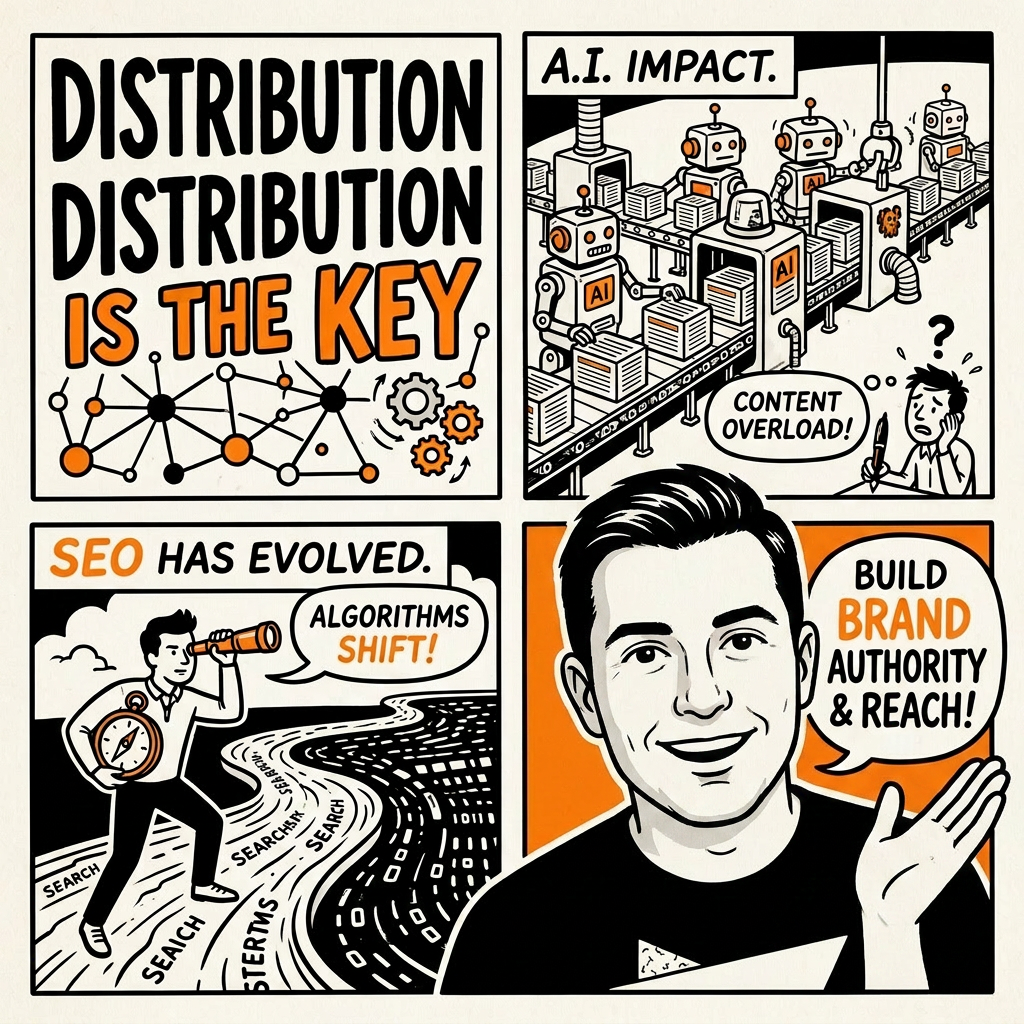
It's the, you know, I like to say in something I've been talking a lot about recently is, you know, distribution is the only remaining moat when execution becomes infinite. But at the same time I think that's not entirely true because I think expertise does still allow for some layer of defensibility.
At least for now.
[00:32:24] Speaker A: Yeah, I mean, yeah, maybe in the next, I would say years. But the pace of development is kind of insane. In the past six months, what's coming out of even Claude, you know, Opus, the newest opus and the newest sonnet versus what came out a year ago, I just watched. Do you remember when they were making that joke about Will Smith eating spaghetti and that video? Yeah, they, they did. The first version is like all his faces all over the place.
[00:32:57] Speaker B: One of my agencies is Jenny I video for ads and, and like the, one of our slides on like, like our new customer onboarding is like you have to understand the moment that we're at right now. And it's literally, it's, it's the, the litmus test for AI video quality is Will Smith eating spaghetti over the past four years.
Because like, you know, you go from the first version where it looks like, you know, eight bit like, like you know, Mario to like the latest version where it's like him and his son eating spaghetti like on like a terrace in Manhattan. And like it's, it's better than movie quality.
[00:33:32] Speaker A: Yes. Yeah. So I'm excited and terrified in the digital marketing game because that level of firepower is definitely going to shoot some people's faces up.
But at the same time we can do like you can, you can imagine you know, like a. You know, like the something I can do now that I thought of in. In 2015, when I first came up with, you know, SE Arcade as the brand for my dual marching marketing agency slash SaaS tool. Like, I wanted a pixel fighter, and then I'd, like, turn, you know, I spent like $500 hiring a guy to animate Rand Fishkin as like a floating, you know, fighting wizard in pixel art form to fight, like a black hat guy. And there was like a clip, like, of a GIF, you know, a set of GIFs. And it costs so much to get done. And somebody just pinged up on. On Twitter. I'm like, oh, my gosh, I could do this. And I. I made, you know, a fighting avatar for Paul Batarina one of my last interviews, you know, because he wanted to be like a necromancer. I'm like, okay, okay, here we go.
So, like, that level of quick adaptation and creativity can then be matched and you can get output really fast.
[00:35:03] Speaker B: Yeah, yeah.
[00:35:05] Speaker A: The.
[00:35:05] Speaker B: The time. The. The time compression between. Between, like leveling up the quality of these releases is. Is astounding to me.
It's like every week, like, you know, just again, this. This video agency that I'm an advisor for, like, watching them where it's like, you know, one week, the next, like, oh, we can't really do figures, so let's not do them. That's fixed this week. Well, lips aren't really great yet, so that's not. That's. Let's. Let's make sure we don't have any close shots of, you know, where they're talking up. That's fixed. Like, it can't really do persistent light, you know, in certain angles, camera angles as it's panning. So, you know, we need to make sure we do jump cuts between these. Nope, that's fixed.
Like, really, really crazy.
[00:35:53] Speaker A: How does it kind of wrap up here?
What are you hopeful for in digital marketing?
What you. Is the best outcome that you think could happen? Like, if we were putting. The glass isn't just half full, it's half full of something good.
[00:36:13] Speaker B: Because it's a tough question.
I don't know. I. I've never. I've never been having. I've never had as much fun as I am right now because, like, all the.
All the silly ideas that would be too time consuming or too risky to build. Like, I could, like, could just build in a couple hours now.
And so there's like, really no good reason to not be just building every day.
So I think I think a lot of people before that maybe would, wouldn't have the courage to just, to just build it, whatever it is.
I think that's gonna go away. I think, I think we're gonna see. I think there's gonna be a whole new class of makers and creators, and it's not just people dancing on TikTok. Like, I think we're gonna actually see some cool, Some cool technology, some cool apps, some cool websites, like, get made because the bar is just so low, I think.
[00:37:15] Speaker A: I agree.
I had the idea like four years ago. I'm like, I hate pushing the lawnmower. I wish I had a remote control lawnmower. I tried to like, go through the steps, find a mechanical engineer and like, figure out how to produce it. And it turns out, you know, 20, late, 20, 25, somebody released it and they won a design award because it's literally just a remote controlled lawnmower. And I'm like, why did we have to jump to the Roomba guideless thing?
We had that great model in between. But he was able to bring it to production. And I read really fast using AI assistive technology and 3D printing. And these new technologies are unlocking a lot of capabilities.
[00:38:03] Speaker B: Yeah, I think it's. I think it's astounding.
[00:38:07] Speaker A: Well, tell us as kind of wrap up. Just remind us where you're at if you're doing anything notable, if people want to connect with you. Are you doing any conferences, doing any speaking or have any courses, things like that. If you want to get connected with
[00:38:26] Speaker B: me, I mean, I'm still pretty pretty vocal on Twitter.
It's not, it's not generally helpful. It's usually. It's more me, I think. Like, it's like hot takes and, and me calling out things that I think are annoying as I become an older and older curmudgeon.
But besides that, I did, I did wrap up. I've been, I've been publishing like a lot of this. The premium content that I used to, to sell through all sorts of different courses and communities and whatever is all, A lot of it's all just free now.
I spun up recently just because I did it like two weeks ago.
I think it took about 20 minutes. Like over coffee. I was like, I was like. I had the idea to create a new site to put all my agency training, content, agency resources together. Call it agencygrowthengine.org and just code a site to curate all of it and make it all make sense in literally 20 minutes, start to finish.
So it's just, just like, cranking out sites. Like, I redid. I redid ancillary over the weekend. Last weekend, I built a mobile app for GLP.1 muscle protection. I did it in 12 hours. Like. Like Sunday. Like, the whole app deployed to the App Store. Like, just. It's crazy these days.
[00:39:48] Speaker A: Well, I'm interested to see what, you know, you create on a lazy afternoon coming up. So I'm still on Twitter, determinately doggedly still there.
So anybody else wants to tweet at us?
Yes, it is Twitter, not X. It will always be Twitter.
[00:40:07] Speaker B: It will always be Twitter.
[00:40:10] Speaker A: I appreciate the time and the interview. Thanks, Nick.
[00:40:13] Speaker B: My pleasure, Jeremy.