Episode Transcript
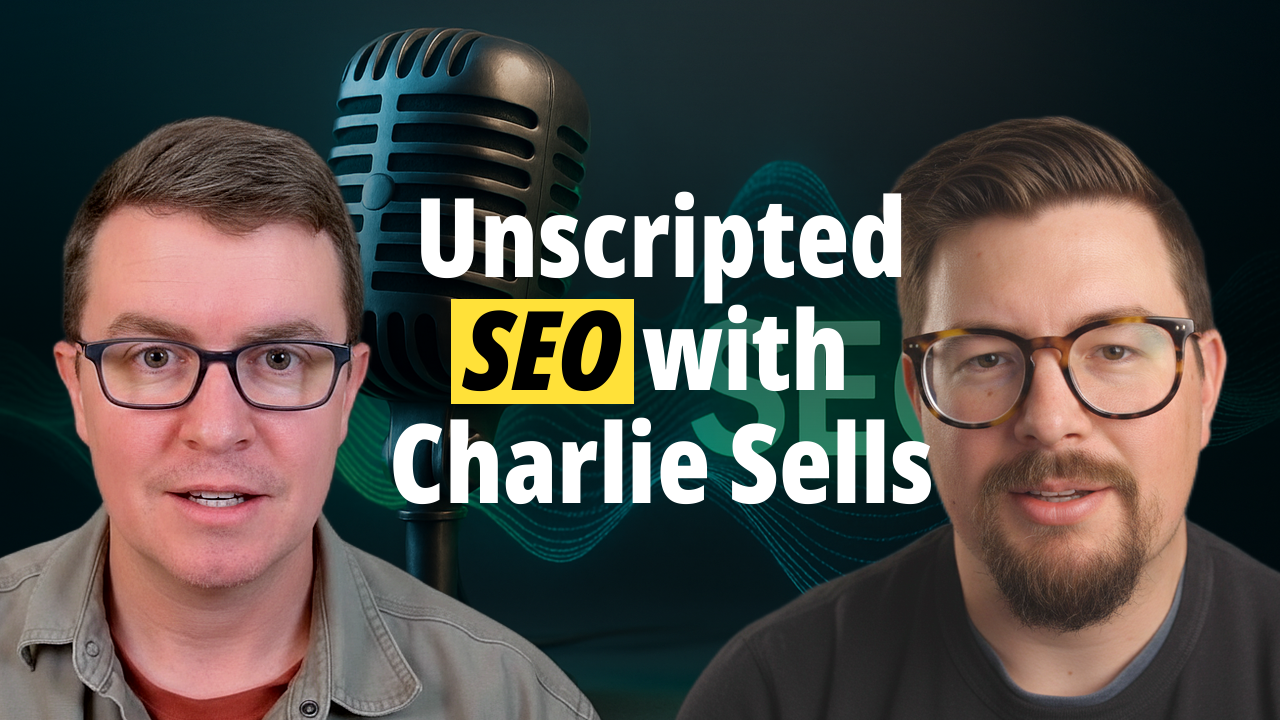
[00:00:01] Speaker A: Hello, I'm Jeremy Rivera, your unscripted SEO podcast host, and I'm here with Charlie Sells. Charlie Sells is going to settle himself right now for us and you as an audience on why he is an expert worthy to be listened to for the next half hour.
[00:00:19] Speaker B: Well, man, thank you so much for having me. I really do appreciate it. So, long story short, I have about 15 years of experience in brand messaging and positioning, and over the last two years, I've been working with small businesses, solopreneurs, thought leaders, and even marketing teams and creative teams, helping to reduce confusion and complexity so that everybody can get clear and go faster and do more of what they love, which is build really successful brands.
And that looks like everything that you could imagine, from helping with visual identity to bringing everything under one roof. But more often than not, it's just locking arms with owners and leaders to help them solve better problems and ask better questions.
[00:01:09] Speaker A: Let's talk about service area businesses and developing the concept of brand.
When you do the same thing as many other people in a niche, you know, whether it's construction, you're delivering, you know, precast concrete walls, what is it that actually develops a brand if you're not not providing a truly unique service? You know, if you're a, you know, roofing is the same everywhere. So what factors are you looking towards to create branding that isn't, you know, unique to a specific product?
[00:01:51] Speaker B: That's a great question. It's exactly where I start. With every single client, we look at the data, we look at everything top to bottom and say, what is working now? Where are the gaps? Where are the.
[00:02:02] Speaker B: And I will typically try to find where there are inconsistencies first so that we can then create a roadmap together to implement things really kind of slowly. I mean, there's usually some things that you have to address really quickly, like consolidating systems and platforms or tightening up, you know, look, tone, feel, or getting on a specific platform or something like that. So I think specifically with service based businesses, that's one of the most unique challenges, but it's also easier than I think we've made it in the marketing world.
I mean, in the SEO world, service based businesses are just like bowling alleys. They're trying to stay hyper local. They're trying to stay right there at top of mind where you don't just drive by them, but you see a billboard or a yard sign or you see somebody bowling and you're like, oh, yeah, I should do that again, or it's kind of translates into the other aspect of it too, where if they try to think too big and too regional, that's where you really start to spin your tires. Because you're not necessarily competing industry specifically, right? You're not necessarily competing with somebody across the state.
You may not even be competing with somebody super nationally. And so narrowing your focus a little bit and not feeling like you have to do all of the things all of the time, that's the most important piece. And I would say part B to that is.
[00:03:30] Speaker B: There are things that I always look for, not just when I do an audit, but when I'm working with small business owners where I'm always looking for two things. One, are we being really consistent every touch point of our brand? Does it look the same? Does it sound the same, does it feel the same on a sales call, social media website, emails, you know, in person interactions, whatever that is. Always looking for consistency. Number two, and I'll tell a story about a client I've worked with recently. Is, are you, are you really leaning into your unique competitive advantage? I've been working with a client in, in Florida. They're in the event and the event and conference staffing space.
There are lots of national companies that just want to grab a 1099 employee for a week or a weekend and, you know, staff the conference and then go on their merry way. And so my client in particular was a little overwhelmed thinking, how am I possibly going to compete with all of these? And so as we dug into their brand and as we dug into their business, what we realized is they're the most trusted name in conference and event staffing. Their retention rate is like in the 80s and 90s. It's ridiculous. And so my advice to them was don't try to be bigger, don't try to be flashier, don't try to be anything other than who you are. And so now that we've started to dial in that messaging, they're so much more confident in the communication that they send out to their clients, because they know that they are. They already have that trust built.
They're also not so overwhelmed by feeling like we have to do X, Y and Z in order to grow. Because, yes, they want leads, they want new business, but at the end of the day, they also want to serve their existing clients and repeat clients more consistently.
[00:05:21] Speaker A: I find that a lot of.
[00:05:24] Speaker A: SEOs miss the picture of the power of your existing client base. There's such a focus in these keyword research tools of how much volume is coming to these particular keyword phrases. And I, I was guilty of it too. You know, 10 years ago I remember a specific conversation of, okay, well this is your Google search console. These are your branded queries. We're going to ignore those. We want to focus just on the non branded keywords and phrases.
And given, you know, 2023, the changes to Google in terms of its emphasis on brand identity, particularly around hcu. Other factors coming in, the revelation of the heavy use of, you know, click metrics and association of brand and entity. Had a really good in depth conversation with Kalicube and Jason Bernard.
[00:06:25] Speaker A: Diving into the concept of entities.
What's your understanding of that side of things?
What is it that you need to build within Google or outside of your site to build an entity? You know, hey, we're Riverstone pools, we install pools in Nashville.
What do you have to put out there these days in order to develop that entity? And how does that align with the concept of the brand work that you do?
[00:06:55] Speaker B: I think it's, I think it's mission critical if you don't have the basics set up. And I would even call your business, your Google business listing. And some of those, some of those keyword components that you mentioned, those are just super basic. I did an audit for a brand here locally in Nashville not too long ago and within, within 10 minutes I knew we had a big problem. I searched on Google for their business name for their website and I couldn't find it.
I mean it was gone. I did not know where it was. And their Google business listing sort of kind of mentioned it, but there wasn't even a little icon there. And my mind was just on the wall going, who set this up? Like, why is this not like it's the most basic thing in the world? Because search engines are the yellow pages today. You want to make it easy for somebody to just find you like that. Now when you looked across some of the other results, yeah, they were mentioned here and there were backlinks there and there were some other good things. I think if you were, if there a more cohesive and basic foundation put in place. But it was almost flabbergasting for me to go, why is this happening? And then go, we have no idea. And I think to this day we still haven't quite pinned down what it is. I'm like, I just want to blow this up and start over. It probably has to do with all of your records and everything else. But I think you make a good point that it's so easy, yet we make it so complicated where we feel like we have to chase all of the non branded traffic, we have to chase all of the bigger fish where if you will just do the branded stuff really well, you will do perfectly fine. You'll actually make it easier on yourself and on your team. I worked for four years for Dave Ramsey and Ramsey Solutions and that was something that we focused a lot on, was the balance between branded and non branded branded. You have that on lockdown. There's 35 years of, you know, brand equity that's, that's tied up there. Right. But when it came to non branded, we also were very strategic about saying maybe there is just some things that we need to refresh, not create from scratch and let Google crawl that and then we go from, you know, position 10 to position 7 and we don't have to go from position 1 million to position 100. Right.
So that became a really interesting exercise in some of the brands that we worked on because we knew we had the branded terms on lockdown. There were even some non branded terms that when you search for them, you would find them in some of our competitors websites because they were trying to get some of that organic traffic themselves.
But at the end of the day we were going to crush it. And so small businesses in particular, they have that same challenge, right? If they will get their branded terms right, then you can focus on the non branded terms. But shiny object syndrome is rampant amongst entrepreneurs and businesses, myself included. Where we always want the bigger and the better or the newer.
If we'll just do the basic foundational stuff that will make a big difference.
[00:09:47] Speaker A: I've actually subcontracted for two different agencies that worked with Dave Ramsey and I'm good friends with Chris Rydberg who used to work with Dave Ramsey.
[00:09:58] Speaker B: I love Chris. Yeah, we got to work together on a couple of projects before he wound up leaving. We had about a two year overlap there. It was great.
[00:10:07] Speaker A: It's a small, small Nashville world.
[00:10:11] Speaker B: You talk about an SEO genius too. Like I would sit in meetings and just go, how what? You're connecting dots that I don't think anybody else knew existed.
[00:10:20] Speaker A: He's really good.
[00:10:23] Speaker A: So I, I, I do like taking that piece of, you know, piece of history of looking at the power of developing a brand.
It's really the inverse from what a lot of SEOs grew up on of, hey, you need to develop this non branded traffic as a reflection of Google's trust and authority, but not actually doing very much or focusing on the cross channel. The power of associating your brand and entity that you are that thing So I would much rather have a branded keyword of.
[00:11:02] Speaker A: Atlanta lawyer Lamar Law Office Lamar Atlanta Law Office versus just Law Office Atlanta. Because then that's a reflection of those two things are commingled in a quantumania sort of sense that Google has understood the association of the entity with the underlying intent of what that entity is supposed to be providing.
I think those type of branded things. Google Search console just added some additional filters to their search console interface, one of which finally is a filter that allows you to see what Google understands as your branded queries. And for those entities that have been struggling, I have one where brand identity was the phrase save fry Oil, that's the name of their company. But you could imagine the SERP is, you know, AI overviews, videos and articles of telling people this is how you save fry Oil. So they did not appear as in the sidebar. They didn't show up as a brand name. They, they, their entry was, was a mess. So we had to do a lot of fun foundational work. They didn't have an about page.
And it's just like, okay, well you want to communicate to Google what it is you do, where you are, are you legit, you know what, what are the facets of your business? Who's associated? Are you big, but you're not actually, you didn't create an entity home for yourself where Google can gather that information and validate it elsewhere. So adding an about page, getting, you know, anchor text from all kinds of different sources for the brand name eventually solved that problem. Hey, now we show up and I think that a lot of entities, a lot of businesses don't think about that cross braiding of, you know, maybe they put it off on PR or maybe they think, oh, that's just general marketing and I need to do SEO, which is, you know, just seen as like, let's fish for keywords. But it's, you know, it really needs to be tied and united better. Like Melissa popped Rickety Roo, like her thing is all about communication between these teams. Because as an SEO, you carry that value message. It gives you an entree to talk to the email team and show them, hey, if we drive more people to this page on the site of this fantastic content that I've created, you don't have to spend write as many emails because it does more of your job for you. Or hey, do you have content that you would love to have to support some of your campaigns? What would that look like? So having conversations, you know, I think it was my guest, Matt Brooks, you know, SEO'S superpower is communication. Why aren't you talking to people? Are there any instances where you've won the room just by literally talking to somebody?
[00:14:05] Speaker B: Absolutely. There's so many times that I can think of where I've talked to a client and even in some of the initial conversations where the problem that I think they're trying to present, they think it's the silver bullet. Most often it's, hey, I need to be doing social media.
And my answer is always, well, maybe that might work. But what happens after, after you do social media, like, what are you trying to get them to do? If there is no strategy for what happens after that you're just going to be wasting your time and more than likely wasting some money on creative assets that, sure, they're a flash in the pan, then they do this, that or the other, but.
[00:14:47] Speaker B: It'S not the thing that you should be doing. And so inevitably, when we dig down a little deeper, they'll say things like, well, yeah, I don't really love my website or I wish I would have built this thing, or somebody looked at it five years ago and I've sort of maintained it and all of that. And I'm just going, there's no cohesive experience here.
There's no, you know, I try to call it an ecosystem. Right. If everything in your ecosystem is speaking the same language, then it's going to work. There are lots of people who have pieces that are missing there where it's not an H1 or it's not an H2, or there's no alt text or whatever. It's just, you know, all of those missed opportunities that they could be taking advantage of, in addition to creating blogs and creating content and lead magnets and everything that actually matches that customer intent. So I think you're exactly right that there does seem to be a disconnect. And it's not for lack of good intention either. Right.
Small business owners, they're so good at doing what they do, but there are some things that they either outsource and never check up on, or they built it once and assume that that's going to be the thing that is going to last forever, and then inevitably something changes.
I mean, the amount of times I'm sure you and I have had to explain the Google changes and the mail exchange changes to clients over the last several years, why do I have to have record? Why do I have to have this validation and whatnot? I mean, there's just some things that folks don't know. And if you don't have that technical expertise. It's hard to know what to look for as well.
So, again, I'll go back to, like, the staffing client that I'm working with.
When I was looking at keyword research, I was like, why do you not have this in an H1? Like, you should have, you know, the city that you're in and event and conference staff as a keyword in here. And they're like, oh, it's in the graphic at the top of our page. In a designed graphic that can't be crawled, that had no alt text. I'm like, nobody cares about that. And Google's not recognizing it. And they were just going, oh, we had no idea. I was like, because you're just expecting people to come to you when in reality, you have to plant a flag in the ground and say, here I am, and make it easy for people to find you.
[00:17:05] Speaker A: Yeah, I had my early career, 2007, I made a site in Dreamweaver, and the client insisted on. They wanted a specific font, so they needed all of the text to be recreated as images.
And I had him literally sign a document because I explained it four times. Google will not be able to read the content on your website. Please sign here that you understand. I have explained this three times they signed it. And a week after the site launched, our boss says that our website's not online. It's gone offline. He can't Google it anymore. I'm like, what?
I told you, Google cannot read text on images.
I'm glad I got that signature on that, because I was, like, about to do it without him. Like, fine, you're spending an extra $500 to change all of the text into images.
Whatever. This is a $500 suicide note you're writing right here.
[00:17:59] Speaker B: That's right. That's right. And I'll do the work. You know, that's. I still get paid by you and I get to work for you, but I'm also not going to be liable for something that I know from an expert side is not going to work. Oh, I had.
I know we all have horror stories like that, right? Where we're just like, hey, I probably wouldn't do this, right?
Had one client who was like, oh, my friend so and so loves this particular system. I'm like, it's incompatible with everything else that you were doing from a technical standpoint. They were like, yeah, but they said this is how they grew their email list and did this, that or the other. I'm like, I'm sure they did, but they also don't have the piping that you do on the back end.
So if you want everything to be super complicated, if you really want to get a developer involved in all of this, you are more than welcome to. But if we were just to add this stuff over here and they're like, no, I just want to do this, okay, that's fine. Just know that you have been warned.
[00:18:58] Speaker A: There is definitely a challenge of communicating, you know, the value of what it is we do on SEO appropriately, not overselling it at the same time, you know, so keeping and managing expectations and balancing, you know, ROI expectations for, hey, your consultation is costing me this much this month.
You know, how do we, in this age where I think that conversation is shifting in certain aspects as new technologies come online, have smaller or larger outsized influences?
Has that conversation changed at all for you? Or is it still, hey, this is a long term play.
Finding multiple values and connecting it to revenue is, you know, a layered process and it takes time. Is that still the same conversation as 2007 or has it developed its own new wrinkles since then?
[00:19:57] Speaker B: I think it's a both. And of course, I mean, everything has changed in the last 20 years. Everything's changed in the last two years where we've all had to retool and account for, excuse me, AI and lots of other things. Right.
I think more, when you get down to the foundational thing that I believe is the bigger challenge there, it's helping a, helping a leader or a director or owner or whoever it is, really see the forest through the trees and see the biggest picture. So, for example, I've been working on a brand new project where two organizations are coming together and it's gone really smoothly up to the point where we have to make decisions. And I was like, okay, so here's what we're going to do. We're going to have a filter through which we are going to make a decision. It has to match this criteria and it has to follow these, these particular things. In the course of our conversation, I can't tell you how many times I have said to some of the people, very well intentioned, very good ideas, just because it doesn't belong here doesn't beli. Doesn't mean it doesn't belong somewhere. And that has totally shifted how I talk to small business owners, especially because a lot of them have really great ideas that have some legs and have some merit. But plugging it into the right place, that's the key that I think they're missing. Where they Insist on having something on a webpage or some particular asset and you have to pull back a little bit and go, all right, we can do that. But if you were to put it in an email sequence versus a homepage, it would dramatically change everything that you do in a good way, not in a bad way. And so some of it is that coaching aspect of helping redirect your client's expectations. To say, I absolutely love this idea. I think it has a place in what we are doing. I just don't feel like it is here right now. And here is the why behind it. If we focus on these things, if we focus on building the taxonomy and the technical side and the metadata correctly, if we do that just from a foundational standpoint, yes, absolutely. Record a direct to camera welcome video and put it on this page because it's going to matter. But the welcome video is not the thing. The welcome video is not going to be the, the silver bullet in all of this. Right. And I think like, just from a broad standpoint, I think a lot of clients think their website is supposed to be that. And I can't tell you how many times I've said to clients like you're if, if the weight of your business lands on your website, you have a problem because now you're no longer thinking about the value, the service, the experience that you're providing. You're just assuming that this one billboard, so to speak, is going to be the thing. And if that's the mentality you have, yes, it does have value, but it's not the most important thing. So if you can break that traditional mindset of sorts with small business owners and leaders, then you can start to lead them into the other areas that are really going to move the needle in other parts of their ecosystem.
[00:23:00] Speaker A: Brand names, PR citations, unlinked mentions, link building.
How has link building changed because of LLMs?
How has the understanding or pitching of getting your name out there changed?
Possibly to the better. As my friend Michael McDougall says, I don't have to argue about PR values or Dr.
Value numbers anymore. Just we need to get our name out there so that we'll be picked up in chat. GPT.
Is that a conversation you've had? Your perspective on how link building has, is evolving right now?
[00:23:50] Speaker B: Probably have an unpopular opinion about this because I understand the importance. I think we're going really fast, maybe even so fast as we're out driving our headlights a little bit where we can't see where this is supposed to lead next, or we're Going to wind up doing a lot of things that matter in the short term but don't matter in the long term. Right. And you're exactly right. LLMs are changing exactly how search is done, how information is aggregated, where you show up, how you show up, all that kind of stuff. I mean, I'm pushing some folks, like one of my clients in particular, to go way more grassroots and find ways to get on podcast with niche audiences that are actually in their icp, that are going to move the needle. Right. I think all of us, and I use this example all the time, right. All of us would love to be on Joe Rogan in some way, shape, form or fashion because there's millions of viewers or you know, pick your top podcast, top show, top whatever it is. Right. I think all of us have that aspiration.
But even like this conversation right now, I'm not necessarily trying to be all things to all people necessarily. I'm trying to. I'm trying to work with small business owners and find those areas where I can be the most effective. And that doesn't look like, you know, doing the national brand type stuff like I like I used to when I was in house.
[00:25:09] Speaker B: So, you know, I'm encouraging my clients in particular to sort of narrow their vision and narrow their scope a little bit when it comes to that. Now, from the technical side, whenever something gets posted, yes, we are backlinking and we are making sure that everything talks to one another and that our stuff is on their stuff and their stuff is on our stuff. Right.
So, I mean, we're making a dent in there. I think it's still important and I think it's going to matter. But as squishy as this ground is still right now, I don't know that anybody knows in particular the best practices other than what they've discovered today in a lot of ways.
[00:25:48] Speaker B: So I also firmly believe, and I've had conversations with some other folks that I know who are very SEO minded.
I don't think traditional SEO is dead still. I think it still matters. And I know that there's always a propensity to say like, oh, the new thing is here, so focus on the new thing and forget the old stuff. Right. Again, shiny object syndrome. But at the same time I also think that there is an opportunity to say, well, somebody's still going to search for that. Somebody's still going to. I mean, there's not a 10,000 number next to this thing for no reason.
So somebody still has that traditional intent. Whether LLMs are grabbing from you know, a trillion sources or two sources doesn't really matter because somebody is still looking for what you have. And whether you give it to them organically on social media or paid on social media, or through your website or through your content or backlinks or whatever, it just, it still matters that you match intent more than anything else.
[00:26:51] Speaker A: I think the proof in the pudding is the very fact that at the end of the day, a portion, a good portion of, you know, there, there, like I talked to Alejandro Mayohans who, who kind of dug into, you know, there are. If, if it's very well understood, it's using its training data set to answer the question. If it's not, it is literally going and searching on Google, going and searching on Bing. It's a very fancy interface to search results. So those first tier results or their second tier results are being powered by discovery, not through their own index. They're not querying and doing, you know, very complicated, you know, shard analysis. You know, they're not doing TFID or anything else to pull from it. They're literally augmenting their existing training database of information with Google search results.
That should be, should of have been the end of the SEO is dead, you know, plague in us every four freaking years. You know, it's the mobile given, you know, oh, oh, we're doing voice search now. All searches will be through voice and SEO is dead. I've been in this since 2007 and I am, you know, maybe a little too over it, but this time it felt really fierce. If everybody's like, SEO is dead again. And it really was like six months of just article, article, article, and then the grifters appear and then they put out their nonsense and then we've had enough time.
[00:28:33] Speaker A: People who have bought the stuff realized this isn't working and gone back to SEO, I think in significant numbers to turn the trend back.
So I look at it as, you know, there are new things to be worried about, there are new conversations to have, new problems to solve.
It's not an entirely new discipline because at the end of the day, gosh, what do you do for LLMs? You write content and get backlinks. You write content and get mentions, you know, so.
[00:29:07] Speaker A: Let'S see, back to your core fundamentals, which should be powered by what you focus on, on brand. Like, how do we get those signals out? How do we amplify those signals?
[00:29:18] Speaker A: I'm curious, what, as we kind of wrap this up, what's in your top two action items when you are onboarding a new client. What are the two things that you're always, you know, there's Firefly, you know, Wash would sit down and he'd flick two switches. You never knew what they actually did. But every single scene, every single time, you sit down and flip those two switches. So what's your two switches you always flip when you're starting a new SEO campaign or consultation?
[00:29:51] Speaker B: Yeah, I think the first thing is, and I do this with any client in any, any capacity. Whether that's short term, long term, doesn't really matter. The first thing I tell them is you've got to have a mindset of curiosity.
If you are certain, if you are dead set, if you are rigid in your thinking about your brand, then this is not going to go well. If you like, I'm going to ask, probably I'm going to ask some questions that you have never thought about before.
One of my favorite questions to ask to get business owners in that mindset is what is it like to be on the receiving end of your brand?
You've got to. You can't just go by what your customers say, you can't just go by what the reviews come in as or what your performance metrics are. You've really got to put yourself in the seat of your customer and you've got to think, what would it be like for me to receive this experience?
And one of the reasons that I think I'm most effective, especially in the short term, is I try to stay as objective as possible to say, this is what the data is saying. When I looked at all four of your customers or your competitors, I knew immediately who they were for and who they were not. And I can tell you what your differentiator is. And if you will lean into that, then you will start to see that kind of traction that you've been after for so long. But it has to come from a posture of I will entertain the doubts, I will entertain the data, I will actually lean into the disbelief. And if you have a big enough team, the discussions that we've had to where I don't shut things down and I remain open, that's the most important thing, I think, to move your brand from here to there, to reduce complexity and confusion and to start getting clear and aligned. I think the second part is just, you know, you've already mentioned it as well, to hold it with an open hand. I think we have.
What has happened in social media has now translated into the entrepreneur space where we feel like there is one thing that we could do to boost Sales. There's one lever that we can pull in order to flood our funnel. There's one lead campaign that is going to make our year absolutely explode. Right.
I take a very slow approach to that. Where, yeah, there are things where in the midst of an audit or in the course of our conversations in my research that we're going to have to fix immediately. Sometimes that means consolidating systems and platforms. Sometimes it's as simple as we have to stop doing this right now because it's bleeding us dry.
[00:32:11] Speaker B: But then there's a larger roadmap that transpires from there to say, hey, listen, we've got to go a little bit further out. We've got to zoom out and not just think end of the month, end of the quarter. We've got to think about if where we want to be a year from now is our goal, what has to be true between now and then in order for us to do that. So it's a phased approach in a lot of ways, I think, specifically when it comes to SEO.
[00:32:37] Speaker B: Sometimes it's. Sometimes it's like, hey, listen, you are not going to understand all of these words that I'm about to use. You don't care about DNS records, you don't care about taxonomy, you don't care about, you know, metadata and all of that. I know it works. And you're just going to have to trust me that some of the work we're going to do is not going to be seen from a visual standpoint. Right. I think that's the other thing that a lot of entrepreneurs and business owners get caught up in is if I can't see it, I don't know that it's working. If I don't. If I can't see it, or.
Or it doesn't support something that is super visual or super public, then why am I even doing it right now? I think part of that is just the coaching aspect to say, this is why this matters. Again, working through that with a client right now where I didn't go super technical, I used very easy words to say when I go into your website, here's what I'm going to fix. And they were like, cool, just go do it.
I think it will work.
And that's all you can ask for, for.
[00:33:33] Speaker A: Those are the best clients, honestly.
[00:33:34] Speaker B: They really are. Yeah.
[00:33:36] Speaker A: I mean, sometimes it's really nice to have somebody who's super clued in and you can give them very specific technical things, but sometimes it is nice to be like, hey, I'd like to do stuff to your website and they're like, go forth.
Like, I have gone forth. I've done the. Done it. Those are. Those are always the fun ones.
Appreciate the conversation.
You know, Charlie sells clarity over everything. I think you mentioned when we were talking before about a PDF where downloadable, you might have. What's that about? So I can add it to the show notes.
[00:34:11] Speaker B: Yeah. So I've just recently created a little overview of the taxes and the costs that are ruining your brand and your business. And there's an assessment in there to see how clear and aligned or how confused and complex are you. And you can see like, oh, yeah, I'm doing okay.
Or, you know, things are off the rails and they're on fire and we need some help immediately. So you can go to clarityoverything.com it's in the top right corner. Or it'll also be. We'll put a download in the show notes as well.
So, yeah, that's just like newly released. It's primarily geared for small business owners, but creative leaders, marketing leaders, directors can also find some value out of it. Pass it around your team and see. Like, can I.
Are we being consistent here or is maybe that's consistently bad. Right. We're very confused and very misaligned and everybody's feeling it. Right.
But there's some other little action items in there to say, like, here are the things that you can do to start moving away from the path to brand erosion and really into brand momentum.
[00:35:16] Speaker A: Fantastic. Thanks so much for your time.
[00:35:19] Speaker B: Thanks for having me, Jeremy.