Episode Transcript
[00:00:01] Speaker A: Hello, I'm Jeremy Rivera, your unscripted podcast host. I'm here with Alessia Korobka and she's going to introduce herself, what she's been working on, and we'll get into it from there.
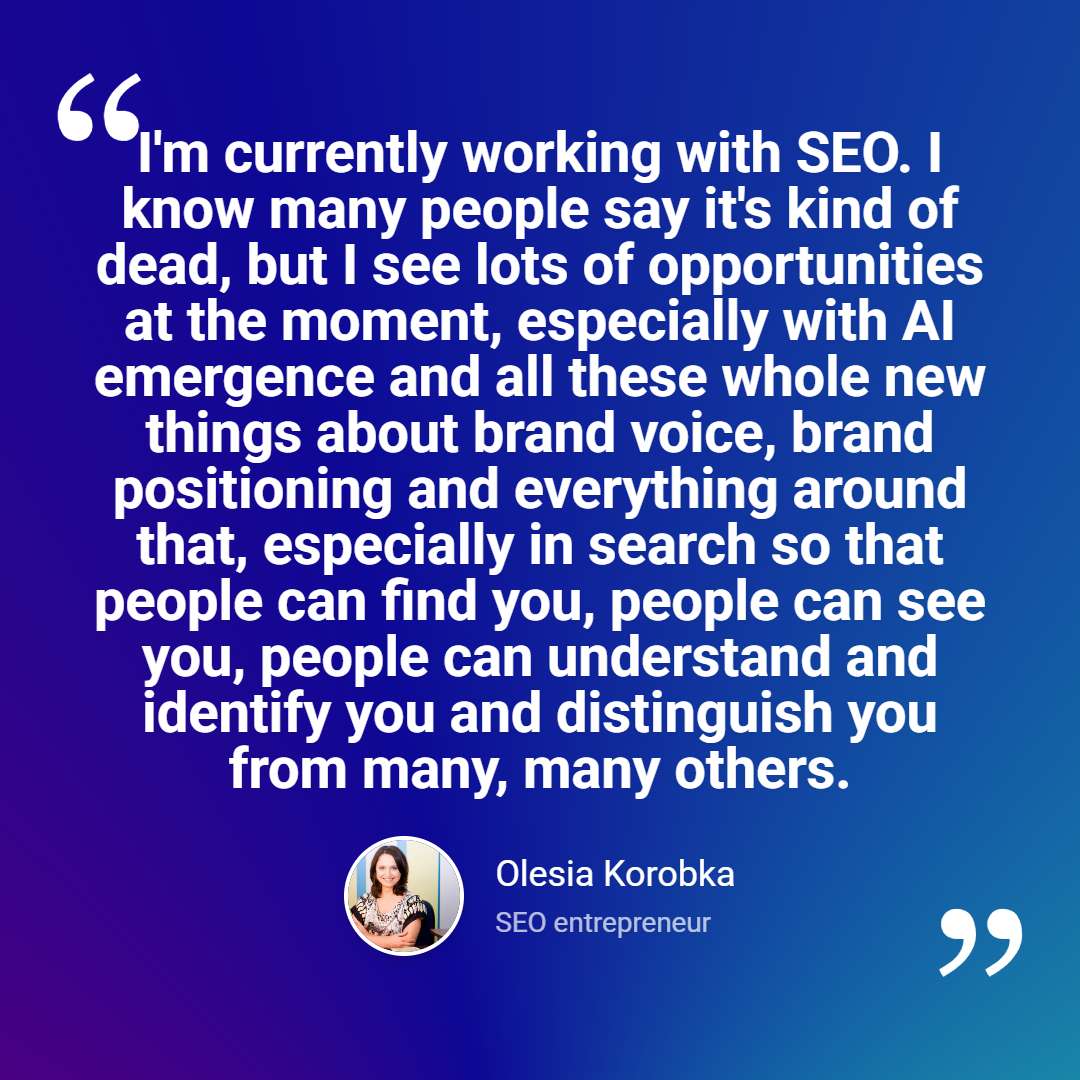
[00:00:13] Speaker B: Oh, Jeremy, thank you for inviting me. It was my pleasure. I'm currently working with SEO. I know many people say it's kind of dead, but I see lots of opportunities at the moment, especially with AI emergence and all these whole new things about, like, they are not new, but many more people are trying to position themselves somehow and to make themselves distinctive and unique in the age of AI and the brand voice, the brand positioning and everything around that, especially in search so that people can find you, people can see you, people can understand and identify you and distinguish you from many, many others.
So that's what I'm trying to do in search currently. Help brands stand out.
[00:01:03] Speaker A: Love it. Are you freelancing? Are you working with a particular agency or group?
[00:01:11] Speaker B: I used to be a freelancer some time ago, sometimes now I'm doing a few fractional roles in software as a service companies, and I also have an agency and I've also started a new venture some time ago.
I'm doing many things. I'm currently positioning myself as SEO entrepreneur. If SEO dies, I'll be digital marketing entrepreneur or something like that.
[00:01:38] Speaker A: I get that feeling. I'm doing the same thing, kind of diversifying multiple channels and thinking of myself as not just.
If you'd asked me five years ago, hey, what are you? I'd say I'm a freelance SEO consultant and. And that was it. But now I too consider myself a digital entrepreneur. And I'm looking at, you know, multimodal multiple channels.
But it's as much for the experience of having things in my own hands that I can grow without the limitations of that client or that employee structure of like, okay, I'd like to do this, and they say yes or no versus like, I think I'd like to do this. And no one's saying no. So you go and try it.
[00:02:30] Speaker B: Yeah, part of it too. But also I want to try new things. And, you know, the organizations, especially big ones and enterprises, they're kind of slow, so you need to do something before you introduce to them. I'm still approached by people from these companies, big companies who want to do these, you know, lots of blog posts about very generic topics with their corporate blogs, which has not been ranking for five years and will not be ranking for five more. But they still somehow are used to.
[00:03:04] Speaker A: Spending money on that it is interesting. Like the, it took a long time to get these large organizations on board with the concept of hey, you need a lot of content and you need to like do a lot of marketing. And they somehow equated that to I need to make a lot of blog posts. And that's like, that's all we're doing. We're just, just that, that that's the only part of the site that's ever touched or focused. They never think, oh, I should, you know, do a case study section, maybe a master class or a tutorial or make a spin off and do like a, a teaching series. Like it's always just nope, you just need a blog post. What's our blog post topic and can you optimize it after it's done?
[00:03:53] Speaker B: Yeah, it's always in the retainer. And the only thing that is interesting for them is how many blog posts a month can you deliver? And somehow they are not offering any, you know.
No. Like subject matter experts to review these blog posts sometimes. It's funny, it's funny. It's still here. So what amuses me the most currently this year, 2025, but people are still looking at the blog posts as like traffic producing machine. I don't know why.
[00:04:26] Speaker A: Right, so you said that you, you worked in particularly in SaaS. Is that like one industry that you have a lot of experience with or have you had a role or worked with clients that are in other niches or subtypes where you've had a lot of experience?
[00:04:49] Speaker B: I think that SaaS is the biggest portion of my experience. Startups and SaaS and also.
But I worked in many, many, many niches including financial niches, insurance niche, I gaming. I've started working with iGaming Niche recently and a few others.
I've got lots. And also I used to work a lot with local businesses from roofing, you know, to all kinds of bonds and everything.
[00:05:23] Speaker A: So what was the biggest gap between two niches that you were working on concurrently? Like having to change gears of doing local to SaaS or like I know there is, there are big differences in how you approach like it SEO. So what was the biggest gap, that difference that you worked on at the same time and what were some of the biggest differences that you were putting into your campaigns?
[00:05:59] Speaker B: The biggest difference was when I started doing web SEO a bit. So incorporating it into the strategy. And it's very, very different because most of the things that I'm specializing in is technical SEO. I'm good at knowledge graphs and in building Knowledge bases and in making the company findable within different knowledge graphs and incorporating knowledge there and lots of these things. But they are so much different from like very social aspects though sometimes you can see lots of things in common. But I may tell you that when you start working with very, very many, many, many different niches, you can see how like similar they are. In fact. Yes, they have these distinctiveness between each other, they have some differences. For example, in igaming niche they don't have that much quality content. For example, everyone steals from each other and they just reiterate the same old tune and it's practically all spam.
However, the basis is the same everywhere. So you have this technical part so that your content is scrollable and findable and so forth. And you have this content part where you have some text, some images and you have these backlinks part or backlinks is not correct way to say that. But like third party content that references to you properly in a way that helps you to have authority and to have more voice outside there.
[00:07:40] Speaker A: So you too are looking at links less as a game of let's get as much juice link juice as possible and more of a reflection of how frequently are we mentioned.
What authority sources can we tap into to gain bigger exposure on larger parts of the web? Is that.
[00:08:07] Speaker B: Depending on the niche in igaming niche you need to have more mentions and more links. And in some of the gaming niches it's just the game of links actually. So you don't really have that much content or it's not very good. So it's just how much you can attract from the outside.
In some niches, in some complex niches, for example, they are very highly technical companies where you just cannot publish that everywhere. You know, you have like a few sources, hack and use and Reddit and something like that, and that's it. So you are restricted in where you can get those links or mentions from and you also need to do that where your target audience is. So the target audience sometimes sticks to one or two forums and that's it.
And YouTube.
[00:09:06] Speaker A: So that's.
[00:09:06] Speaker B: Yeah, it depends a lot. But I've always been, I'm not against links in any case, I think that you need them, you need these mentions, you need these references.
[00:09:18] Speaker A: Yeah, I, I don't think it's, it's a naughty word.
I think link building is good. I think just viewing it from like a bigger perspective and looking at that value not exclusively. I know that there are people who look at us like, oh, it's just a doctor score or a domain authority score. I'm like, oh, it drives me nuts every time because there's you know, know there's anchor text and then there's a context around it. But there's also the page is anybody visiting that site that's coming through does that link represent like, like an interview that you did somewhere else and there's people that listened in that channel and they're engaged and they're going to flow through to that entity or is it something that's just on a, you know, fourth layer down page somewhere in the back end of the site that you're hoping Google might crawl and give you value for? So like I don't think link building is bad. I think just understanding, you know, getting the right mentality of in that part of SEO is important.
[00:10:27] Speaker B: Yeah, right. I do agree also from the point of view of knowledge graphs for example you may like for SEO it's important, it's vital that you have a website. But if you are building a brand, for example, very good, you need to have a website. But you may have this knowledge panel in Google without any website just by incorporating knowledge about you on the third party website and in social media. So it's also important.
[00:10:57] Speaker A: Yeah, I was going to ask you about that about some of the tactical I know I talked with Callie Scott of Blue Orchard about building knowledge graph entries on third party sites. He recommended trying to have an entity home like an about page or a specific page where you try to control and display as much information about your entity as possible. Its history, its source, its founding your key members and using schema to try to tie those things together. But it is a process of for your niche finding out where are the authority sources that Google is referencing.
[00:11:43] Speaker B: And not only Google now we know have new game players which don't really use schema like with their AI output. Like they use schema for organizing their own knowledge but they don't use the schema on your website. So at least at the moment and yes, so it's important. I learned this from Jason Bernard a couple of years ago and I'm using that a lot and I'm optimizing the about page of course for like the websites and projects I'm working with. And yes or sometimes it can be just a homepage there start to appear some startups and organizations they that don't really have any content for B2C and they are B2B but they still need a website to be findable. Not that they are attracting some audience to that website. But their investors or their partners, they want to see them in search and they want to understand that they are legit company and that they can be trusted. Because right now if you want to achieve something and you don't have this home entity or something about you, you are less credible somehow. So you don't look serious. If you have only Instagram profile, no one will treat you as a serious company. Even if you are like a very small, you still need to have at least some of good landing.
And yes, all the information there about yourself.
It is natural, isn't it?
All the most powerful things are so basic actually when you look at them.
[00:13:25] Speaker A: No, I agree. It's funny because it's like, oh, we need to have an about page and it needs to talk about us.
That's a head scratcher. I mean that's really what it is. But I cannot tell you how many times I've done an audit and I've been like, you didn't say anything. You said we're great at customer service and we fulfill your expectation and we're there when you need us. Like, okay, you described both a home cleaning company and a decor company with those vague platitudes, like you got to be more specific. And I think you're right that it's as we enter into an age where the only Google's not the only player anymore that's trying to put these pieces together, you know, GPT perplexity and these other crawlers are gathering this information too and putting together these profiles to put together.
You know, almost old school PR style like putting these pieces together. That's what LLMs do. They gather disparate signals and put it together to make it make sense. So that's kind of fundamental. Like talk about yourself thoroughly, effectively and say what you do here, guys.
[00:14:53] Speaker B: Put that LLMs txt you file new standard for LLMs so that they understand what you are actually doing in if you are a source and all those kind of things as well. And sometimes you say like we have a good customer service and then you try to find a link to their customer service and you cannot.
Or you after five minutes of back and forth trying to hack their website to find the support, you start this chatbot conversation where AI answers you, you know, recursively the same I don't understand you, please or something like that. And yeah, it's quite funny. So yeah, be specific and just do very basic things and you'll be ahead of your competition and you'll be findable and you'll be there.
[00:15:42] Speaker A: It's definitely. I've worked with several organizations doing knowledge base setups for their support team and it's crazy how difficult the main organization seems to make that process of like, oh no, your support. We can't possibly put support front and center. That implies that they need support. And our tool is so intuitive. So it's in the footer and you got to click to this and it goes to the support page. And the support page links to a knowledge based page. But then you can do your search like how many you get? You got three or four hops before they can actually search and try to find whatever, you know, the actual, you know, use case. Because once you sign up for it, you know that should be the homepage. Like you need support docs like in your face. Like you want them onboarded to get every piece of information. And that should be part of your mission too as, as a SaaS of like, hey, this is how you do this with our software. Because guess what? People are googling, how do I do this with any software? So yeah, that's true.
[00:16:54] Speaker B: And also with this AI chatbots. One of the owners of the tool actually was compl that he sometimes answering those customer support questions himself and sometimes people start cursing right away, you know, from when they ask some questions to the support, they use the censored words. And he was wondering why.
But you know, to start talking to a real human support without talking to AI, you need to incorporate some of these words to scare off the AI because in that case they switch you to customer support faster. And many people know that. So they start like talking very right away to avoid these long conversations with AI.
It's kind of funny that.
[00:17:50] Speaker A: No, I know, I saw that there was a, there's a trend that the.
I think Semrush Patrick Stocks was saying that he's starting to see in Google. People notice that if you use swear words when you're googling something, it strips out and leaves just the organic results. You don't get ads and you don't get AI overviews. So even now in Google search console and in your keywords, people are starting to see buckets of swear words coming up with their brand because people are just kind of sick of being foisted on. Oh my gosh, I can't even see organic results. So yeah, bleep.
Give me, yeah, yeah, give me my shit.
[00:18:40] Speaker B: That's kind of funny because you like I'm trying to be polite with AI bots, you know, just to keep some human part of Me not to become, to be, to keep my civilization, so to speak.
[00:18:53] Speaker A: Humanity.
[00:18:54] Speaker B: Yeah, yeah, humanity. But it's funny that it may work like in a different way for us as a humanity eventually when we want to get to the human.
[00:19:07] Speaker A: So yeah, no, it can be.
I don't know why I have this personal experience like you know, you have to pay a bill, you have to sit through a five minute called prompt chain to finally get to the point where you on your touch tone keypad, you know, like we haven't done this a million times. We know how to. We know that like you put in the number and like they just walk us through these things like dummies and you get really frustrated at some point and I really wish that our industry and AI, you know, new people coming up and it could maybe help with that of like having an interface immediately available that can help get you immediately to support or immediately to pay your bill without all the extra friction. And yeah, I'd love for that to be the next step. I don't have much hope though.
[00:20:04] Speaker B: Let's see.
[00:20:07] Speaker A: So I'm curious, you said you're a digital entrepreneur, what are some of the other projects that you're working on or have worked on that that have taught you something new?
[00:20:19] Speaker B: I'm currently building this service where I do link building for brands and not link building but building their fortress of mentions and correct mentions and content on the third party site so that they can be recognized and they can be heard and they can be findable and that's about it. It takes all my time at the moment because I see this opportunity with AI and with brand search been so popular. So I jumped into it and I just developing it and working there. So that's what I do from morning to the evening. Also another thing which I'm trying to build is you know, this fine tuning of AI to answer certain questions so that I'm not sure if we have that many websites in the future. I'm not sure if we need them at all. I think that we have too much of content which is not unique.
You can and lots of spam which is not required. If people start to use chatbots more or personal assistants more, they will not be visiting those sites ever again. So I think some informational partial niche which with not so useful content they will die out. And I want to prepare for that. I want the companies to have their buckets of information, valuable information specific to their business and specific to their business goals. So what I do, I help them to build these databases so to say of their industry and themselves that they can integrate whatever happens to Internet, whether we shift to web 3.0, whether we don't. You can use this knowledge base to generate website, social profile, even blog post if you like, podcast, a video, anything, tutorial, whatever else. But you need to have this condensed, distilled knowledge inside your industry about yourself that helps you achieve your business goals.
So I think that this AI at the moment, like evolvement, so to say, helps us to achieve our business goals more. We don't need to do many things like make generic blog posts. We can do only that that helps us to get customers buys. I think it's good.
[00:22:55] Speaker A: Interesting. Yeah.
I myself, I have a ton of podcasts that I've done in the past and one thing that I'm trying to do is unite those into a single database where I can query and say, hey, give me seven quotes from different people about citations and be able to pull those out and be able to use those in an article.
So I definitely see the utility of pooling that knowledge in a way that definitely was not available to businesses five years ago.
The. The rate of change is very rapid. How quickly do you think businesses are? Like, because there's. We're on the cutting edge, you know, like in SEO. I remember in, you know, 2012, like I had already seen most of those Cambridge Analytica articles of like, oh, they're invading our privacy. I'm like, yeah, we've been doing that for seven years already. Like, so how far ahead do you think we are technologically versus mass adoption of these new capabilities?
[00:24:12] Speaker B: I think it's now very fast. I was not expecting that earlier than in five years, but it happened faster actually, and maybe it will happen faster again or maybe not. We'll see if we have some worries again or something like that. It may become even more fast. But it's funny that you've mentioned that you are building this knowledge base with your podcast because I'm doing kind of the same. I'm also having a few videos and now you have this notebook alum, you know, and all these kind of other parses and you can use LangChain and everything else so that you can get lots of videos and get content from there and connect them into one database. What I'm thinking about is that in some point it's easier for the language models to get API from your informational base and get all the content they need and create it themselves. So you don't need to create the website and all these interfaces and all that. So Maybe there will be another structure of the web where you have these API calls or some other kind of calls and you don't really need to have a website. You just have this pod or I don't know, a bucket with your information and various systems just connect to it to generate the content from it so that you don't have to do that. But I think that and it's easier to maintain. So one central focal point of your business where you connect to social media, different LLMs and everything, different assistants and they just use it with the API and you really don't really have a website.
[00:25:54] Speaker A: I, that's mind blowing. But I can kind of see how that might work. It would require a meta move that I'm not sure financially. Like there's so much invested in like Google as a search engine of like having that interface be Google. And then they get to sell ads and then they give access to our stuff that we made. And that's kind of been the devil's deal, right? Like hey, you can steal our stuff and show part of it or more of it or more of it and make money off of me but you know, you'll eventually send them to me to make those purchases.
I think at some point, you know, the betrayal, I do wonder if at some point the betrayal of, you know, zero click searches of, you know, they took over the travel niche, they took over the, the ticket buying niche, they took over the, the hotel niche, they, at some point Google's greed is going to, you know, backfire on it. I hope in a way that, you know, if we can develop these knowledge pools and an alternate way to let people connect to them, you know, possibly through, you know, their preferred GPT provider, then, then the experience is going to be different of like a subscription or like, you know, some alternate financial model that can let us bypass that, that agreement with Google sufficiently to get those eyeballs and give access to people who are interested in that exchange. I think that's a fascinating concept.
[00:27:36] Speaker B: Yeah, that's interesting. But we don't have the money for that. But only big tech companies do have. So it depends a lot on them. And I think that's why they are in such a, I don't know, hurry with all this thing. They don't want to lose private information about us and they understand that who controls this access to private information will win actually in the long run.
[00:28:05] Speaker A: I think you're right.
There's a lot of money flowing right now and trading hands as they try to jockey and position to be, you know, the next big thing.
I hope that some of these iterations are positive for, you know, businesses positive or for consumers at the end. But I don't hold my breath for too much.
[00:28:38] Speaker B: My friend Dart says that these new models, LLM models, they fail to connect you with adult content.
And we do remember, well, that Internet started to evolve thanks to adult content mostly.
The one who figures out how to incorporate adult content into the new meridian has to win the most so that it's also social.
[00:29:05] Speaker A: That is a very good point. It was cat pictures and videos and adult content.
80, 90% of the Internet at first, the Wild West. So, yeah, I think you're. I think that's. That's accurate.
Speaking of cat pictures, I know that you're involved in a charity.
Do you want to get talk a little bit about that and how people should be aware of it?
[00:29:35] Speaker B: My friend Anton Schulker here was very involved and worried about the cats and dogs that suffer from the war. They sometimes are abandoned by people who used to be their owners, or sometimes they have just a very unhappy experience in their lives. And there are people who save these cats and dogs and get them home and heal them and look after them and feed them. And there are quite many of them. And these are very small shelters that don't have any financial help from anyone except for Anton. So what he does, he created, not a fund, it's not something very big, but he started accumulating money for these shelters and passing them to them so that these cats and dogs can have food and can have home and can have hope for the future, for the better future for themselves. So what he does is an SEO charity. We have SEO charity event, SEO character for both. We've had already two conferences. They are online, and we are having a third one in March 25th of March. Please join us if you can. And what we do, we talk about SEO and the concepts that are closely related to SEO so that people who watch it are inspired by what they hear and what they see. And they can donate money to help these animals and also have sponsors for the conference.
And we take this money, we don't get anything from it ourselves, neither Anton nor me. And we just pass them to these shelters so that they could continue operating and saving cats and dogs. Because people can walk away, sometimes they can run, they can go to another country.
But cats and dogs, they cannot. Usually some of them are closed in their buildings. So the volunteers go and save them. They have to break the doors to get these pets out. And so. And they are very vulnerable. And it's like they had this contract with a human that the human will care about them, but the humans abandoned them. So it's good that there is Anton and other people who can take care of them and can continue doing the human part of the contract, you know, so that they can be cared about.
[00:32:01] Speaker A: That's fantastic. I think that's an incredible step. I know there's a lot of loss from the, the war against Ukraine, and I love to hear, you know, action being taken for those that have the least to do with it. You know, animals had nothing to do with that war getting started.
Just a madman in another country thinking that he can come in. I. I love this. I'm going to support it as much as I can. I'll put into the show notes details about how to participate.
Is it an open call for people to from other because this is an SEO podcast, I'm sure there are people who could contribute as panelists. Or is it mostly looking for participants and people who can promote and bring more visibility to the event? Which is it, both or either?
[00:32:56] Speaker B: Hello, everyone is welcome. Right now we already have the speakers and we have Googlers among them. So there are lots of valuable info. And what I also was thinking to make for the third one, for the third conference is what you said about your podcast creating a database out of all three conferences.
So that. And creating a book or something downloadable for people who are looking for some kind of information because there's lots of valuable stuff actually in this conference, we are not just sitting there and looking at you, asking you to donate. People are really trying to deliver very valuable knowledge about SEO and digital marketing. And even if you don't want to donate, please come and just join us because it helps to create visibility or share among your friends or like talk about it. So any kind of engagement is super valuable because it helps us to get more eyeballs.
What we found out, what I found out working with other charities is when one person shares in the social media and 20 more people come, one in 20 will donate or will share with 20 more and thus we get more and more people. So even if you just come visit and share in your network, it's also super helpful because it works.
I don't know how to say it, but exponential.
Yeah, it is exponentially. So every input is super valuable and you'll find lots of valuable information for yourself because we are doing that helpful for everyone.
So for the speakers, for those who join us, and for the cats and dogs eventually, fantastic.
[00:34:46] Speaker A: Super happy to support that. I'LL make sure that it's linked in the show notes and wherever I share this podcast, everywhere that I can I would note for you.
I started and I learned from Aaron Wall's SEO book.
I was given a given a copy of it and said before you do anything, read this whole thing. So a guide based off of, you know, I know that there's a constant flow of people coming in and wanting to learn about SEO. So maybe distilling and seeing if you can generate a book based off of these panels and discussions from these different conferences and then that you could also, you know, publish that and you get the book sale revenues then going to the charity.
I know Aleyda Solis, she made the Learning learningseo IO site which is very well structured.
You know, complementing off of that and having a downloadable resource based off, you know, for charity would be fantastic to have in the market.
[00:35:53] Speaker B: Yes. So that's what I will be doing after the third conference when we have all the three and with this new knowledge and everything. So very looking forward to it.
[00:36:04] Speaker A: Thank you so much for coming on. If people want to interact with you, find out more about what you do. Are you, do you hang out on LinkedIn? Are you on Bluesky or on Twitter? Where can people find and amplify your message in Google?
[00:36:22] Speaker B: Whatever pops up there for you, just use it. I've optimized myself a bit. Not too much, but a bit. So it will be unfindable.
[00:36:33] Speaker A: Awesome. Thank you so much for your time.
[00:36:36] Speaker B: Thank you for inviting me.