Episode Transcript
[00:00:00] Speaker A: Hello, I'm Jeremy Rivera, your unscripted podcast host. I'm here with Joel Miller, who's going to introduce his company. He's going to introduce himself, but I want him to do so through the lens of why we should trust him as an expert.
[00:00:17] Speaker B: Thanks for having me on. Yeah. My name is Joel Miller, and my identical twin brother and I run the sky floor, and we do digital marketing. I mean, that's sort of like the umbrella, right? Digital marketing. But really what we've been kind of focusing in on in this latest season is that we are problem solvers. We help you get to an outcome and a goal. And so we're not just here to push some buttons or, or apply your style guide to a website or whatever. We. We want to actually know what you want to achieve and then.
And then do whatever we can to help you get there. And so we really work across tons of industries. We do all kinds of work really centered around the web, but it's wide ranging. One of the things that comes to mind immediately is that we had an ad in the Bears game day brochure that they pass out when you come into the Chicago Bears stadium.
And that's distinctly not digital. Right. But there was a digital component to help our client achieve their goal.
[00:01:20] Speaker A: I like the connection of the marketing strategy. And, you know, this is an evolution I had to go through myself with my own marketing and with the services that I provide of kind of evolving past. Oh, hey, what I do is, you know, I edit meta titles and I build backlinks and generate content.
No, no, like, there's there was a fantastic interview that he did where he talked about, like, this pyramid of value, you know, and at the bottom, it's like executing on something specific. The next tier up is saving you time, and then a tier above that is enabling you to meet your goal or to become who or what you want to be. And from that framework, it's like the lowest here. Yeah, you can tell them that thing or you can tell them that next level of I'm going to save you the time that would have taken you to do X, Y, or.
But really that highest tier is enabling them to do or be the thing that they want to be. Whether that's a successful business person, whether that's a hybrid philanthropist and business person, you know, or the highest selling, you know, person within the team, whatever it might may be, you know, enabling the business to do that, that's a much better way to go about, um, you know, and. And making sure that your product and Service delivers on, on enough value that you're going to be hired back.
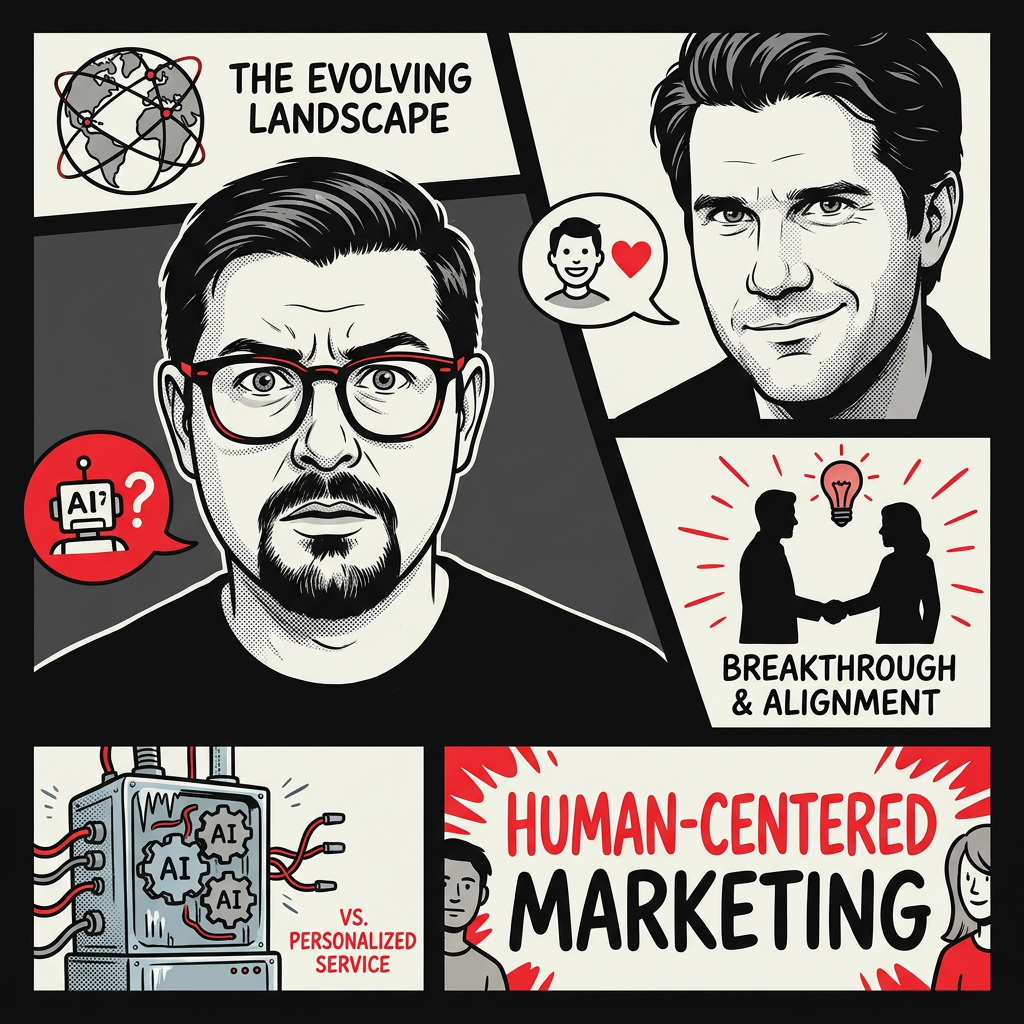
[00:02:54] Speaker B: Right, right, right. Yeah, I love that. I mean, especially in the AI era that we're not only entered into, but living amongst. And, you know, there's a lot of fear and loathing and, and I'm not sure we'll find out how true any of that is, but, but what you're saying is, is a key distinctive, right? Like that's a thing that a computer will never be able to do quite the same way that you or I can. When we get to really, truly partner with a client and say, all right, we know where you've been, where you're going, and we can use some of these tools to help get there. But like the human ingenuity to help you achieve those outcomes so you can be who you want to be. That's going to be a distinctly human task still.
[00:03:35] Speaker A: And I think it kind of unveils a little bit of the lie. As you know, we, we're in that front runner portion I saw amazing graphic that showed of all of the millions of people, it was like 20 lines and 3/4 of them were gray. And they had never used any sort of AI tool whatsoever.
And then there was, you know, yellow lines and, or green lines of people that had tried it casually. And then down in the bottom right corner, a number of millions were those who use it daily.
And we're in that, of that, that vanguard, that forward element, adopting those things. But there's definitely a scoble moment of like being the guy who's wearing the Google glasses while taking a shower like you're, oh, we're so adopting this technology. It's totally happening. It wasn't happening. And you were embarrassing, you know, because you were thinking four or five steps ahead of the people that really needed to mainline accept it before it was useful. But the lie behind that that I'm talking about is that, you know, AI can do anything. You know, that you can achieve any goal. You just feed in the right prompt and you're going to get the right output from. I would say, you know, I've talked to other geo or generative search engine optimization guys like Chris Tweeten, and there's always a big gap between what's promised and what you can really deliver. There is a lot more that you can deliver in terms of capability. What's been some of your dilemmas that you've solved and some of the dilemmas that remain after you analyzed what are currently available tools to help provide solutions that have An AI element.
[00:05:22] Speaker B: Sure.
I mean, a story that immediately comes to mind is employing a custom GPT for sales enablement for one of our clients.
Again, not websites. Right. But in the digital space. And how can we help them achieve their goal? They're having some sales issues. And so I listened to. And I think this is probably.
It's kind of built into the answer. I listened to 30, 40 hours of phone calls, something like that of incoming lead calls and to their entirety. Right. And I just sat there taking notes. And granted, I could have an AI just analyze transcripts and, and then tell me what it thinks the weaknesses are, and some of those things will be true.
But it, it's not going to understand the tone of the conversation. It's not gonna necessarily understand how that one pause came across. So there's all these, again, human elements that I need to parse through to get the outcome that we want. But then I took all those things and put it into this custom GPT. And then using CallRail, we have automatically grade incoming calls. So it's based on the human work, but the AI does the thing the computer is good at, which is now saying, all right, here's the six categories that need help.
How did they perform?
[00:06:44] Speaker A: You're right. In the analysis, it can only. It mostly is going analyze the actual text. It won't.
You might end up with a call where, if you looked at the transcript, you have no idea where it went wrong. You know, it looks like, oh, I hit A, B, C. We said this, this, and this. And I can't identify why they didn't do it. But if you listen to the call, you could hear the hesitation of the response. Request after friction point B. You know, oh, it's too expensive or it doesn't have enough seats. But they didn't say that it didn't have enough seats. It was just. And silent. In an appropriate silence that you can feel like if you've ever done sales or done. I mean, if you're in SEO or marketing, you've always done sales of yourself, but you kind of get that moment of like, oh, I just missed it.
They have an expectation or they're not saying, but I'm not getting it. So there's definitely subtext that humans are programmed to understand. Right, Right.
[00:07:53] Speaker B: Yeah, that's true. And I, I mean, I immediately think of. I've always been fascinated by words or phrases, maybe that they mean different things depending on the tone.
And.
And so I, I mean, I can't think of all of the. Probably some of my better Examples. But immediately as you were talking about it, I was thinking of someone who might say, well, that's great.
Or they might. Right. They might say, well, that's just great. Those are two different things. But if you're just analyzing text, it might just say that was an excellent moment in the call where the person seemed pleased.
[00:08:30] Speaker A: That is true.
My friend Matt Brooks at Seoteric says that ChatGpt is your least trained but most popular customer support representative.
Definitely come across that moment where it's giving up answers that it's beyond its capabilities. It's also that I found and maybe you can back this up. If you're asking for answers, you will immediately bias an LLM because it cannot be objective in its response out of the box. It is an answer engine and can therefore, you know, it's that wave particle. You know, if you observe it, it changes it. And so you, you have. In order to get it to do a prompt, you have to give it the input which then influences the output.
[00:09:29] Speaker B: Oh yeah, I think that's one of the like. And maybe, I mean, you know, we all see the. You have to download these 120 prompts that will completely change how you use blah, blah, blah. And there's always some interesting stuff in there. But I think that's like one of the ways again that the human component has to be part of it. And you're right about the leading edge people. I mean, we will likely have an advantage for some time because we'll have used it so much that we innately start to understand how to get better results because we feel that tension of, oh, I know when I phrase it like this, you know, it's, it starts, it's going to give me a certain output because it thinks that's what I want. And I actually don't want that some of the time. Right. I don't just need a yes man. Yeah, yeah.
[00:10:19] Speaker A: Until GPT is programmed to grow a spine.
[00:10:23] Speaker B: Yeah, right, exactly.
Yes, for sure.
[00:10:27] Speaker A: So tell me about your current interplay between classic SEO.
I feel so old traditional SEO marketing, but it really is, you know, like the, a lot of the fundamentals are still there. You know, we have these, this trifold system within LLM tools that, you know, it's got its training database which you can then influence with SEO and then you've got. When it doesn't or can't find the answer, it's going to do searches. And so in some ways GPTs and Claude, et cetera, are just fancy wrappers for Google results.
[00:11:06] Speaker B: Yeah, it's Interesting because it's been changing for a lot of our clients like rapidly in the last four months.
And I don't know if you're seeing this. I'd be curious to hear some of your, what you're seeing too in your business. Because we're still like at the edge of figuring out exactly how to handle the drop, for example in organic search results because of AI overview. And we're seeing that, you know, it's been significant for some of them, not everyone. It kind of depends on what the content is. But you know, we're seeing some, in a lot of cases an increase in impressions, but the clicks are down 40%.
And so it's interesting because we're kind of right live in the middle of figuring this out for, for them because it's also shifting around a lot.
But you're right, I mean there's a lot of like key components that are, are still the same. In fact, in a way it almost just means you have to sharpen up some of the things that like the, it might not just be as easy and again that's a simplification but it might not be as easy as you just need more interesting, better content more frequently.
Now we have to get a little bit more strategic.
[00:12:25] Speaker A: Yes.
From what I've been seeing, you know, it comes down to impacts by vertical, you know, working with you know, a radio station.
Publishers are getting hit harder and harder which is, you know, Google is progressively more and more willing to poison its own well of and disincentivized again another layer, you know, and over monetized. There's a current lawsuit that's going on that's revealing even more of Google's monopolistic tendencies and absolute willingness to rig, you know, pay per click bidding systems to maximize profitability. And then you know, restack and Restack SERPS again and again with you know, pushing organic. There's so many categories now where organic results are. You can't even get an organic result on the first page.
[00:13:31] Speaker B: Yeah, you're like, yeah, here's, you know, and we're, we're doing this a lot and clients are too of course which they're running searches and they're like all right, so this keyword combination, of course it also might change based on a lot of other factors. But, but generally they're getting, you know, here's where we get AI overview first and then down below that are some place results and then down below that are the next group of sponsored results. And you're right, sometimes the organic stuff is maybe Two of them show up at the bottom, maybe not at all. And you have to go to another page if you're ever to see it. I mean, we're seeing this in ad buying too because a lot of the keywords that were working for some of our Google Ads clients are no longer showing any at all because that's where they're putting this kind of, this, the overview content. And so we're having to shift, and it kind of sounds like logical, but we're having to shift more to the like high intent combinations, like you know, blank, blank, near me, that kind of stuff. It has to be. We're, we're buying that more than we ever used to because otherwise it doesn't even show up. It's crazy.
[00:14:40] Speaker A: Yeah, I think a big, you know, strategy analysis piece is, you know, just dissecting and understanding the SERP space in a more, in a deeper way. You know, you can't just rely on search volume numbers anymore. You know, you have to understand the different ways that it's slicing and it's also, you know, driving on the back end. Hey, I need to work better with my email teams to, you know, actually, you know, drive value out of those secondary captured audience systems. So I can use, you know, social media to capture audience which then I can direct to these pages and get them to convert as opposed to, you know, it's like fishing in ponds that you created versus going out to the ocean. And you know, those type of demand generation systems I think are more necessary now for you to have that inter, interdiscipline capability as a marketer more broadly rather than just singularly a Google reverse engineer.
[00:15:52] Speaker B: Right? No, totally. It's because at the end of the day, like the one thing, especially if you're collecting information like emails, audience can't be just taken away if it's your audience by whatever the next thing is that Google's gonna do or any of them. Right. Like if I have, I'm capturing that information over time, I still control that. And so I, that's a, that's a big thing that we're, we're looking at as far as helping our clients understand. All right, I know you, you were like viewing this more in almost a traditional lens from the last however many years. Like you put some money into it and you get some results and it's leads and it's like, yeah, yeah, yeah, that's good. But, but what if we actually started building you an audience that you could take with you no matter what's going on and, and get some people to actually follow along with what you're doing. But like, I don't know about you, but some of that like requires personality. Like someone has to kind of be out there. Yeah, yeah, yeah. Cause like LinkedIn, right? They're not.
What is it, something like eight times more likely if you post something on your personal page versus a business page to get viewed and clicked and read and you're like, so that's been a bit tough. Cause we have to try to talk to some of our clients into being out there more than they want to be.
[00:17:23] Speaker A: That's true. It is a strange time.
It's interesting because the more that AI gets pushed to the fore, the more that humans are wanting people to pass the sniff test, you know, of like, are you human?
How legit. And you know, my wife was mentioning this like she just was working, she just picked up an apprenticeship as a tattoo apprentice and she was talking about how the, with more and more videos that have come out in the industry, it's almost like the more raw and unfiltered your footage is when you're in Snapchat, people are responding a lot more to it than, you know, one or two years ago you couldn't get anywhere unless you had an incredibly overly polished, right, you know, video that you're releasing super professional quality. But it got subverted. Like it was so profitable that then they started creating AI processes. And now those types of videos that were super popular and picking up all the traffic aren't performing because people are not interacting as much because they're like, oh, so and so is just an, they're just an AI avatar, you know, right. Two years ago you go back to the quality of video and it's, you know, one on one, one person and share, talking to the video saying X, Y or Z.
But now it's such a different game because you know, along comes AI and they, they have the ability to swap in anybody and, and you know, these mass marketing tools realize the value of that niche. But now that's not exactly. It's like, let's say, I think they said that new gen Alpha slang was oh, that's so AI.
Like oh, that's AI as in slop, as in it's not trusted. And so it's interesting that those proponents of new technology that most want it to become just kind of the default of this is accepted. We're just going to do this so people accept it has pushed such a poor quality product out there that now AI is synonymous with junk, synonymous with low quality Synonymous with no effort. Like, the most advanced technology in the world is producing the lowest quality junk out there. And it's just this inverted thing that I find actually kind of a lot of schadenfreude out of, like, I'm enjoying your embarrassment of like, you created this culture. You pushed out. Keep pushing. You know, it's like the Jeff Goldblum moment of you. You kept asking the question of if you could and never stop to ask the question if you should.
[00:20:26] Speaker B: No, it's true. And it's funny. Like, I mean, what's. I, I don't even. I'm not sure what's going to happen with this, but scrolling through Facebook right now specifically is just.
It's kind of a nightmare because you're like every other.
I. I'm trying to think of the last time I saw a real clip. I mean, it's. There's some in there, but like, mostly it's stuff that's too outrageous to be true. And then, you know, they hide it in that next line. See more. And it's like, these are created by. With AI for your entertainment. And you're just like, well, I already knew that because none of this. That's not something that actually ever happens. But, like, what's going to happen?
Like, does Facebook start to monitor that and try to stop it from happening? Do they even care? As long as we're engaged and angry about it and commenting? I'm not sure, but it's kind of irritating right now.
[00:21:20] Speaker A: It's definitely a time in the market and it's for prognosticators and those people who are in that lower acceptance quadrant where, you know, more and more people are going to be looking to us for. For those answers to map out for them how they play in those playgrounds.
I'm curious, what's. What are some of the things that, when you're bringing clients on in the past six months that you've had to add to your stack of analysis or processes to kind of cope with our.
Cope with our current reality?
[00:22:02] Speaker B: Yeah, a big part of that is the geo concept. I mean, everyone wants to know how you're going to help us show up in an AI search. And they were saying that before they saw the organic dips, but, you know, now that conversation is getting louder.
So that's one big piece is adding that in. I think another one is just navigating the AI landscape with intelligence. I mean, a lot of people are curious about it, but they. Or they use it very.
At a very cursory level and they know because of our personalities and the space that we live in that this is something that we spend a lot of time with and considering. So they are just looking for guidance on how should we be viewing this, what should we be using it for, and what should we not be using it for?
And so we've been able to step in with some of our clients and say, all right, here's what we think. Here's how we see it working. Here's the stuff it's good at. Here's the areas that we don't want to use it, and you probably shouldn't be using it either.
So I think it's like a cautious optimism.
It's a.
It's a.
I don't want to be the person who's out there saying that it's. The world's falling apart because of it.
I think we shouldn't ignore it. We should be using some of these things. But, like.
But we see more that our clients are nervous about it than they're excited about it. So, like, conversely, we get to come in and say, yeah, but here's some things you might want to think about utilizing it.
[00:23:44] Speaker A: Yes, it's definitely. There are at least two edges to that sword. If not, it's like two swords stuck together three times as many other sides of the sword this many ways.
It is interesting because for every downside, there's an upside, and for every upside, there's a downside.
The funhouse mirror of, you know, pros and cons, both societally and functionally as a business to navigate. So, yeah, I can definitely see, you know, those consulting moments of, you know, concern.
And it's. It's interesting to me as I view different, you know, types of businesses and how they're uniquely impacted in very specific ways and niches.
What are some of the niches and industries that you've been working with and what have been some of your answers that you've been giving to clients for their marketing issues? In this. Again, repeat myself, but in this. In this very age.
Right.
[00:25:03] Speaker B: Well, I. One of our biggest clients that we've been working with for a long time is a tutoring company.
And so they do act, SAT test prep, and then academic tutoring, too. They're called Academic Approach. Highly recommend. They were great. But it's interesting because they have a lot of their competitors are using AI tools for tutoring, even to replace that.
And so, you know, they're coming out with, like, subscriptions.
Use our AI tutor, you know, and now, whatever it is, $35 a month versus this hourly rate.
And but that's like distinctly something that we're deciding not to do as, as consulting them and, and as we talk about it, because it's just not their business model. It's. Their business model is high touch, very customized service and people have to do that. Even though something like an AI can probably teach you a lot of the basics, it's not going to understand exactly what your student is going through.
How they suffered through the first two or three practice tests and had to figure out how to improve their executive function. How to not just learn some tips and tricks but to actually like hone parts of their skills that will actually apply to like their academic careers and potentially their college careers too.
Right. It's like, it's I guess avoiding the shortcuts for the personalized customized service which is how we try to run our business too. So it's like, it's very close to home. There's no, we don't want to cookie cut anything.
[00:26:56] Speaker A: I did an interview last year with somebody who worked in the education space and you know, actually it was two years ago and the concerns were kind of pre GPT of hey, you know, students are using Wikipedia for answers and they can't cite that. And now we have, we had at that time, even in that conversation, you know, a major pluturism issue.
[00:27:26] Speaker B: Right.
[00:27:27] Speaker A: So I would imagine, you know, the irony of an education program turning around and offering AI as tutoring is just kind of.
But you're right that it is a business model proposition too of like, oh, hey, well that's actually SaaS. You're offering a SaaS for a, a human, you know, custom human element. So that's probably not going, you know, that's not such a long, long term solution because the problem with SaaS is that it iterates and evolves and you got, then you gotta keep on that and keep them addicted to the platform. It's gotta give more value and, and you need a lot more, a lot more subscribers to keep up with that business model.
So yeah, I would also be recommending finding ways to highlight the value of that human participation. And I think that's going to probably be like the ultimate response in the next couple of years. Is a focus of a human renaissance of like I think so too.
These new tools can do all this cool stuff, but what can these silly humans do? We can do so much more, you know.
[00:28:43] Speaker B: Right, Yeah, I know. I think it's super interesting because I, there's just, I think there will be a higher Value almost like if you could level the playing field. Like let's, let's just say at its best that AI as a tool will level the playing field so that everyone can bring whatever idea they have to market pretty fast. And let's say it's decently good, right. It keeps getting better and better. Cloud code can one shot you any idea you have and you can launch it. We're still gonna end up with the same problem, which is why does anyone care? And how do they even know that this. You made this thing? And that's always been the issue. That's why marketing is important and so that and audience is important.
So I think it's like in a way it's gonna change the conversation because the human element is gonna actually be the most important thing.
It always was. But it highlights it when there's not all these other maybe gates in the way. Like do you have enough money to make the thing or I think a video for this, right. Like if you if see dance 2 or 3 or 36 or whatever it's going to be, you can, we can make a whole, you know, Hollywood grade movie in three minutes. I don't know how fast it'll be, but is the story good?
[00:30:05] Speaker A: Yeah.
[00:30:06] Speaker B: Is it.
Do people.
Are they interested in it? And if they are, they're probably interested in it because of the person who came up with the story. Right? Like that still has to be there. There has to be some kind of human element. Again, it's not just type in a bunch of prompts and press go. And then we all go. Yeah, yeah, I'll subscribe to that.
[00:30:28] Speaker A: That's our.
[00:30:29] Speaker B: That's something I care about. No, because we still want to know who's making it and why and what's. What's all this like underlying things that machines just don't innately have on their own.
[00:30:41] Speaker A: Absolutely agree. Let's kind of wrap up here. If people are interest interested in the human element, that is Joel Miller, where can they find you? Do you hang out on Substack? Are you on a LinkedIn guy?
If they are interested in learning more about you, where can they find you?
[00:30:59] Speaker B: Yeah, we on our website, we have a blog that I write frequently. You can subscribe there. And then I'm on LinkedIn as well and I also post some of my content to Medium.
So if you look up the Sky Floor or Joel Miller on Medium, you'll find us for sure.
[00:31:15] Speaker A: Fantastic. Thanks so much for your time and unique human insight.
[00:31:21] Speaker B: Thank you for having me.