Episode Transcript
[00:00:00] Speaker A: Hello, I'm Jeremy Rivera, your unscripted SEO podcast host. I'm here with Bradley Benner of Semantic Mastery for the simple folk who haven't had the honor and pleasure of running into you yet.
Give an introduction, let people know a little bit of your history. We don't need to go too deep into it. We've got a previous episode, a previous interview, if people want to go deeper into the weeds. But I want them to know that you know what, what I know that you know.
[00:00:31] Speaker B: Well, thanks for having me, Jeremy. Yeah. Bradley Benner from Semantic Mastery and Semantic Links. Semantic Mastery is my information product kind of coaching business for teaching local marketing, local SEO, AI implementation now for local marketing and local SEO, also for business development.
But Semantic Links is my white label kind of SEO fulfillment service.
We do fulfillment services for other local marketing agencies, primarily off page signal fulfillment such as link building, citation building, branded assets, press releases, that kind of stuff. But we do some on page consultation, full SEO audits, et cetera.
I got into SEO back in about 2010ish to learn how to generate leads from Google for my own contracting business.
It led one thing led to another. I became fascinated with it, fell in love with kind of the whole process of being, being able to manipulate Google and did both kind of SEO and lead generation for my own business, but also for some contractors that I was working with at the time because I was an electrical contractor.
And then kind of because I, I, I got fairly good at it. Part of it is just because I was so, you know, interested in it. And so I started monetizing lead gen assets and things like that when working with contractors. And over the course of a couple years I built up enough of a revenue, enough of income that I was able to actually stop doing electrical work and go full time into marketing and SEO, local SEO. And so that was around 2012. And then from that point on, you know, over the years we ended up, I ended up developing Semantic Mastery, which is our information product business, because I got a pretty good knack at being able to teach the concepts in a way that's easy for people to understand. And so, and then just around 2020, actually 2022, right in the beginning of 2022 is when I started my white label services.
And by far that's taken off more than anything else that is my highest revenue generating business.
So link building is a, is a very near and dear to my heart now, which is kind of funny because I used to hate link building. I always used to use outsource white label Fulfillment providers for my own agency.
But I needed to find better, more effective links out of necessity for my clients performance. And so that's why I developed my own link building service after many months of testing to come up with what we're going to be talking about today, which is completely relevant and that is links with relevance.
So that's what I think our topic is going to be about today. But yeah, semantic links is kind of my highest revenue generator.
Semantic mastery is more of a passion project for me because I like to teach and coach and that's about it. I still run a local SEO agency too by the way for it's called Tree Care hq. I work with tree service contractors only. I niched down in 2020 to just working with tree service contractors. So I do more than just marketing and SEO for them now. I also build AI operating systems for them, help them to integrate business growth systems, that kind of stuff.
[00:03:36] Speaker A: So it seems to me it's one of the upsides. There's, there's silver linings when it comes to all of this. These AI tooling everywhere, right. Like I have 10 conversations and we tend to focus on, well you know we're, we're having a brain drain and people are outsourcing their thinking to it and you know, there's hallucinations which are, you know, destroying people's trust and people are overusing it. But I think on the operations side like there's a huge unlock, you know, like the silver lining aspect of AI where smart application is kind of reducing kind of that capital workload requirements to bring some of these ideas to market. And so in house teams or consultants are able to have the idea for a solution which 10 years ago it would have taken an extra 10,000, $20,000 worth of coding investment and finding right person and then dev and spec and development. But now it can be a weekend, a couple of weeks, maybe a month of figuring out oh hey, you've got this hole in your workflow process, let's figure out how to fill that.
[00:04:57] Speaker B: Yeah, I agree. I mean I think the most important thing is like one of the things I found with talking with contractors, tree guys mainly, but I've talked with a couple of outside of that industry about building an operating system for them is that you know, a lot of the times they don't have their processes defined very well. And so that forces them to do it because that's the only way to build any sort of an AI operating system is you have to clearly define the processes and have them kind of mapped out and everything and then it can be built. But yes, if they don't have clear processes in their own business, you can't automate it because then you're just automating a sloppy process. And it becomes, it becomes a hell of a. It becomes more work maintaining it and trying to rearrange things properly than it does just like to just do it manually because you end up, you add another layer of complexity on top of an un.
Unefficient process, an inefficient process, you know what I mean? And that is having AI then, which is also doing, performing an inefficient process. So therefore it compounds, or kind of, you know, it just compounds the problems is what I found. So that's something that I do when I, when I have a chat with a contractor, you know, I basically have them walk me through their processes and that, you know, tell me exactly what happens when, when a lead comes in and how long does it take and all that kind of stuff. And we map all that out. And then what I do is just go back, I feed all that data just from a Google Meet, right? So it's a. I get the transcript, the recording, and then processes it through Claude or I use cursor for everything. So I basically work inside of cursor, but I just process all that through cursor and it spits out basically a proposal with a plan for building that, that automation, et cetera. And then I could just go back and present it to the contractor. So it's been really interesting because part of what I've been teaching at Semantic Mastery for years is really developing SOPs. So I'm really good at looking at a process and kind of breaking it down into components that I've been able to over the years kind of write, you know, draft SOPs. I do those myself and then hand them to, you know, subordinates personnel.
But it's really no different with AI. It's the exact same as you have to process. You have to document the process in a very granular way and then submit it to AI, whatever agent you're working with or model you're working with. Except I do have to say something to kind of qualify that slightly. And that is, I've actually found that especially more recently because the models have advanced so much that when you're working in like an IDE environment, like I work in cursor because cursor has hands, it can go out and create things and touch tools and all that kind of stuff. And so what I found is actually If I document the process and then clearly define the process and what the desired outcome is, and then I ask the model, like, hey, here's what the process is as it currently stands. But I want you to develop a workflow or pipeline that then manages this process and look for ways to make it more efficient, to improve it. Because just because that's the process that the contractor may be using doesn't mean that that's the most efficient way.
And usually the models will find workarounds and things to make it more efficient, better, less expensive, more effective, whatever, on their own. Things that I wouldn't have thought about or the contractor wouldn't have thought about. And I've learned just through experience over the last few months of doing this, that instead of being so rigid and saying, here's the process, build an automation for this, you send the process to the model and say, here's what it is, this is the desired outcome. This is why we want it or the client wants it. And can you improve this process? Show me what you got. Show me what you're working with. You know what I mean? And then it will come back. And usually, like, I always work in plan mode to begin with with anyways. And so it ends up sometimes a very lengthy discussion back and forth before we ever agree to a build plan, if that makes sense.
[00:08:49] Speaker A: No, it definitely does. And I think it was Melissa Popp, who I interviewed, and she said, don't accept the first draft of any plan given to you from any LLM model.
That should be like rule number one for anybody that's using these tools.
You gotta go further. Like, you have to, you know, you can't, can't outsource and kick back.
My last interview five minutes ago, Mark Pearson's like, you know, half the problem with LLMs and AI is people are just, you know, chatting at it, sitting back and then hit and send. And yeah, it's not going to do the trick. You know, it's going to lead to compounding problems. So we have to think critically about these, the superpowers that we're being given as consultants. These superpowers were being given as business owners, as SMB owners, as consultants, SEOs, you know, these are very powerful tools.
And so we need to treat them with the respect that the superpower deserves.
[00:09:55] Speaker B: That's right. I agree.
[00:09:58] Speaker A: I was curious since our last time that we talked, you know, it's been more than a year at least. I can't keep track of time anymore, but I know it's at least a year since we last dove into link building. We talked about it from that, from your historical perspective. But we're kind of looking at a big change in the game. You know where I think, I think I could phrase it this way. Google is not as does not have a solid monopoly on the AI search space right now.
And whether that was, you know, a flub of how they rushed Gemini to market, whether the other snuck up, or just the weird quirk of oh my gosh, it's 2024, ChatGPT arrives in everybody's mind, you know, as, as a cultural phenomenon moment. And it wasn't attached to Google. Google didn't trigger it.
But it seems like we have a more level playing field and we have more areas to optimize and the uniqueness is there. What you do, you know, the last two LLM consultant folk that I talked to, what you do for visibility in GPT might not work that well in Claude and you're now it gives you different paths to go down. There's some commonality.
In what way do you think that applies to, you know, off page optimization and how should we be thinking about that off page part of the SEO equation?
[00:11:34] Speaker B: Well, it's interesting because, you know, my link building agency is called or off page white label agency I should call it is called Semantic links and it was based in 2022 when I launched it in January of 2022 after again months and months of testing in 2021.
And I kind of came across, you know, what should have been fully obvious way sooner, which is it's not some stupid third party metric like DA or Dr. Or trust flow or anything else that matters about whether a link is valuable or not. What matters is whether it's relevant. And we're in the AI era where language models run. Everything behind everything is a language model now, right? And so because of that it's all based upon what they understand about our language, which means relevance. Right. So relevance in database relations, kind of vector search and all that stuff. And so like I totally got away from even when I teach now or I coach or when I'm talking to clients, my either. Well, local SEO clients, we don't talk about local SEO much because they're tree guys and they don't know anything about local SEO, nor do they care. They just want their phone to ring. But when I'm talking to SEO professionals selling white label services, I don't even bring up the word keywords anymore. I talk about search queries because it's not a keyword based algorithm and it hasn't been for years. And I still see, you know, as a white label provider, I provide services to other marketing agencies and SEO professionals. And I'm telling you, 80% of the work that comes across my desk, they're still optimizing like it's 2020.
It drives me up a wall, by the way. It drives me up a wall because these agencies and so called professionals are out there selling SEO services to unsuspecting local businesses, taking their hard earned money and saying that I'm going to get you, we're going to get you results and you're doing stuff that has been outdated for years. And then they wonder why they're not getting their clients results and, but they're still taking their money. You know what I mean? And that drives me up a wall, really does. I think it's unethical. You should keep up with what is working today if you're going to be selling it as a service. And if you're not, then you shouldn't be selling it. You should go elsewhere, enter another industry.
But when it comes to, again back to link building, it's links with relevance that matter. And I kind of discovered this through a lot of testing in 2021. And so when I realized that by looking at, look, if you want to use a third party metric like DA doctor, Trust, flow, whatever, as kind of a secondary metric, after determining that a potential link source is relevant to what it's going to be linking to, then fine, use that secondary metric as your determining factor is to.
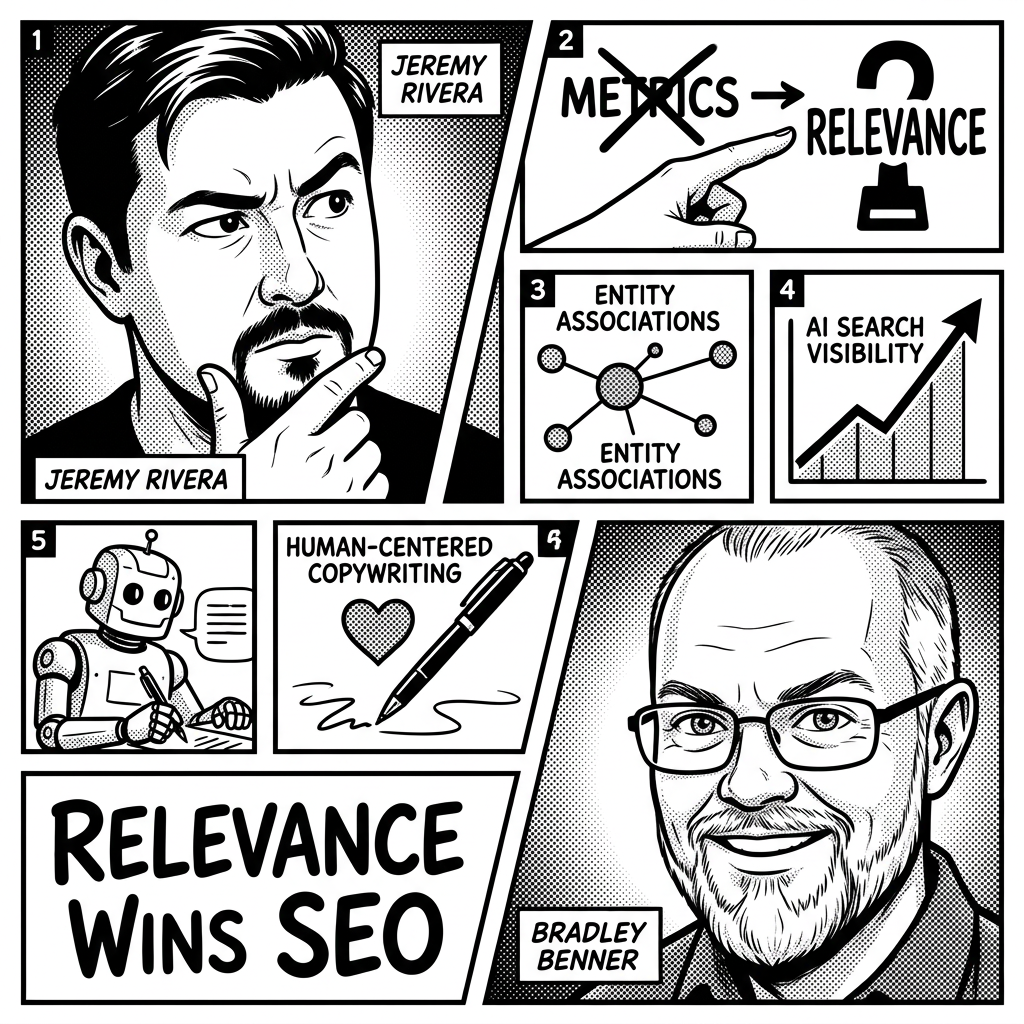
Right, but you should look at relevance first. And here's why. Because look, no longer are we pushing traditional metrics. We shouldn't be as SEOs. Right. What we should be doing is creating relevance or, and rein entity associations. Right? Or basically who, who the brand is, what products or services do they provide, in which locations or area do they provide their products or services. Those are called like our jobs as SEOs now is not about pushing metric, it should be about creating associations, strengthening those associations and helping forcing the models and the algorithms to recognize those associations.
That's our job. And here, that's why relevant links matter, because. And here's the thing, we build links. Almost 90% of every link that we place for clients are at tier one are brand anchors. Okay? Or what I call a compound anchor, which is a brand plus type of an anchor brand plus a product or service term or brand plus a LOC or area term or brand plus product or service plus location or area. Right, right.
And that's again because what are we trying to do, we're trying to create associations. When I teach local SEO, like on page optimization, I teach entity association statements, AKA a semantic triple, as the SEO title, right? Because I look at the main optimization elements of a page as kind of like six, six points really. But there's two components to one of them, and that is number one is the URL, number two is titles. But the titles includes a meta title on H1, right? Because there's a meta title, also known as SEO title. But then there's the H1, which is the page or post title. So there are two components to titles. I'll get back to that in a minute. Then there's headings which are H2s, then there's subheadings, H3s, 4s, 5s, et cetera. Then there's media and internal links. So there's really six kind of main optimization elements of a page, but there's two components to titles. And so I always recommend when, when optimizing for search, you should optimize the SEO title in a very strict semantic triple format. Entity associated. This is who we are, this is what we do. This is where we do it. Type thing. But then the h1 becomes a restatement of the entities that were referenced in the SEO title. But, and I say restatement, not repeat, you restate them using entity variants, but more of a compelling kind of like advertising copy, copywriting type headline. Like it's more for the humans. The SEO title, the meta title is for the bots, for the models, but the H1 is for the human visitor. They see and go into traditional Google search, they're going to see the blue link. It matches the queries that they're searching for. So they click it. When they land on that page, what do they see? The H1, that should be compelling and a lot more conversational, but still referencing the entities that were mentioned in the SEO title, but using variants. Right. And so my point is, if we are talking about creating these associations, which can be done via what I'm talking about always having the brand in close proximity to relevant entities, whether it's product or service entities, or location or area entities, or a combination of all of those things, that's our job, is to try to get that brand reference nearby what's relevant. So as it relates to links, back to the original question, links should be number one. I think almost every single link that should point it direct to the Money site should be a brand anchor or some variation of a brand anchor. Like I said, a compound anchor. And then it should be placed within relevant content because then now you've got an anchor text link with the brand name that is now within relevant content, meaning it's nearby entities that are related or relevant to that business and or the area that they serve.
Then if you publish that post onto a blog or site where the overall topical themes of the site are also relevant to ultimately what it's linking to, that provides a stronger signal from that entity association, if that makes sense. And then if you're looking at the backlink profiles that are already pointing to the referring domain that you're going to publish the post on that contains the contextual link to the client's asset, then you should be looking at the backlink profile to determine what is the relevance of the link profile pointing to this domain. So there's basically like three layers or levels of relevance matching that can be achieved when you're doing link building. And all of that strengthens those entity associations between the brand, products or services and the locations or area. And so I totally believe 100% wholeheartedly that third party metrics are useless. What we should be focusing on is relevance to strengthen those entity associations.
[00:18:57] Speaker A: So then the trick is because LLMs, as far as I know, and correct me if you have a citation, they're not using links like Google does for page rank purposes or for filtering and quality. Their LLM models are more interested in just the mention level and connecting the domain by association, but not deeply.
So therefore you can hit two birds with one stone by that semantic coupling that you're talking about of brand plus a service. Like, you know, if you're permacast walls, you know, you'd say hey, we're permacast walls in Florida, you know, or we're permacast walls delivering your concrete walls. Or you know, if we're your doing oxygen monitors, you know, we're pure air, your source for oxygen monitors. And that's the anchor text that you want to link because then it's also a mention. And then you, you get your hit on the LLM side and you get your link on the backlink side. Is that the.
[00:20:10] Speaker B: Yeah, because what you said about like LLMs aren't looking at PageRank link equity. That's not what they're looking at. They're links are used. That's how the models and the algorithms, the bots, that's how they crawl the web, that's how they navigate around the web. That's why I just mentioned the main optimization elements of a page. Right? URL is Always the first touch point because that's how the bots found the page to begin with. Right. So the URL is the way that I look at how language models look at links are navigation elements, but are they linked to or navigating to or from a relevant source? And if there's not, there's a disconnect like what is the purpose of this link? If there's not an association between the two properties that makes a relevant association? I mean if there's a mismatch there, then what is the purpose of that link? And so that's why like you mentioned a brand reference, that's a citation, right? A citation is a published mention, usually at least two out of four data points that we in the SEO industry would call napw. Name, address, phone number and website. A citation is a brand mention plus any one of those other data points. So Brandon, website, Brandon, phone, brand and address, something like that. And those are, that's what I consider the difference between a structured and an unstructured citation. A structured citation is going to be very strict. Name, address, phone number, with or without a website, but in a very structured format like business directory listings.
But unstructured citations are brand mentions with one of those other data points elsewhere on the web. So press releases, branded assets, brand mentions on blog posts, things like that, those all can act as unstructured citations. And that's what influences LLM or AI search visibility right now more than anything. Don't get me wrong, you can still and should still optimize on page to increase the chances of the the brand's domain or website being referenced in the AI or cited in the AI search results. But the quickest way to actually improve AI search visibility right now is through third party mentions, right? So citations a high authority, highly relevant or hyperlocal depending on what the search prompt or query is when you're query, if it's a local search query, which is what I focus on, then having brand references on hyperlocal sources can help on highly relevant sources. So topically relevant sources can help high authority properties like structured citations like all the big directories, Yelp and all those types of things, super pages, et cetera. But then also like high authority like media and press releases. Press releases work really, really good for helping to improve AI search visibility because you get brand references on high authority media and news style like freshness factor type properties that the LLMs like to cite.
[00:23:02] Speaker A: Yeah, freshness is definitely one of the primary factors I'm seeing right now in
[00:23:09] Speaker B: LLMs a hundred percent.
[00:23:12] Speaker A: So Unfortunately, I didn't book.
I think you did hit the ball though, really far out into that field of exactly the answer to that itch that I had in the back of my mind of what is it about links that we need to be worried about right now? And honestly, like, I feel kind of relieved because it's, it's a pretty solid strategy. It, it works on both folds, you know, and, and the value of, of links.
The, the arrival of LLMs almost makes link building easier to justify in the budget now.
[00:23:49] Speaker B: It does, in my opinion. And I love the fact that because language has become the forefront of our, the technology search and everything that we use, we got away from that spammy stuff that we'd been doing as when Google was the only kid on the block, we didn't have to be. All we had to do was spam stuff up to the top of the search results and it would convert because there wasn't other options. But now, as you mentioned earlier when we started this interview, because Google's no longer the only kid on the block, there are so many options for consumers to search, to use for search, that we have to focus more on not just getting exposure across all of these different surfaces, but also in the copywriting and the marketing side, the actual direct response marketing side of things, the human element side of things. And so I like that because it's almost forced us to get back to more traditional marketing and copywriting techniques and skills, but still have the technology component too, but in a lot less of a spammy way. And to be honest with you, I was never proud of some of the spammy stuff that I did as an SEO, but it worked, so I did it. But now I'm really a lot more focused on like we should be, like the structure of a page. The main optimization elements that I've described a couple of times, that should be for really for the models and for the bots. But the paragraph text between those main optimization elements should be for the human. It should be to convert the human to answer their questions. You know what I mean? So that's kind of how I teach how to optimize right now. And it's really brought us back to, I think, a much kind of more sustainable practice in this industry.
[00:25:30] Speaker A: I absolutely agree. Anybody who wants to hear a little bit more from this guy, go to his semantic mastery course. He's got a ton of videos out there on the YouTube channel and I'll make sure in the show notes his links for his semantic link service. If anybody's in SEO and needs some backup firepower executing on SEO. Go check it out. Make sure it's all linked in the show notes and on unscripted SEO.com, thanks for stopping by, Bradley.
[00:25:58] Speaker B: Appreciate you, man. See you later.