Episode Transcript
[00:00:01] Speaker A: Hello, I'm Jeremy Rivera, your unscripted SEO podcast host. I'm here with Timothy, who's going to introduce himself with a focus on his expertise, his experiences in life that have made him trustworthy in his niche and industry, which I hope he'll then elaborate on. What would you say you do here, Timothy?
[00:00:26] Speaker B: Well, I.
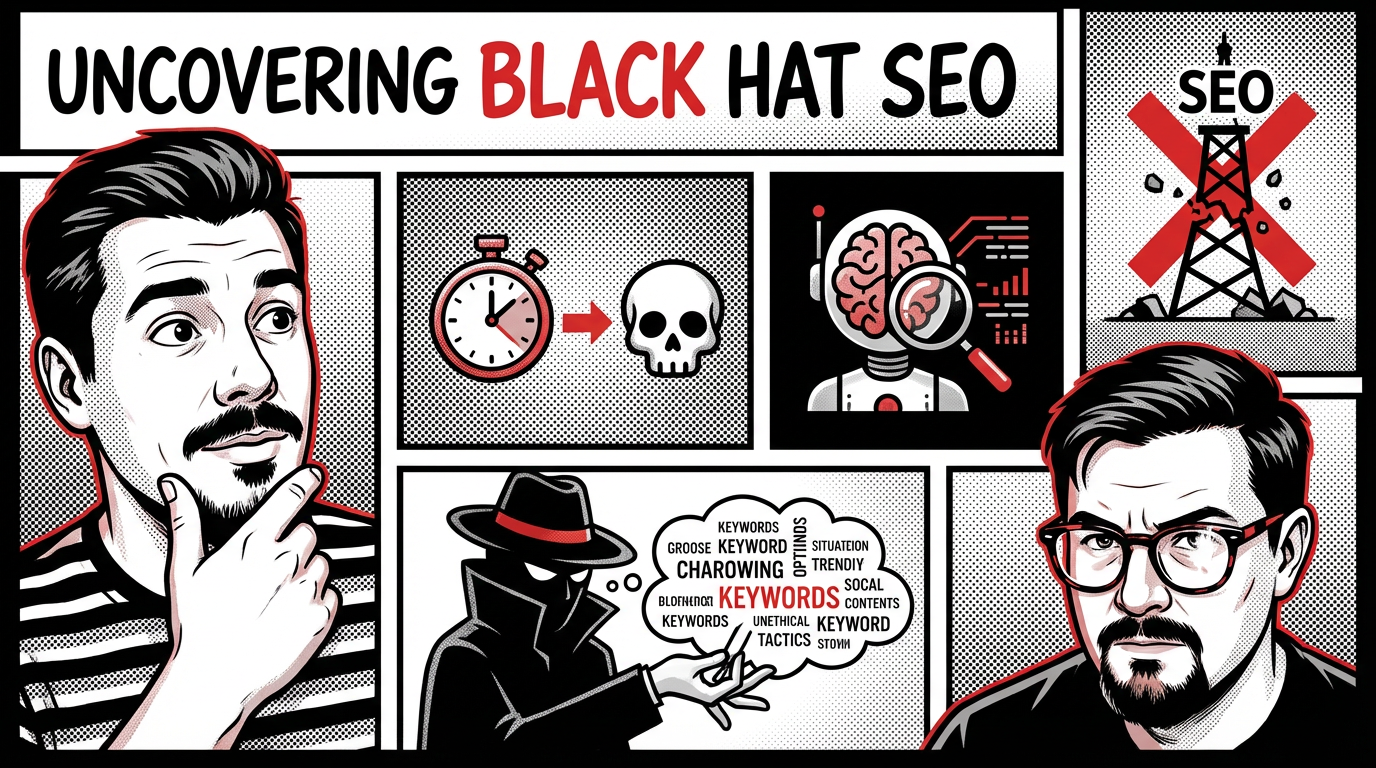
I used to do affiliation in the gambling market, but now I've since retired from that. Now I just basically discover BlackPad SEO and report on it. I basically, I really enjoy digging into how it works, so I try to decipher that through my posts on LinkedIn.
That's basically my. What I. What I do now for fun, really.
[00:00:52] Speaker A: Is there a history that you have some experience where you came in contact with a lot of those? Like, I've had close brushes and run into some very unusual and dangerous approaches to SEO that I would call Black Hat.
What is it about your previous experience that's led you to be able to uncover what is Black Hat and what does that look like now? You know, I know in 2007, when I started, it looked like, oh, you know, 500 pages with white text on a white background. But things are a little more advanced
[00:01:34] Speaker B: or more sneaky, bit more nefarious, I'd say. No, Black Hat has definitely evolved.
When I started, Black Hat was just hacking websites and putting links or using the old, you know, site counter and injecting it to the Java code. That was really effective back then.
So basically no user could see it, but Google could, and that's what mattered back then. And you could get tons of links that way. I know because I tested it.
I built like a site counter and in that was like links for gambling sites. It was a short experiment. Like, I'm not proud of it, but might as well be honest. And it worked magically until I stopped it because it seemed just unethical, really. But that was Black Hat back then. Today is way different, in my opinion, way worse.
[00:02:28] Speaker A: Can you elaborate a little bit more about what nuance or what aspect or angle of modern Black Hat is so much more dangerous?
[00:02:42] Speaker B: Okay, so, well, what I'm digging into now is basically expired domains, right? Drop domains, I call them. And so high authority old domains somebody didn't renew, let them repurpose in the gambling sites. Now, this shouldn't work, right? But there's a trick to it, and I keep calling it the canonical trick, which literally, this is the way a canonical was supposed to be used. According to John Mueller, back in 2008, he had like a little blog post that explained how it worked.
Basically you take any old high authority domain I found for the US Sweepstakes market, for instance, Carolina Partners, an old mental health clinic, and the domain still has somebody bought it or scraped it. Basically it still has the old mental health PDFs there to build trust.
And what they do is they take this domain then they bombard it with, I mean spam links that look like something out of 2002. Like it would be bad for 2002 or today. It's horrible. And just related. Anchors, sweepstakes casinos, best sweepstakes casino. All those keywords, right. To what I think build, you know, top tool relevance through links. Because in my opinion the only thing Google values is links.
Right.
Because how many times can you write about sweepstakes? How do you know which one is the best sweepstakes? Yeah, it's the same content, right? So what determines the rankings are the links.
What they then do is they canonical it to a fresh domain.
I think at this time it was like top online sweeps.us.com or some subdomain like that.
And this lasts for about a week and then the domain dies. But then you just canonical it again. A domain name costs 10 bucks. So it's infinite, an infinite loop. And it's in every market I've seen so far.
Sweden, Germany, Netherlands, Italy, every market. It's worldwide from what I can see.
And it's so effective.
I mean it's absolute spam that's ranking. And since it's everywhere, there's no solution in place, I guess because if you recall back when Google announced the site reputation abuse, they also had an expired domain add on penalty or something for the use of. So this is old stuff. This is like five, six years. But I've only seen it really pop up now because it used to be parasites everywhere, right? Yeah, Forbes and whatnot.
Now it's drop domains and it's so effective.
And whoever's buying these domains, I mean, I haven't quite figured it out yet, but I'm getting close. I feel like some domains work, some do not. Like I've seen 100 examples that do not work. But then one will work for whatever reason.
I'm not entirely sure why. Either it's roulette or there's something I'm missing.
[00:05:46] Speaker A: Perhaps if I could throw something out there. You said that it was healthcare, one of the facets. I talked to Linden Darth Na Darth Knoth on Twitter about the medic update and we were theorizing that what was the secret metric? What Was the thing that they could flip overnight to suddenly change the results across the board. And the.
The answer that came to both of our minds was distance from seed.
That, you know, no matter how good an article, if, you know, because I consulted with Dr. Josh Ax, you know, in 2014 and told him, hire Gannett writers, you know, deep relevant links, you know, cite medical journals so you can overcome that, you know, perception that you're just a chiropractor and you have talented writers.
Healthline had on the similar topic, just like three sentences on a page versus, you know, 2,000 words written by like a literal scholar referencing four different medical journals. I think it was on Turmeric was the one that we were looking at. So before Medic, you know, Josh Axe was ranking. And then overnight it flipped. And this three sentences about Turmeric on the Healthline site was suddenly the bee's knees. That's what was showing. And Dr. Axe's site dropped off.
And our theory is that it's distance from that trust source within that vertical.
So within health and wellness, obviously, if you can get links from hospitals, there's a higher level of trust within, inherent within that domain. Whereas as good as Dr. Josh, Josh Axe's content, he couldn't get medical links because of the nature of his business, you know, supplements and, you know, chiropractic, you know, while widely believed in, is not mainstream medical practice. So he wasn't getting links like Healthline was. And it flipped overnight. So it couldn't be, you know, it had to be something that was like a mainline signal. So perhaps in their quest to just, just, you know, grab these drop domains and then spam them and then try to pass that value, perhaps the ones that survive are those that had come with a close distance to that trust trusted seed, you know, maybe a link from another hospital or maybe a link from a government site just kind of gave it that trust factor.
[00:08:29] Speaker B: Yeah, for sure.
[00:08:30] Speaker A: Inherited. Perhaps that's a factor in play.
[00:08:37] Speaker B: I mean, what you're describing here is they had better links, right? Or a misunderstanding. They had more trustworthy links. Better links, stronger links, right? Yeah,
[00:08:47] Speaker A: it's links from trusted sources. And I think you can, to a certain degree, almost map. It's not a one to one thing, but if you go within any particular vertical, you kind of tend to see it. This is a factor of what Google defined as trust rank.
So behind the scenes, within verticals and niches, they would determine what are the source sites, where they're the most trusted sites. And so you could map easily in cosine relationship those sites that were truly trusted 1, 2, 3 hops at most to these secondary sites if they're legitimate entities. Like if you're, you know, delivering concrete walls, you have a certain certification, you know and you have industry licenses. And so any site that doesn't have a connection to those license sites either through one or two hops lacks that signal. But if you're closer to it then you get that signal. So it's just another. It's not just. It's quality link but not quantitative, it's qualitative based off of links from a specific subset or type of. That's been already been determined as an authority.
[00:10:07] Speaker B: Yeah, I mean it could be. But you know where I get confused is where I see other sites that don't work or drop domains that are even more powerful than this Carolina Partners that's also in like healthcare or it's an aid site that don't work.
Now I don't assume to know Google's algorithm in detail of how it finds a link trustworthy, but it would seem to me that an 8 site with links from, you know, everywhere that was a legitimate AIDS site would should rank. But it doesn't. Like for instance just the other day I found in Sweden or it was like two weeks ago an old UV armband detector thing that was an old store for an UV armband and it absolutely dominated Sweden with the new gambling Canonical. Right. But the links weren't that impressive. So I don't understand what I'm missing here. What you know, because links should be it. Right. The trustworthy links. But then I see so many examples where it just doesn't work and it's the exact same method spam it up Canonical.
So it's really interesting.
Now if I haven't seen all those examples I would totally agree with you. It has to be those impossible to get links for a gambling site. But I'm getting so many mixed signals here with the drop domains. I check that I can't give a definitive answer on it. I even saw Tori Spelling's old site was bought and turned into a crypto casino portal. But that doesn't work.
So it has a monster backlink profile if you've ever checked it.
[00:12:00] Speaker A: That's crazy.
[00:12:01] Speaker B: Yeah, anything they'll sniper anything.
Anything for rankings. Right.
[00:12:08] Speaker A: So I have seen around the edges kind of gray hat or you know, legitimate people that are trying to get links from expired domains and then stand them up and create a true current topical hub out of it. I've seen that strategy where you Know, they'll acquire a site in a vertical like home repair and then they'll, you know, restore the content but then transform it into a home repair kind of PBN style site where it has, you know, at least relevant content and then use that to link out more with a more sustainable method.
[00:12:59] Speaker B: That's really old school SEO. I used to do that. I snapped everything and I restored the sites and just to build links, right.
I must have snapped 2000 domains easy back then. But then it stopped working, right, because there was a referee. And this is the big problem here, there's no referee.
You know, Google used to have a huge anti spam team, so they would stop this like very quickly. Now it takes years and years when they're trying to automated I think.
[00:13:29] Speaker A: Do you think all of the attention's just gone over to AI, to the AI overviews and it's is that I haven't yet seen a highly publicized case of abuse of the AI overview succeeding.
Have you seen any successes in that space or.
[00:13:53] Speaker B: No, but I haven't shift like I live in Europe. We don't have that many AI overlays. And when, when we do it's, you know, it's for questions, right. It's not like a high intent, your money or life keyword.
And it's especially not prevalent in gambling where I checked.
I mean, I see. Or hardly any overlays at all.
No, I think actually ChatGPT is who ruined it for everyone with this black hat stuff. Because as soon as ChatGPT launched, Google had a competitor, a huge one, who was taking market share and they, I think flipped out about it. And now they had to really get their AI going because they were like market leaders in AI, but they weren't ready yet. And then ChatGPT launches and this is when everything collapses. In my opinion, this is when parasite starts. Because now they're automating it, right?
The entire anti spam team is just gone, I guess, or relocated. And all the resources is going for this AI stuff, which arguably they're doing really well with their AI. At least when I compare it to ChatGPT, I think it's equally good or better.
[00:15:10] Speaker A: Do you think the implementation of HCU is related to it? As in they thought, oh hey, we've got an anti programmatic SEO tool now on the spam team and we can just rely on machine learning to identify these patterns. And you know, like HCU was the reintroduction of Panda, right? You know, Panda slash Penguin. There's argument over whether it uses link signals or is actually grading how helpful your content is. I, I tend more towards it's probably a hybrid of using mostly link signals along with some content signals to actually penalize based off of a lack of brand entity.
[00:16:04] Speaker B: Uh, I mean, it's a good question, I don't think. You know, I, I was never hit by hcu, but again, it's, it's. I was doing gambling back then, right?
There's only so many ways you can write about a slot machine.
So I wasn't affected by it in that sense. But, you know, of course I read about it and how many sites it affected.
I think the only positive thing out of HCU was killing those recipe sites. You know, where you get the entire bloody life story and then you get the recipe. Just give me the recipe for us. I don't want to read that. Right. It was all for SEO, so that's the only, I guess, positive thing about it, in my opinion. But yeah, I think it's algorithmic now. They're trying to at least, but failing miserably in my opinion, when it comes to combating spam.
[00:16:57] Speaker A: I think it is.
It's funny because Google created the market, you know, by only ranking those recipe articles that added their life story. Like, I remember 2000 2010, I had a friend who, you know, she had a recipe site and she's like, I have to, I can't just put up a good recipe anymore. I can't even show myself cooking it. I have to, you know, do all of these extra steps. And then Google with HCO is. HCU is flipping it around and punishing those creators who were basically incentivized. Google created the monster and killed it. But I'm not sure that the health that the HCU and then layering on top of it, the sudden launch of AI overviews, which then turns around and consumes so much of your content and then doesn't even give you the courtesy of saying thank you, you know, not even a citation or reference that you were used in their training material.
The, the positive upside culture of, oh, hey, I can create, I can be a creative person, I can write about this stuff, I can travel the world and visit all of these, these locations. And if I write about it thoroughly, then I'll be rewarded with traffic, which then funds that.
Do you think that there's kind of a snake eating its tail moment either now or getting worse as Google now will continue to just regurgitate and there, there's less and less incentive to be a publisher. Like, I'm working with A radio site network, 50 radio station sites, and their lunch continues to be eaten.
They're putting out the news, but it's getting eaten right away. And they're getting less and less attribution.
[00:18:52] Speaker B: Oh, I mean, if you had no incentive, you're not going to do it. Right. If the AI just steals your content and regurgitates, you know, a copy, basically. And originality will die too, I think.
Right. Because there's no incentive to write. So why would you write unless it's a hobby?
Why would you produce good content if you can't even rank? Because then an AI steals it and then gives the user the answer and you don't get any credit from it. Now that's.
It's like they're killing the Internet with that, isn't it?
[00:19:27] Speaker A: Yeah, it definitely is.
Overall, a reduction in, you know, the creative potential. Because, you know, I think on some level maybe they're thinking, well, if you're a genuine enthusiast about it, then you're obsessive and you'll write about it anyways.
Maybe.
But, you know, that ignores huge swaths of fantastic, useful content that was being creative, created out of people who could then make a living doing it and doing so much more and providing so much more. But that, that cycle is just reversing on itself. I don't, I don't know how we get out of it other than the eventual paywall reality. And, you know, people start blocking AI overviews, blocking Google and just creating. Trying to find alternative ways to build audience.
[00:20:29] Speaker B: Yeah, I mean, to be fair, I find it pretty useful. Like for instance, the other day, my remote control for the TV unpaired.
And, you know, I don't want to go through Samsung's, you know, documentation. It's a nightmare. AI just summed it up for me. It worked in those cases. I see it as super helpful.
Yes.
But for all the other reasons. Yeah, not so much.
[00:20:58] Speaker A: It is hard because I cannot argue as I use Claude every single day in very large ways to execute things at a scale that would have been astronomical for the deliverables that I'm working on. And content creation just moves much more quickly. It's just kind of that balancing act of, you know, too much of this AI, you know, The public side of it, the tool side of it versus the functionality side. It does have that data pollution problem, I think. I saw a statistic at Brooks of SEO Terric mentioned it of There is, there's no good AI, non AI, polluted content since 2015.
You know, you have to go back to older style content. Because you know if you have, you have.
Jarvis was doing its early work LLM based tools, 2015, 2016.
So to truly get content that has been in no way influenced by LLMs, you have to go back to pre2015 training material of which there's only so much.
[00:22:20] Speaker B: Yeah, it was like Jarvis was writing well back in 2015.
[00:22:27] Speaker A: Yeah, I used, yeah I used Jarvis in 2015 and that was pretty late in the game actually.
Early LLM tools, you know, upgraded from Content Spinners 2008, 2009 early LLMs 201120 to 2013. But I remember clearly using you know, Jarvis in 2015 before they had to rebrand to Jasper because of the success of the Iron man movie.
So that's how old it is. But
[00:23:07] Speaker B: yeah, like I never used it. I'm old school I guess.
Like at most I'll use AI to just okay, check for grammar errors, make add a joke here and there and then I still rewrite it afterwards.
Tell me, how do you feel about large media organizations moving forward with using AI content editor? So to say you have some human oversight, but most of the content is written by AI and they just fire all the writers because that's the trend I'm seeing now. Because it's cheaper, right? And it's faster. Yeah, but you get the same bland like have you seen ChatGPT? There are like certain keywords you know instantly. This is by AI. It's quietly, it's brutal. You know those keywords. It's always AI who uses those keywords.
[00:24:02] Speaker A: I have seen that. I know indeed transitioned away from hiring live human writers first in their foreign markets and then moving over to the American market.
They went almost entirely AI powered with minimal human human editing.
So I'm keeping an eye in the tab on on that and I know of several other large, large organizations, some of which have already started crashing. I know I was keeping tabs on some of the big programmatic SEO bros two or three two years ago who you know, went all in on replacing any content creation with just creating mass content through ChatGPT with almost no editorship. It does seem, at least in the past three months there seems to be of updates from Google where they're starting to slap some some more things down for mass AI content strategies.
Lily Ray is always a good go to to keep keep your your fingers on the pulse for that.
I think there was an unnamed update two or three weeks ago that seems to have hit a number of sites that were just, you know, AI slop. We could Call it.
[00:25:35] Speaker B: Were those algorithmic kits or manual?
[00:25:39] Speaker A: They appear to be algorithmic hits, but it's good. It's harder to, you know, it is hard to say if they went in at the same time and hit, but it is, it's a. So anytime that that happens, you do have that. You know, maybe they hit some sites manually to make it seem more effective. Google's really good at that fud, you know, stomping around and make a big noise about something they don't like to scare the more reasonable citizens out of out of particular behaviors. They did it with family.
[00:26:16] Speaker B: They said that about parasites back in 2020 and drop domain. I think it was 2020. It's as far back as then and AI content at scale. But we still see it, don't we?
[00:26:26] Speaker A: Yes, yes.
[00:26:27] Speaker B: I'm actually seeing now that parasites are like slowly dying. It's very interesting.
They're not getting the strength they used to. So maybe something happened there. I mean, What's the word I'm looking for here?
Assume you're in a prison and you have to supervise the entire web and manage it. I mean, what a monumental task.
So either you automate it and you know, successfully or you have to hire like you know, 10,000 people to manually check it. It must be monumental. Which is maybe why it took six years to finally crack down on parasite SEO.
This canonical trick, I'm fully expecting it to disappear in five to six years.
Probably hopefully sooner. I mean it is just spam.
[00:27:24] Speaker A: So are there any other tactics that you've seen in the black hat arena that are new and unusual or is it pretty much old?
[00:27:38] Speaker B: No, I mean the parasite is old school, right. It used to work ages ago and then it stopped working because there were managing it Google and then it started working again. Canonicals were never as powerful as they are today. This is old school stuff again.
And then you have, you know, through the Google leak it became clear that they use the click metrics, right?
[00:28:00] Speaker A: Yes.
[00:28:01] Speaker B: So that I think is plays a huge part of why canonicals work. But I can't really prove it right. Without getting analytics to the sites which are not going to give me.
So using spam bots with VPNs, I actually researched it a bit. You can hire like you can rent a box of Android phones. It's just the motherboard, right. And they're each connected to a VPN and you can manage it from home. You can just send bots to go through the search results, click on your site and increase bounce rate.
And it's not that expensive either.
[00:28:37] Speaker A: So I had seen that and had a friend who was curious about its long term efficacy.
I saw some posts on a local forum of a couple guys that went hard on it and got burned. So I think there's probably a ceiling of. Yeah, there is because if you suddenly drop off that level of clicks then that seems to trigger. So then you're invested in always having a minimum of fake bot traffic.
So you gotta kind of keep up appearances. So at some point that's going turn on your natural business.
[00:29:20] Speaker B: Yeah, I mean what you're basically doing is you're faking branding, right?
[00:29:25] Speaker A: Yeah.
[00:29:26] Speaker B: So I remember I used to do SEO in Sweden for gaming and there was a casino site that was on every TV channel like Massive Brand, it was called Ninja Casino and their backlink profile was terrible. But because of all the branding they did, I think they just got so many brand visits and they just pushed them up to like position one or two casino and then they ran into some legal trouble when Sweden regulated and they dropped off a cliff.
Completely gone.
So I think this bot traffic, this is what it's simulating. Right.
Real use until you get caught. I think Google is getting pretty good at finding bots because PPC ads kind of demands it. If there's no value for the advertisers, there's no value for Google and we try to kill it.
[00:30:20] Speaker A: I think what's interesting on the bot side of things, I wonder if you have an opinion on this but you know, about a year ago Google updated and removed the ability for rank tracking tools to show 100 pages of results at a time.
And the impressions on all of my client sites reduced and across the industry we lost all of those impressions because they were being inflated by visits by, by our famous, our friends at Ahrefs Semrush and you know, every son of mother who wants to track rankings
[00:31:00] Speaker B: don't know why they did that. It could be because of clickbots. It could also be to stop other AI programs scraping their search results right there for instances.
Either way is possible. Right, but if it really was clickbots then why didn't they do it sooner? That's my question.
I mean it certainly wasn't to stop rank trackers, right?
[00:31:24] Speaker A: No, I think they were willing to accept the bloating and accept the extra cost of serving those results.
But once Anthropic made clear that they were going continue to scrape, you know, they didn't want to directly feed their competitors, which they are still now like honestly Claude and GPT and even Grok are in some ways just fancy wrappers for Google results.
[00:31:55] Speaker B: Yeah, agree.
Yeah.
Well, I guess Google uses Reddit too, for some reason, but yeah, yeah. Jesus. Have you. Yeah, no, I stay away from Reddit. I don't like it. It's more a us thing.
[00:32:09] Speaker A: I think it's pretty popular here and I was just shared, you know, a link to a company that will astroturf using VPNs and aged profiles, fake popularity on Reddit for you, for, you know, to get you mentions and. Or links from. From Reddit.
So anytime Google shows favor to a particular area, you can expect eventually somebody tries to figure out a workaround to astroturf those real signals.
[00:32:46] Speaker B: I think once Google has had enough of that partnership, it will slowly die to where it was at least. I mean, Google had a partnership with Twitter too, back in the day and it surged as well. Was a lot of drama about it, I think I remember. But then they stopped the partnership and so it settled down to where it was. So with that said, I think Google is inflating, ready more users, more data for the AI race. We have to win, right?
[00:33:17] Speaker A: Yes.
[00:33:17] Speaker B: I mean that AI race is just inflating stock values. Like, expect a crash, man.
Even with the semiconductors, it's not paying dividends yet. Have you seen OpenAI's costs and what they actually pull there?
That's not sustainable.
It's.
[00:33:39] Speaker A: It's an interesting time knowing on the back end, the marketing and knowing better what these actual tools can really deliver as far as value. And then seeing 5, 6, 7, $8 billion valuations, it's like, why would you ever valuate, you know, semrush as high as they did when it came out. Like, it just like it's a good tool, but just doing an IPO and oh, it has this much value. I don't know why people sign up to do that when they know that eventually, like you can't defy gravity forever. You can't. There's. There's only one GameStop, you know, like, he can't be a meme stock forever.
[00:34:26] Speaker B: Yeah, Yeah. I haven't really followed so much, to be honest. Is. It's not going well, is it?
[00:34:33] Speaker A: It's come down a lot. Yeah. And I expected that because anytime that you go public, the expectations of shareholders is equally or more brutal than private equity.
Moz got bought out by private equity mid 2000 teens and they drove it into the ground. They murdered one of the more successful SEO SaaS, companies with a brilliant reputation. Rand had done so much hard work to build it up and they, the equity partners just kept demanding more and more profitability, more and more profitability. And that came at the cost of their entire business model. Now people don't even think of.
People don't Even think of SEOmoz anymore as an SEO tool or anything in the SEO industry.
[00:35:25] Speaker B: I guess not.
So I guess we'll just expect awards to get bought up soon and IPO'd as well and follow the same path.
[00:35:34] Speaker A: I've talked to Tim Sulo at a couple of conferences.
I'm confident that he has seen those lessons and will not be taking it ipo. I think he's in it for the long term for himself to stay.
So I'm hoping that that continues to be true because, uh, like I said, you know, either private equity or going public just creates these distorting pressures on software companies that.
[00:36:06] Speaker B: Yeah, yeah. Like look at Google.
[00:36:10] Speaker A: Don't be evil. Oh yeah, gotta get rid of that.
[00:36:13] Speaker B: Yeah, don't be evil. Right. Remember when they said just write great content? Wasn't that fun?
[00:36:19] Speaker A: Just write great content so that we can see.
[00:36:25] Speaker B: Yeah. I mean there's no the way to train an AI, is there? Of course, you go to the source of all human knowledge.
I mean the Internet.
With that said, I don't think AI is bad. I use it a lot for menial tasks.
Like, you know, I have a huge document or you know, summarize this for me maybe because I don't want to spend four years reading a thousand pages and they, they do get it wrong sometimes, but you get the gist of it. And for that it's really helpful when I used to, when you, you order drop domains, for example. Okay.
So you get a huge list of coming domains. Okay, so sort them by this. This. That is super helpful if you're using it like menial tasks like that and also, you know, even for writing, but in the sense that just grammar check it or something because spell check on word is iffy, I would say.
Yeah, so that's where I use it to. Even for my post I have chatgpt. Just go through it, check it or any inconsistencies because I can ramble on sometimes and you know, maybe correct them and show me where you corrected them and then usually I just rewrite them again.
[00:37:44] Speaker A: So yeah, I using it. I've found the phrase as a strict editor is usually the best bet. And then also tell it, hey, tell me what you're going to change, what you think I should change before.
Before. Because I have, I do a lot of cleanups of the transcripts of conversations that I have with SEOs.
And I realized if I'm not careful with how I prompt invented, I did one recap and it made up a whole section of like total stuff that we never actually said. So you have to be very mindful. Yeah.
[00:38:24] Speaker B: Double check it.
Oh, interesting.
Well, you know, the num. Hundred thing, I didn't even know that was a thing before the news came out. Like, I didn't use that. I manually checked and if you're not, you're nowhere.
[00:38:43] Speaker A: Anyway, so, yeah, so that was always the interesting thing about, you know, rank tracking because I worked at Raven Tools, competitor to Moz, and so, you know, I was in on the negotiations with several different data vendors providing rank tracking data.
And you know, the scale at which they were sending bots to Google was always mind blowing to me as I'm purchasing this data and paying them, you know, negotiating over, you know, 0.0007 cents for each tracked keyword for each search engine.
And you know, it, it's a pretty, pretty challenging industry to be a data vendor for because Google's constantly, you know, trying to keep you out, you know, trying to, you know, keep bots from scraping. So they have to have regular protocols to swap that around. Raven Tools used to do it in house.
They helped create a second company, Authority Labs, which continued that business on separately from Raven Tools. Um, so knowing all of that, I wasn't surprised personally, I was just surprised that Google finally did anything to actually counter the bot, counter the amount of scraping. But in the context it made sense because, you know, Anthropic and others had just upped their game and started crawling the shit out of their SERPs.
[00:40:20] Speaker B: Server costs, right, exactly, server cost, yeah.
Yeah.
[00:40:27] Speaker A: Well, I appreciate all your time. I love a good organic conversation and there aren't too many folks that are focused either on Black Hat or on the link side of things. So I appreciate your unique input.
Shout out again if you have a company or if you have a LinkedIn profile, I can add it to the show notes.
People can see where you're publishing your articles and information.
[00:40:51] Speaker B: For sure.
Absolutely. Yeah. Sounds good. I could talk about Black Hat for years. Honestly, whatever works. You see it in gambling first because that's where the money is, right?
So usually I'll see the latest Black Hat, if I can explain it, pop up there first.
The more lucrative it is, the shadier it gets. Basically.
[00:41:19] Speaker A: That's the unfortunate side of humanity, right?
Where the money is, the scoundrels go.
[00:41:27] Speaker B: Yeah, I was part of that industry for many, many years, but I did more gray hat SEO, so. But yeah, thanks so much for having me. It's been a pleasure.
[00:41:39] Speaker A: Thank you, sir.