Episode Transcript
[00:00:00] Speaker A: Hello, I'm Jeremy Rivera, your unscripted Batman.
I just read this today that if you tell yourself or tell somebody that you're going to do your task as Batman, you do it more effectively.
So I'm going to be the Batman of unscripted SEO podcast post today. My name is Jeremy Rivera, and I'm here with Mike Montague.
[00:00:28] Speaker B: You go with Iron Man.
[00:00:29] Speaker A: Ooh. Okay. Okay.
What's your preference? There is a personality. Is it a cinematic universe or just, like, a less tragic backstory?
[00:00:40] Speaker B: All of the above, really. I mean, who doesn't want to be a charismatic billionaire with a bunch of cool toys who's a genius? But also, for my business with using AI for marketing, I take the Iron man approach rather than the Terminator approach. So those of you that don't know those analogies, uh, Jeremy seems like his nerd qualifications are up to date, so he does. But like, the.
The Iron. The Terminator approach is, like, building, you know, AI agent robots to go out and, like, you know, kill your leads and bring them back to you. And the Ironman approach is how do we wrap ourselves in technology, get Jarvis AI in our ear, giving us some insights we didn't already know, and like going out and turning ourselves into superheroes with AI. So that's what I'm all about.
[00:01:28] Speaker A: So your brand is. It's Avenue 9. Is it Avenue9.com or AI?
[00:01:35] Speaker B: I own both, but, yeah, dot com is the primary to me.
[00:01:39] Speaker A: See, there you go with the Ironman. The old school.com versus the AI coming back.
What are you finding is the main pain point that you're solving with the service that you're bringing to market? Because, you know, Claude claims to solve all your ills, so why do we need you as a human to step in between the magical solution in Wonderland that is GPT and the man.
[00:02:10] Speaker B: You just triggered, like, three major thoughts in my head. I'll start with the pain point part, which is AI is so big that, like, no one person can keep track of everything that's going on with it, especially a busy small business owner who is not in technology or marketing like us. So the other problem is marketing is so big that, like, no one person can know everything there is to know. You can't be an expert in SEO and social and content marketing and inbound and, oh, by the way, direct mail and other, like, there's just. It's too much. So I try to, like, bridge the gaps here for both of those in a way that, like, small business owners can get their head around. Like I heard I can use AI for my business or I could just ask Claude, but it's going to ask me to like, you know, set up an integration or do something technology wise that I don't know how to do as a, you know, an attorney or an accountant or, or something. And then the other side of that is like the marketing strategy, which, which is point number two you triggered in my head, which is right now, I don't know. You can disagree with me. I think that like AI is getting a really good C in everything, but it screws with people's minds because if you don't know a subject, if you ask it something, a class you would fail in, you go, AI is a genius. It knows more about whatever accounting than I do or it knows more about SEO than I do, but it doesn't know more about SEO than Jeremy does.
It's getting a C minus and Jeremy can get an A plus. And so really I think that's why you would hire me as a human is I know my industry, I know AI and marketing better than you do, which means I can tell when AI is hallucinating or it's a bad advice or it's just a C grade, which is not bad. If you completely suck at SEO and you've never done it before.
Getting a C by asking Claude what to do and applying the things, not bad.
That's a pretty good afternoon's worth of work. But it's not going to get you to where you want to go either.
[00:04:21] Speaker A: I think I'm going to coin the phrase because I forgot what the other phrase was from the video that I'm referencing. But I'm going to call it clod hopping. Where you get an email from your client and they send you 20 downloads like of 40 pages each and they're like, I have solved this. I need you to read every single page of this output right now. And as the subject matter expert, you're like, this is all pretty mid, like super obvious conclusions, just huge amount of volume.
[00:04:58] Speaker B: You know, there's a hundred pages document from one of my clients about their, their marketing plan and you're like, there
[00:05:07] Speaker A: ain't no way you wrote that yourself. You put in 5 Pro.
[00:05:10] Speaker B: Fully admitted, but, but they just assume that Claude is smarter than we are, which I think is the, the problem. It's not bad. Like I said, a C is a really good grade.
The problem is that other 20% is the hard part. That's what we needed humans always to do. It's the emotional awareness that kind of context, the, like, storytelling of your business, the heart and the nuance and knowing when to break the rules and all the other stuff that, like, is the hard part. That's the work. We, we didn't really need an AI to cover the easy parts. We had interns and other people to do that for us.
[00:05:52] Speaker A: It. It does occur to me. It's like the intractable SEO problem of, hey, now I can publish a ton of content.
Um, AI is great for that. But if we're honest with ourselves, we were just hiring Philippine workers and Colombian writers and overseas writers to do our writing at scale before, so it's not really that. That much better. It's okay. But it isn't going to win a Pulitzer Prize.
[00:06:21] Speaker B: Right. That's the big difference. And I'm with you. I mean, that still saved me hundreds of dollars a month on my podcast production. And yeah, and instead of waiting overnight for the them to the Philippines while I sleep and having it the next day, now I can have it in 15 minutes.
The time turnaround is great. The quality is about the same, in some cases a little better, some cases a little worse.
But I don't have to necessarily pay for repeats and stuff. But you're right.
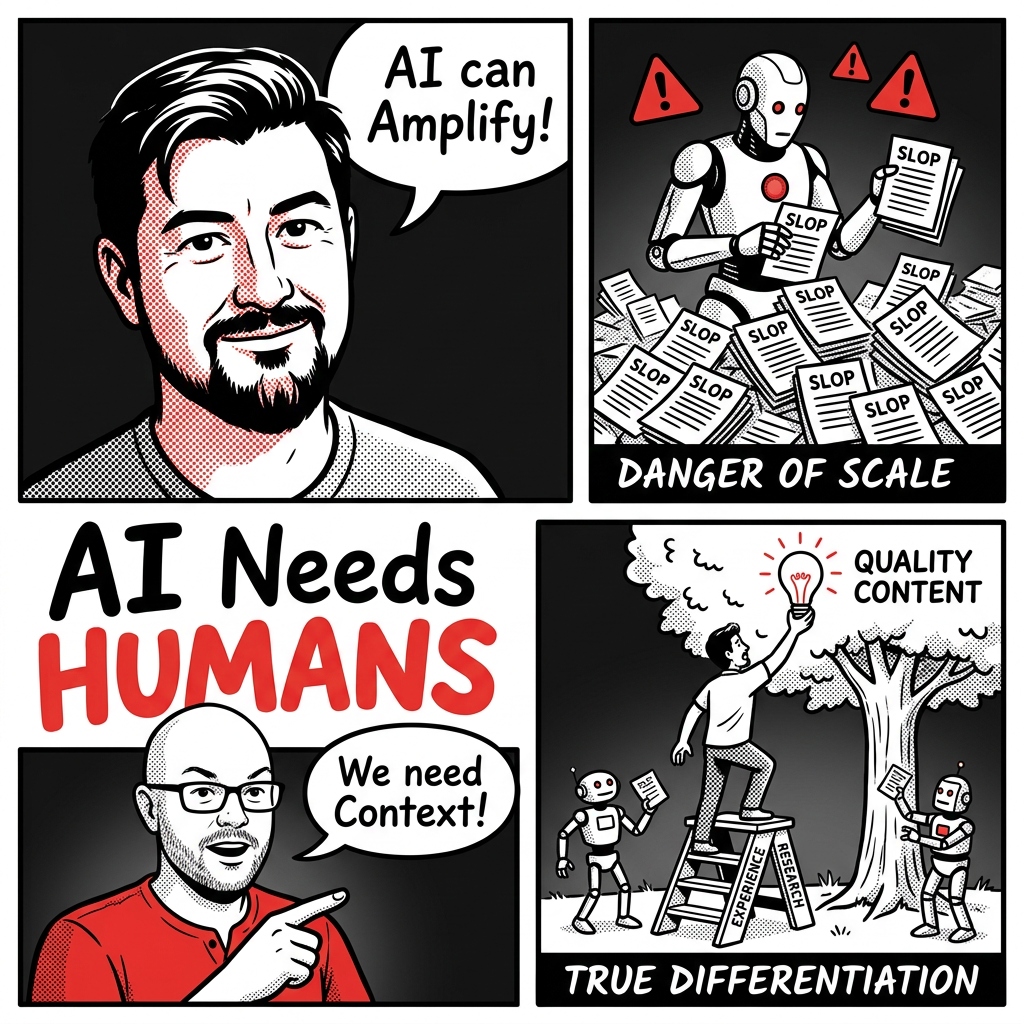
Another way I describe it is it's kind of an amplifier for what you're already doing, and it's definitely an echo chamber for your thoughts. But if you have bad SEO strategy or bad marketing strategy, it's going to allow you to do it faster.
[00:07:06] Speaker A: Yeah.
[00:07:07] Speaker B: Which is just going to get you to fail faster.
It's not going to switch bad strategy to good strategy for you.
[00:07:15] Speaker A: I'm curious, have you found it? It's helped any. All in your boring niches of helping things come forward because, like, oh, you install concrete walls. That's exciting.
Um, you know, certainly not a lot of sex appeal, but is it helpful to. To have, you know.
[00:07:36] Speaker B: Oh, my God, yes.
I did SEO blogging for a garage door company for three years.
There are like three interesting garage door stories. I used those up the first month and then had to. Had to keep going for. For three more years. I feel like that project and those types of projects now are a lot more.
And you can get a lot more nuanced because I can instantly get a C grade in any subject. So where I have an IT client now, and I was just posting a blog about cybersecurity details and processes and stuff that I don't know anything about.
I can at least speak the language now and understand the basics much faster to get up to speed and then I can have them review for accuracy and expert level details. And that's one of the things I do at my company is I'll interview the, the founder, the top salesperson, best client or whatever, and then turn that into the marketing material so that I already have their context and expertise built in. Sort of like you do with the, the podcast here.
But the, to me it makes it a lot more interesting because there's other angles and I don't actually have to go learn that much about garage doors if you care. Jeremy. Sidebar. It's security. You can break into a garage door just by like sticking a coat hanger through and then pulling the little release lever and you can open it up. It's one of the biggest security breaches in any home.
Turbo peel is one. And then like safety of it like falling on kids and stuff.
[00:09:17] Speaker A: Well, not falling on kids, but getting ganked by the springs and pets.
[00:09:22] Speaker B: Yeah, and the springs breaking and stuff. So it's like safety, security and curb appeal. That's it.
On repeat for 36 months.
[00:09:34] Speaker A: That, that brings me to an interesting question, which is how many plumbers do we actually need to write articles on how to fix leaky faucets?
[00:09:51] Speaker B: I mean now search and discovery is so good we probably only need one.
Right, but how it.
[00:10:00] Speaker A: So does that mean we no longer have that, that aspect to rely on of, hey, we can put out top of funnel content and you know, it ranks and then gets traffic. Well, the CTR for cite being cited in AI overviews is abysmal. Abysmal. I'm not sure if it's actually results
[00:10:25] Speaker B: is, is down what, like 50 to 80%?
[00:10:28] Speaker A: Yeah, I just saw, I think Lily Ray put out an article or it might have been Cyrus. I think it was Cyrus Shepard. He put out a study following these big blogs and there was an 80% traffic loss for, for most of them there was like 20% of the cohort did gain traffic, but 80% lost 80% of the traffic overall.
Which is terrifying.
[00:11:00] Speaker B: Significant and terrifying. Yeah. I think there are some strategies and ways out of this.
The problem is I think it's splitting into two really distinct camps.
One is you gotta be that winner. If AI is only going to recommend one company, you've got to be the one company. And you're going to have to get your stuff everywhere. It's like SEO on steroids. Right? Like we need a thousand blogs and a thousand different places, not just on our site, but like be the thing people think of when they think of plumbing. And you could Win that race. The other one though, which is the path that I try and go down, is like the old school stuff, the branding, the storytelling, the interesting personality. You can be memorable to AI and to humans at the same time by starting small, starting local and building back up.
Not trying to play that race of like winning the lottery, but winning and deserving the attention of a small targeted group of people, which is just really good SEO and marketing, it always has been. But it's even more important, like the hacks are done because there's no traffic to be hacked.
[00:12:20] Speaker A: So it's almost more playing more of a business consultant role and plugging yourself further in. You know, I was talking to Patrick Stocks, like, you can't have enough SEOs on the payroll now to change the opinion of the Internet. So the most effective way to improve the opinion of your company online is to fix the problem that people are complaining about.
And you know, with most small businesses it's fairly easy.
Put your frickin number at the top of your stupid website, put your reviews, tell us, tell me what it is that you can and can't do and tell me how much it's going to cost me. Like the bottom of the funnel. Basic stuff that should have been on websites since they were invented, but for some reason it's really difficult to comprehend. Like, hey, we should have.
[00:13:10] Speaker B: I think the step up from that is the trust metrics and things too. So I'd plus one yours and say, like, if you want a better reputation, go get better reviews. Go make sure every single happy customer gets documented with a blog or a review on a site or a featured case study. Any good conversation you have, like capture real human quotes, real human stories, and just document every job. We have AI now, you don't need to make up SEO content when you have conversations and jobs and content and products being sold every single day. But you can't afford to miss one anymore. You can't just go, oh well, this is a good representative case study of what we can do. That's like a drop in the ocean. Now I think you really have to say AI and humans, like we're doing this a hundred times a day and here's 100 case studies, uh, based on every single one. If you're gonna go down that, what are your thoughts there?
[00:14:12] Speaker A: Well, I was thinking about what I've been doing with podcasting. Like I have 120 interviews with SEOs. So I literally had the idea two days ago. I'm like, I have the domain human certified content, you know, human-certifiedcontent.com you know what, I'm just going to throw it up there and throw it out there of like, I'm going to do SEO content based off of those conversations.
So if you want SEO articles as an SEO agency owner to be published on your site, like, come to me, I'll give you that service. I'm like, I'm going to turn these human conversations because I had plenty of interviews where like, you know, it's not hard for AI to come up with a bullet list, but AI will never have that anecdote of having messed up somebody's GSE deployment or their Google my business page, Google. You know, GPT isn't going to tell you about the mistakes that it's made because it, it is a, it is a amnesiac parrot, right?
[00:15:16] Speaker B: It's, it doesn't care and it never really gets the feedback on whether those ideas worked or, or not. Which is another inherent problem to all of that along with the, the echo chamber. But I, I love where you're going there, which is there's other, I think really powerful ways to make some noise in the market today, which is original research. Like AI needs human conversations, documentation and transcripts of real human conversations. It also needs original research at this point. You and I have Both interviewed over 100 people with quality, like quality interviews and the quantitative approach that we can now then roll up into research reports and other original stuff that can then be cited and be more interesting than just like, this is what some random dude in Massachusetts said.
It's like, no, this is What a hundred AI marketing people or 100 SEOs said about this.
[00:16:16] Speaker A: Quantity has a quality all of its own.
[00:16:20] Speaker B: Yeah, there you go.
That works. Anything else you've seen working while I got you on here and we're talking about it?
I think those are the big two for me. Or like conversations and original research and trying to make really good, original stuff.
[00:16:37] Speaker A: Really good original stuff. Gotta have a human in the, in the circuit. But what is, what I think is really having a good heyday is good cross pollination of irl.
So holding that trash clean up, going to your entrepreneur center and offering, hey, I'm going do a seminar. You know, I do home construction. I'm going put out in a class. Anybody can come and learn top five housing improvement mistakes or you know, handyman tips for the day.
You know, I talked to a roofer and they were doing, you know, they brought a trailer to the local park and would display movies for free. You know, and the trailer's Got their branding on it.
So cross pollinating and then echoing. This is important folks, making sure that what you do online is through the looking glass and represented. Because what's Ms. Rob Bonham, I just interviewed him. He's like, I worked with a company and they did all kinds of charitable things but it never came out, you know, and you have to take the time. It's not self aggrandizement for a business, it's is further helping the community because you're encouraging other businesses to do likewise and you're also helping people understand your mission. You know, it's that Tom's main type effect of like hey, if you have, if you can contribute to social good, you don't have to set it up as its own independent nonprofit. You can.
But there's plenty of people that are trying to do good and they would love to, you know, medium, small, tiny business to come along and you know, sponsor an event or you know, take care of a small piece of, of the marketing problem or contribute trash cans for whatever. You know, like the, the day of us SEOs sitting back and pulling up Ahrefs and finding five articles to write. Sorry, those days are gone.
[00:18:52] Speaker B: Yeah, I agree. And that's where I was going earlier with like the customer reviews and case studies is like, I think the goal should be that your online reputation exactly 100% mirrors your in real life work. Like you're saying there, if you give to charity, that should be documented online. If you do a hundred jobs, a hundred jobs should be documented online. And those like as much context as you can give out there. Because I think SEO has always been erroneous a little bit in that it's like trying to get an outsized rank for your company.
And really I think we need to get like the reputation and the traffic that we deserve.
[00:19:37] Speaker A: Right.
[00:19:38] Speaker B: You know, you can't just post like best plumber in Nashville. And if you're brand new, what, what evidence of there is that like the AI is going to figure it out. Google's going to figure it out. They have way more people and money to figure this out than you. It's not just going to scrape your website and take your word for it. It's like the best cup of coffee in New York or whatever or the best pizza slice. Like there's a million people claiming that. But if you can show that you have the highest number of reviews and the highest overall rating and you're literally doing the most plumbing jobs with the best reviews in Nashville, it will pick that up. It will Give you the rating that you deserve. And I think that's, that's a struggle for small businesses to get their head around. Is that what you really want to do is be as authentic and transparent as possible and earn your reputation with old school stuff by getting out there in real life, Earn the pr, do something good, do some great projects and then talk about that.
[00:20:37] Speaker A: I think, I think a lot of businesses miss opportunities for cross pollination. Like if you're, you know, an oxygen monitor manufacturer, those go out to a ton of different types of companies.
You could do, you know, you could put out, you know, an industry magazine for that niche or you could, you know, provide training or awareness that supports them, push their marketing. Like being a support to the people that are, that, you know, if you're in the B2B space, making the play of boosting anybody that does business with you and other channels makes it so much more likely for them to come back to you if they have that secondary reason of like, oh yeah, pure air. You know, they, they did a marketing piece on my, on my boss. Like that's shareable content. There's.
[00:21:32] Speaker B: And it also boosts your. Yeah, your reputation in pr. You reminded me that I used to work for a large international sales training company. And you think like you were saying earlier with sexy businesses, like sales training is not inherently sexy. But we did sales training for some of the largest companies in the world like Uber and Thermo Fisher Scientific and things like that. But we also did a charity in Africa that were like trying to stop human trafficking. And we taught questioning skills and interview skills to border crossing agents to like literally save the lives of young women in Africa.
That's a kick ass story. Or we did sales training for a girl who set the world record for the most Girl Scout cookies ever sold and she went through that. We did sales training for a guy who used a training tactic that we teach in the finals of Survivor to win the million dollars and win votes on the last thing. Like those are incredible stories. Nobody cares about sales training. But I think if you think about your business like that and getting into the impact, like those are the impacts that you deserve and the stories that need to be told.
[00:22:47] Speaker A: I think another thing that it's actually easier and we'll go easier and then we'll go harder. In the AI age, it's easier because you can actually more simply put out there and train your least trained customer support representative. As my friend at SEO Tarek, Matt Brooks says, you know, you got a terrible customer service representative running out There you got five of them. You got Claude, you got GPT, copilot, Gemini. They're out there and they barely know anything about you, and they're scraping the bottom of the peril. You haven't given them any training, any instruction. Your about page is like three lines.
What would you say you do here? Test is failed.
[00:23:30] Speaker B: Yeah, 100%. I think there's a lot of room. And what I hope people are getting out of this is that instead of trying to say, hey, how do I make more slop? Can I use ChatGPT to generate a bunch of new SEO content for me? I call it degenerative engineering. How can I take AI and use it to distill down what I'm really about, like, capture all of this information that's already happening around my business and then turn that into concentrated orange juice? Like this really powerful, strong story that I can then teach other people to talk about the business. And I feel like most people are just working on the wrong end of the problem. They're trying to compete with more slop versus, like, hey, help me distill all of the slop and get out the good stuff that's in there.
[00:24:24] Speaker A: I'm curious if you've spotted any other silver linings of, you know, the intense outcome and focus of AI. Like, you know, people were super concerned and complaining about, oh, we have all these data centers sucking off of our grid. Well, you know, Chevron just launched, you know, Project Kilby, which is natural gas turbine off of the grid. Well, so the pressure of the system often solves itself. Are there other silver linings that you've seen that have evolved out of, you know, the capabilities that LLMs and AI tools have brought to the market?
[00:25:01] Speaker B: I really hope so. I continue to be on this mission, and that's why my podcast for the human First, AI marketing is really preaching this message of, like, we could use this tool to do better marketing. We don't need to do it.
Use it to make worse stuff. We are already overloaded with that. But I think it actually breaks the system then, like, if there are more YouTube videos being uploaded to YouTube than a human could watch in a day, like, it doesn't. It doesn't make sense. We don't need more noise in the system. And so I think it finally broke those old models. So I'm hoping that things flip back over. And I heard Gary Vee talk about it last week where he said, like, grandpa shit. Like, you got to go shake some hands. You got to go meet some people. You got to go think about PR and those campaigns that you were doing. And, and what are some media ways to advertise or bring back direct mail? Like nobody's creating and spending the money to actually reach out to someone with a real message in real life. Or what about lumpy mail and promotional products and stuff? I feel like there's a huge opportunity for really old school great marketing and sales that has always worked. It was just getting drowned out for a while. And the hype machine kind of overwhelmed the noise and the drumbeat for good marketing. So I hope that shakes out. What, do you think it's possible? I do. Or do you think it's just more of an avalanche of slop and we're all just wasting.
[00:26:41] Speaker A: I want to fight against it. I have, you know, I, I have thought for a while that as a channel, direct mail can be a superpower. And I tested it out when I was at Raven Tools. I actually sent, I looked up at an agency, what their address was and sent a handwritten letter as a ploy to get a link. And everybody that I sent a letter to, like a hand wrote the URL, hey, I'm trying to gather opinions and see if old school ways are better. Give me your opinion to get added to my article and I'll give you a graphic to post on your site. And so I had that mechanism to build links and, and I got 10 links for Raven tools by writing 10 letters.
[00:27:31] Speaker B: I mean, really 10 for 10?
[00:27:33] Speaker A: 10 for 10?
[00:27:34] Speaker B: Yeah. I think that's amazing. And I think some of this AI stuff, people are just, they're lazy and they're not creative enough that because they think like AI could write a book for them, they think that they're going to write a book about some topic, throw it up on Amazon and become a bestseller, which is not going to happen. There's too much noise. Everybody is writing a book. Anybody could do it this afternoon, have a book up on Kindle. But what if you used Amazon to print 10 copies of those and then like you said, hand wrote a sticky note and said, hey, Bill, I think chapter three would be extremely relevant to your business. And you mailed that to one of your prospects or client, they're going to open that up, they're going to look at chapter three like it's going to go really high percentages, like 80% plus. Because nobody gets a printed book in the mail, nobody gets a handwritten note, and nobody understands their business well enough to actually write them a personal message or to know which chapter is relevant. And so Everybody else is sending another LinkedIn DM, another message that goes to spam, saying, hey, Bill, I noticed your press release on this and can I get 15 minutes on your calendar? That's not going to work. Yeah, but we can go old school. We can get creative and use AI to make some cool stuff.
[00:29:00] Speaker A: I agree. And it comes from the question Rob Bonnen I asked, I'll give you a chance to do this too, of asking, what's your head scratcher? What's a challenge you're facing? And ask it to the next expert. His question is, and it's related and might be repeating ourselves a little, but he said, when a client insists on publishing AI at scale, what's your actual process for talking them out of volume and into fewer genuinely differentiated pages or posts without losing the account?
[00:29:32] Speaker B: Yeah, I think for me it's simple.
I don't do it. So most of the people I attract, you know, I go, look, there's plenty of people to do that. If you want some, go send them to somebody else. But keeping the account is the key part. There is. I just explained to them, like, look, if AI can write a blog for you, it already has that knowledge.
So what? Why would it index it? Why would it cite your version if it can already write one that doesn't need to be cited? It already has this domain knowledge.
So what could we do that could add to AI, tell it something that it doesn't know.
And that's a really tough question, but there's plenty to answer. It was trained on everything on the Internet and has very little context like you said about you or what happens in real life or when to break the rules and these weird edge cases.
I think that the idea of a thousand blog posts is not bad. The question is, how do you make a thousand good ones?
Throwing more slop on the pile isn't going to get any results.
Do you think people need more convincing than that?
[00:30:50] Speaker A: I think that's a fairly convincing argument and it aligns with, you know, my values of just cause you know you could doesn't mean you should. You know, Jeff Goldblum moment.
Like, you can.
But think it through and think of the ramifications because we've seen now we have had. We got. It was scary 2023, 2024 was scary as an SEO because we didn't have the failed promises yet. We just had the golden things that were being oversold to CEOs, CFOs, CMOs. Oh, we don't need SEO anymore.
We've got AI pros that we can do 10 times as much as we did before with one tenth of the cost and, oh, you're predicting 500% growth. Great. Let's cut Jeremy's budget and stick it over here.
Well now, folks, one year passed, two years pass, and the overhype has finally fallen through. SEO's not dead. It was never dead.
It just became clear, more clear that LLMs and AI overall is a bigger, broader channel of which in the Venn diagram, SEO is not on the right, it's not on the left, it's right in the middle. It doesn't move out. Everything is kind of.
We overlap with other different things as well. But this layer of LLMs is completely stuck in the middle because so much of those responses, there's the knowledge base of what's there within the tool that it knows about.
And if it doesn't know it, it does a tier one search, then it does a tier two search, then it does a tier three search.
That's SEO. That's SEO. That's SEO. And this knowledge graph.
Knowledge graph. Gosh, guys, I wish that somebody you know, Kalicube, had done anything with entities. Cyrus Shepard, if anybody had talked about entity optimization, Garrett Sussman, if anybody had any foundational work about it, like, there's dozens of SEOs who have done killer work. I've interviewed a couple, you know, Grant Simmons, in the game for decades. Entity optimization is a core component of SEO and we're just optimizing the same entities that are now being used in a different ecosystem.
[00:33:34] Speaker B: Yeah. And from my world, it's just brain. That's always been the same thing. If nobody knows what you're about and you don't stand for anything and you say a thousand random things, nobody's going to remember any of them. If you say one message, one brand, one promise, a thousand times, people remember that.
And so I think, yeah, it's all just good strategy that has worked for a long time, but I think it's nice that the bubble has finally burst and that we're at this point, you reminded me. Seth Godin is one of my favorites. I don't know if you follow him, but he says it's a race to the bottom. Like, if you want to try to do the thousand AI generated posts, the problem is there's some other guy in India with a server farm doing a thousand an hour and like he's burning tokens like, like crazy. And they there's somebody else that can do it faster and post more of of those. Like, it's Just not scalable. It doesn't win. And even if you win that race, it's not clear that like the rewards are for that long because Google's gonna find out and then go, whoa, how come this website that just spun up yesterday has a million sites and they can easily identify it.
So I think instead of trying to find a shortcut, build the long way and by the time you get there, you win both of those races, which is like you said, the knowledge graph, the long term race is the one you want to win anyway.
And then some of those other stuff like you know, you're going to be posting all the time anyway. Post the newsjacking stuff, post the current takes on things, the new knowledge that AI doesn't have. And you can win both of those races with good content too.
[00:35:26] Speaker A: Do you have a question for my next guest? A head scratcher, a challenge, a niche, something within your industry, something you've been trying to solve and haven't quite solved yet that you can put into a question format for my next guest?
[00:35:42] Speaker B: Does it have to be SEO related?
Because the one that I've been asking everybody on my podcast and I'm not sure it has a great answer yet, is, do you think we will reach some sort of super intelligence and what does the world look like after that?
Because to me that's the event horizon that all of the stuff we just talked about is fair game until there is some sort of AI super intelligence. And then to me all bets are off. We may not be working, we may be on universal basic income or something.
What's your take on that one?
[00:36:28] Speaker A: My take, and that's a fantastic question.
I'm going to hold that in my back pocket and give that to my next guest for sure.
My answer to that is we have asked that question of ourselves hundreds of times in dozens of novels and dozens of movies.
And if you look at that and do a meta analysis of what happens with the sci fi premise of an artificial intelligence that has true self cognition and the outcome for humanity based off of that, the percentage based off of fiction, it's a very low percentage of that being a positive thing for society.
There are a number of proposed futures in which that that confluence is happens. And then something good, the balance of the world or the story that we tell around it is good, but that's also science fiction.
And, and I was told by the Jetsons that I was going to be flying around with my own personal flying jetpack rig.
And you know, you know, Blade Runner was set in what, 2002, 2004.
[00:37:58] Speaker B: We're in the future of most of those futures.
[00:38:01] Speaker A: Yeah, we're in the future and back to the future were well beyond the future and back to the future and it didn't happen that way.
And while there has been some prescience of some of the capabilities that were described in science fiction are now true, but the implications of it are dangerously mundane and, but also at the same
[00:38:33] Speaker B: time, because like I said, I've asked over 100 people this question. I think obviously the sci fi movie we hope we end up in is like a Star Trek future. I think Minority Report is probably more accurate.
Even though turns out we don't need magical precognitions, we'll just have AI that can predict crime. It can already do it now tell you what corner the next shooting will be on in New York or whatever.
But I think that what most people miss and, and it's with your Jetsons problem is we have flying cars. They're called helicopters. The physics required to fly a car is loud and noisy and dangerous and it's just not worth doing. And I think there are some problems that AI cannot solve.
And so like our, our future will not be all utopia or dystopia. It's going to be a weird mix of all of the things that some things are just not problems AI can solve, like happiness and love and things like that.
So it's just going to be a lot messier than anybody predicts. Lots of cool things and not cool things.
[00:39:47] Speaker A: My final opinion on that would be that the more that AI comes onto the scene, it seems there's a higher regard for humans.
[00:39:58] Speaker B: Yeah.
[00:39:59] Speaker A: There was a moment where the AI cleverly disguised itself as software and people didn't think of software as a threat.
But we've been programming ourselves out of a job for the last three decades. You know, the reality is that the robots already came and took the jobs of one third of America. When we automated Chicago, we automated the great autumn mills that brought so much prosperity to the average worker.
We handed that over, we gave that to the robots. And the reality is the Butlerian jihad that's mentioned in Dune was not actually a battle of humanity against intelligent robots. The reason that they rose up and said we won't make a machine in the likeness of a human mind was because the rulers, they had an automated AI society that did everything and everybody was comfortable until three leaders uploaded their personality and became machine gods and lived, wanted to live for thousands of years subjugating everyone else. It wasn't the machines that Conquered man. It was man that used machines to conquer man.
[00:41:25] Speaker B: Right. Which is way, way more likely for sure. And also I'd highlight that like, you know, you said we've automated a third of the jobs that were around 20, 30 years ago. But those people aren't sitting around out of work, they all got new jobs. And I understand it's happening faster and differently than it ever has before, but that's true of every time period.
It's always moved faster, it's always changed jobs. And we're going to have jobs in the future, they're just not going to be any jobs that exist now. I gotta make new jobs.
[00:41:57] Speaker A: I think. So it's, that is, that's a more intractable problem because it comes down to the values of that society places the value on a human life. And if I've seen anything about the willingness of people to minimize the value of another human life, it's genuinely concerning. If you look at what's been done to Russia over generations, if you look at what's been done in some sub Saharan African countries for generations, we have this idealistic view of how we treat each other in the United States, which I think has protected us to a large degree, but it's not a permanent line and it can be pushed. So when it comes to how we value a human life, you know, we are automating out white collar jobs. That's what's happening with AI. And there are people who have, I don't know what you call like you've got white collar, I don't know what the billionaire class, but like a very few select number of people really receive the benefit of full AI automation of all of these thought based and skill based programs. The end of the day there it we are now competing with machines unlike how we have in prior generations.
We did it stupidly before and maybe we won't entirely program ourselves out of the job. I do worry about our society and you made the joke about basic income at some point, but you know, it's
[00:43:36] Speaker B: not, I think it'll happen. I think people, humans need to work though. And the good news for me is that those leaders and those billionaires, they never sit back and go, oh well, we can have AI do this job. We're just going to take the same amount of work and give it to AI.
The human like collective human strength, knowledge like ability, work ethic is so valuable that it would never not be valuable to someone.
Right. So that's what I think people miss is that having everybody sit on the beach and Take Universal Basic Income is a waste, but we could still provide that and have people choose to work or have them working on something that matters and some of those problems that AI can't solve. I think that's the interesting part for me.
[00:44:31] Speaker A: It's a fascinating open question. Look forward to other guests. I want to give one chance to give a clarification about what it is the services that you exactly provide. Is it SEO? Is it AI? So let's imagine that the doors are opening, you step in and your ideal customer is in the elevator with you. And they say, hey, I just got a bunch of money.
What is it that you do?
[00:44:57] Speaker B: Well, like I mentioned earlier, I help people figure out AI in marketing and that usually means one of three things.
The strategy. They don't know how AI applies or how to put marketing strategy into AI. So I have clients that are IT companies that love AI and they don't know anything about marketing. I have a client that's a marketing agent.
They love marketing, but they don't know anything about AI. Number two is the systems. There's a ton of tools and there's new ones coming out every day. And just staying on top of it, like I said, is a full time job.
So how do I set up the systems, processes and tech so that it works together for marketing? And then the third is my favorite is what I call scalable stories that what AI is mostly missing is the context about you and your business in order to make great marketing. So that's what I help people with. I love to interview people. I'm interviewing a financial planner now who's writing a book and we just talk through each chapter each week and we've trained a custom GPT to write like him, but it needs the story.
So, you know, tell me about your background. Tell me about this. What was your best client? What was your worst client? What happened here? What's your philosophy? And then we put that into those AI systems to execute the strategy. So AEO is a portion of that because it's a portion of marketing. And a lot of people ask me about it, but I wouldn't say that SEO and AEO are my primary offerings. It's more about how do we design the strategy to include AEO and SEO and PR and content marketing and branding and all of that other stuff together in a coherent marketing plan with all the best tools and people we can put together.
[00:46:46] Speaker A: Love it. Give us a final shout out to Domain Name and what social channel you hang out on where people can connect with you.
[00:46:53] Speaker B: Yeah, the Good news about being in Internet marketing is you can just type Mike Montague or FNU9 into whatever search engine or AI you're looking at. But the Human First AI marketing podcast is on YouTube. There's over 100,000 subscribers on that one. Super fun. Like I mentioned, over 100 episodes and new ones every week. Mike Montague on LinkedIn is my preferred channel and where I hang out and communicate with people. So if you want to reach out to me, that's a great spot. Or just go to Avenue 9 and drop a note. Thanks for having me on, Jeremy. Very cool.
[00:47:24] Speaker A: It's been a pleasure. I very rarely get to pull out all the stops on my science fiction musings, so I definitely.
[00:47:33] Speaker B: I was ready to nerd out once I saw your background.
[00:47:36] Speaker A: Oh yeah, this is. This is a representation of my personality. You got Derpy Tiger over here. You got all kinds of Star Wars Dune back here and board games.
[00:47:46] Speaker B: I cleaned mine up. Mine was full of like Star Wars Legos and all kinds of stuff, but now there's just one left over there.
[00:47:54] Speaker A: I saw your little R2 back there, but opening up on comic books and closing on sci fi dystopian conversations is my favorite type of conversation to have. So thanks for stopping by.
[00:48:06] Speaker B: You bet. We nailed it.
[00:48:08] Speaker A: If you want more information about what I do, check out unscriptedseo.com human-certifiedcontent.com, seoarcade.com, all linked in the show notes. I have plenty of episodes on unscriptedseo.com other SEO experts, so if you're listening and you want the details on this particular conversation, always do a detailed article that comes out for each interview. Interview.
Mike's going to post a version up of it up on his site. I'll link that to the show notes. So stay tuned and make sure if you're not subscribed to this podcast, give me a like and a follow. Thanks.