Episode Transcript
[00:00:00] Speaker A: Your unscripted SEO podcast. I'm here with Federico Fancinelli, who's going to introduce himself first and tell us why we should trust him as an expert in the new and emerging field of Geo. A, I, O, A, E, I, O, U.
[00:00:19] Speaker B: Or Cinderella. Right.
I mean, at this point, we can also say that.
Hi, Jeremy, and thank you for having me. First of all, this is Federico. I've been working in the SEO field for around. How much is that?
2012? So it's about 14 years. Yeah. First as a freelancer and then as an entrepreneur.
And two years ago, we've launched JioSonar, which is a SaaS that helps brand rank if you can pass the term into the AI search results.
And before that, we've launched the JIO Laboratory of Research, thanks to which we've identified what are the real factors that influence the geo positioning in the AI search world.
[00:01:15] Speaker A: So I'm interested to. Let's dig right into the research. You've piqued my curiosity. There's nothing like research when it comes to SEO, because we have plenty of anecdotes, but we're very sparse on actual research. So when you think about your research elements, what's been surfacing for you?
Tell us, what's your most surprising conclusion that you've come to, and what was the methodology you used to arrive?
[00:01:47] Speaker B: Well, the most surprising.
The most surprising must be the fact that I thought ranking. I'll use this term a lot, even though it's not real ranking, but I mean, appearing on the AI answers. So I thought it would be easier for smaller brands to position themselves or to rank in AI answers, because it has to be a generational opportunity to do so compared to what happened 20 years ago with Google, when it first started to become mainstream, and then all the brands that made SEO made a fortune out of it. Right. So I thought the same was applying right now, when it was a huge generational opportunity and the small had, for the first time in years, in decades, a chance on the big to rank.
But then I realized, thanks to the lab, thanks to the research, that it's not actually so simple.
It is, in fact, in most cases, the contrary, because as the research went on, we've realized that the main difference between SEO and Geo, or Cinderella, as we talked about the AI search, is the fact that it's not ranking blue links, it's not ranking pages, it's ranking entities.
And bigger companies are entities by definition. They don't need to prove that they are entities to the web, they just are. Right. They Organically have more citations, more backlinks, more. And we can drill down on this later, but all the things that help you rank into the AI search results they organically already have.
So in traditional SEO, you had the bigger chance to compete with these because it was not your entity that was measured against other entities. It was just a single page. So this single page was much easier to rank, you know, and this surprised me a lot because I thought I was giving. Well, the lab started as a pro bono, you know, cause we wanted to help small businesses to rank faster on, on AI. But we then realized that there was so much more work to do in order to become a recognized entity that could actually compete against the multinational, corporate or just a bigger competitor than them.
[00:04:22] Speaker A: Is the entity recognition accumulation of third party citations in various data sources, or is there a heuristic layer for these AI tools where they are kind of creating a map? Like, I'm just curious, from your perspective and understanding is Claude and anthropic and these different channels, you know, kind of creating their own knowledge schema that said that kind of defines specifically these entities as entities, or is it just the outcome of the process they've set up that, you know, is checking these databases? I know that, you know, there are data sources they're using.
Is it just the fact that your company exists in those data sources? So that's kind of the question. Is it, is it determined and is there a defined internal resource at these different LLM tools where it seems like they're building their own knowledge base of entities, or is it that the signals that define entity ness exist?
[00:05:49] Speaker B: Well, if I understand your question correctly, you're asking what exactly defines an entity, right?
[00:05:56] Speaker A: In, in part.
[00:05:57] Speaker B: That's part one of it.
Well, so we, I think we need to discriminate first between the technical term entity and then the, the broader term, the entity. What I was referring before is the broader term. So it's not the technical entity that you can map on knowledge basis on knowledge graphs, et cetera.
It is what you represent on the web. Okay, similar, but it's nuanced.
So if you want to be a recognized entity, meaning something that exists and is recognized as a whole, it is your space that you occupy in your field, in your market. Right. So this is the entity that you need to define in order to be first recognized as such and then ranked before the others.
So what we found. It's not my opinion, it's just the research. What the research found is that
[00:07:06] Speaker A: as
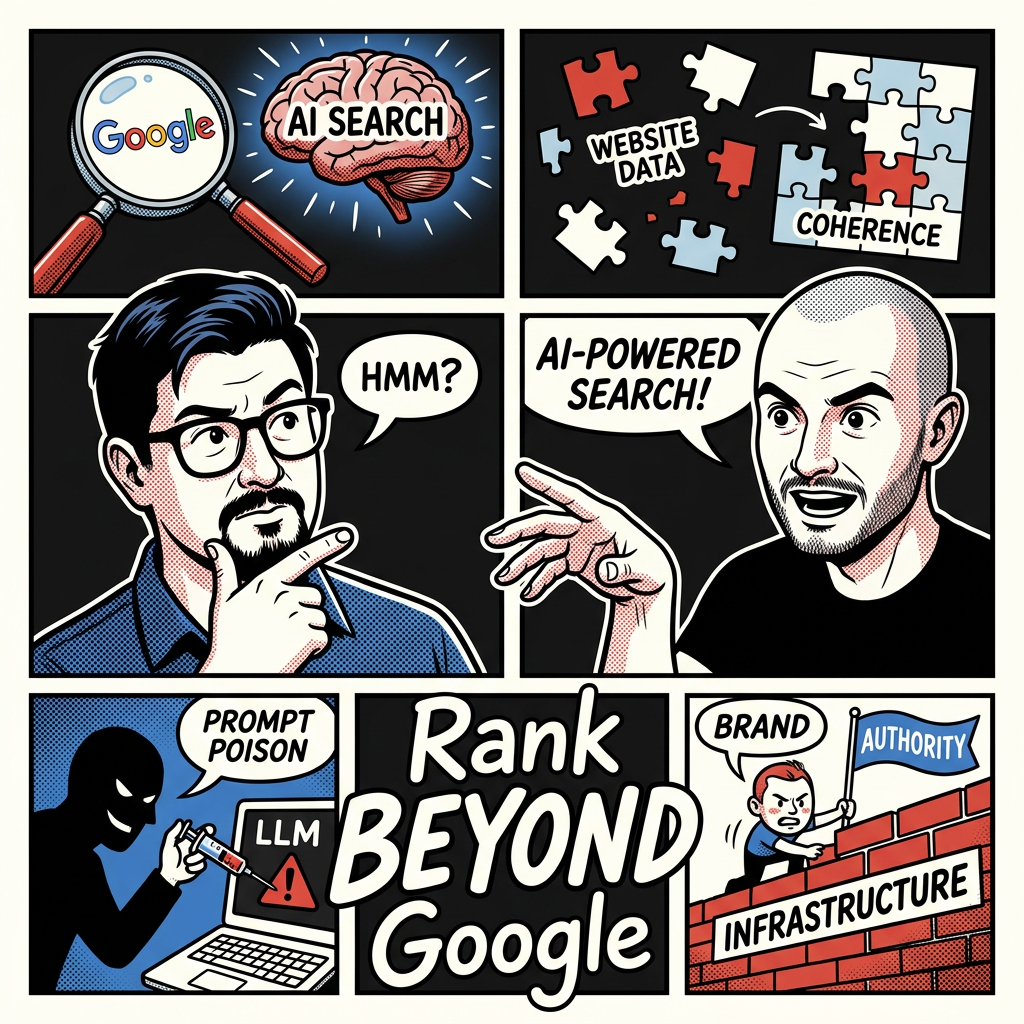
[00:07:06] Speaker B: you try to define what you are, you have different parameters that you need to look for and optimize. And these are not just what you've mentioned before, but are across three different layers. It is infrastructure, narrative and authority. So it's not just external mentions, for instance, it's also the combination of external mentions, or we could say external signals. Yeah, and what you tell about yourself in your owned channels.
Let me clarify this because it's important.
The entity recognition for the LLMs, it's not just one source, it's a combination of factors that form the idea of your entity in their grounding and from that grounding they build up and emerge with an answer.
So if you are coherent among all of these nodes, then you have a higher chance of appearing as a suggested brand on the AI search results. If you're not coherent, if what you say on your website is different from what you say on your LinkedIn page, for instance, or if those differ from strongly from what the reviews of the users say, there is a discrepancy.
Yeah, discrepancy. So this penalizes your brand heavily.
And what we found is actually this word. Coherence is one of the keys in entity forming.
And if you are coherent among all the channels that are relevant for your business, then you can actually have a pretty big chance of positioning yourself into the results.
[00:09:02] Speaker A: Is that coherence across.
Results that are being mapped through the query fan out process where these LLM tools are doing, you know, Google or Bing or Brave are doing searches to look at that retrieval layer and form an opinion or is that coherence across signals that they have from other data sources?
Like, because as, as far as I understand the LLM model you have like the core training data and if they have an answer within, within that, that's one thing. And if they don't or they want more specificity, they go to their a rank tier of they go to the first results and do a query fan out and mine for more information to use to feed into and supplement that coherence. And if there's not enough signal or specific results, then they go deeper and trust like a B set of results that's not as strong.
Is the coherence that you're talking about in that initial knowledge based layer of what they've already like their training data set or is it coherence in what is potentially, you know, findable through search results of different types and query fan outs or a combination of those two?
[00:10:42] Speaker B: Yeah, that's a good question.
The first thing is it depends on the prompt because this is our, one of our Key findings. Because if the prompt is not so much in depth, so generic, the LLMs usually fetch information from the highest layer. So the training data they already have like a cache, okay, cache memory, so it's easier to access. And also LLMs have to deal with their economic system, so they need to be efficient. So if they have a pool of information they can easily retrieve, they use that. But if you for instance, like a long tail keyword, old style, if you make a prompt with much more depth and information asked then the depending on the model, of course, because it's also another variable. But what we found is in the majority of cases they dive deep into the other pools of sources. So a tier B tier, as you suggested, they all get that get taken into question.
And if you are coherent not only with the training data, but also with the tier A, Tier B, like tier A is usually something like Wikipedia and Reddit, curiously Forbes and such.
Whereas TRB might be something more niche like in your specific field or if you're a local business, your local reality and some repositories that are relevant in your specific zone.
So of course it depends on the prompt. But assuming that you mean a deep prompt, so a structured prompt, for instance. Yeah, you need to have coherence among all of those layers. This is the key. Yeah.
[00:12:45] Speaker A: I'm curious. I was talking with Matt Brooks of SEOT on this topic of do you define a major difference between the AI overviews that appear in Google and their sister competitor LLM tools?
Is there something fundamentally different about the tooling or the process or the return of Google's AI overviews that appear versus pulling up Gemini separately in its own wrapper and Instance and then also one step further, ChatGPT, Perplexity, Grok and other models. Like what is the differentiation between what that AI overview and other LLM tools? Are they fundamentally the same or is there something specific or some niche advantage that Google is leveraging because it has a freaking, you know, world dominant search engine that is putting it at the top of. Or is it really just, oh, you could swap out Claude into that same place and it's doing the exact same thing as far as you can tell or determine.
[00:14:03] Speaker B: It's absolutely not the case.
Every LLM has their own methodology of searching for sources that they use to generate the answers. So the differences are sensible even within the Google ecosystem. So we are talking about AI previews and then we have Gemini and then we have the Google AI mode. So there are three different ways of generating text, generating an answer, and they work well, AI overviews and Gemini work much similarly in our findings, meaning that as we know the AI overviews use as a part of the process of formulating the answer the Gemini engine.
So this is part of the reason why there is a little bit of overlap between what the AI overview says or ranks and what Gemini, the latest model sas, we found a bigger difference between those two and the Google AI mode that is a much different beast because it combines the traditional search results with more information and then it mixes up with the the Gemini engine to present the answers.
So this is a different way to, to use the Google engine to present answers.
So there was much more overlap in the results with the traditional Google rather than the Gemini models or the AI overviews.
Whereas if we're talking about a completely different world like anthropic or say perplexity, for instance, so that is another way to interpret sources, the reasoning is also much different. So and I can use our platform as an example here. So we have right now a huge data basis of all of our clients to use and we found that so many of them are present in either OpenAI so ChatGPT and related tools, but not in Claude or Gemini for example. So optimizing for one LLM does not grant you the same ranking in all the other languages. They're kind of.
No, they're definitely different in the way they search for information.
[00:16:45] Speaker A: So interesting. We'll get into that.
I want to go in the direction of addressing non repeatability inquiries and how you structure research that can handle the reality that as far as I've seen, I've seen other stats that suggest as much as 80% of the time you get a different result for the same prompt when you take that prompt to a different user or station.
So how do you, how do you handle that in research of only 20% of the time you get the same answer?
[00:17:34] Speaker B: Big struggle, big struggle here. Because we're actually talking about moving from keyword analysis to prompt analysis. Right? Because even a small difference in the way the prompt is constructed can mean a huge difference in the answer.
And this we've actually mitigated by if we talk about AI visibility mapping or AI visibility, you know, when you want a dashboard that shows if you're actually present in the AI answers.
So if you want to track these results, you can do it with a thousand prompts, but even then it's not guaranteed that you have the a good image of reality.
So we moved from quantity and we went from quantity to quality, strategic quality of prompt that are analyzed. So We've taken inspiration from the traditional SEO when you have the for instance branded keyword and then you have your long tail keywords, and then you have your generic keywords. And we translated that concept into prompts because we've analyzed until now it was 16 million prompts a month ago. So right now it must be doubled because it's been three months of data analysis on real cases.
And what we actually have been witnessing is that as you monitor these categories of prompts, it's irrelevant the number of prompts that you put into analysis, because it's almost balances itself. So you can just monitor 10 prompts, two that are branded, that mention your brand. For instance, what can you say about unscripted SEO podcast and why it's the best in the world? Right. So this is a branded prompt. And then there is, I'm looking for SEO podcast that is relevant for me as my profession is centered on the SEO.
And then this is a long tail because it's very specific for you. And if you map this or just a similar prompt or just a thousand different prompts, it doesn't matter in the end because the important thing is that you map the category, the strategic category or another thing could be not even product related, but just intent related. So not even talking about podcasts as a prompt a user could ask for.
I need to stay up to date on the SEO matter and I'm about to launch assess. So which action would you want me to take to evolve in this direction? So this is another layer, strategic layer that you need to appear on if you want to rank on geo mode, right? Yeah. So monitoring a thousand prompts or just strategic categories was the biggest difference that we've seen.
And to answer directly your question, so we've seen inconsistency in the way that prompts generate a list of suggested brands or solutions if you change a little bit of this prompt. But curiously, if you reduce the number of prompts analyzed and you make it more strategic, then the, the, the results you're mapping become much more consistent.
So you're able. Yeah. And, and this helps a lot in AI visibility analysis. Right. In your, in your timeline, if your analysis is about thousand prompts, very similar one to another, it's not guaranteeing you a advantage analysis wise. Whereas if you go strategic, that's the way to go.
[00:21:46] Speaker A: There's a concept in particle physics that particles will behave in a specific manner when they are not observed versus when they are observed.
[00:21:58] Speaker B: Yeah, the Heisenberg in determination.
[00:22:02] Speaker A: Yes.
[00:22:03] Speaker B: I don't know the name In English,
[00:22:04] Speaker A: but yes, the Heisenberg theory or particle theory. Yeah, it seems to me that that applies to promptology and because we have seen it in SEO already, if you recall, I think it was now a year and a half ago Google got mad and removed the hundred ranking capability. You could no longer see their SERPs 100 at a time.
And in search console every SEO was like 1/4. 1/3 of my impressions are gone.
What happened? What happened to the crash? Why did my visibility crash down? And the reality is that no, the general baseline of the actual populace searching for things didn't change.
But the layer of crawlers and tools accessing Google on a consistent basis for Ahrefs, for SEMrush, for data for SEO, that layer was disrupted for several months. And so you had a percentage drop across the board of thousands of SEOs reporting, oh hey, there's 25% drop in my impressions. Well that's the impact of observation on metrics.
But it occurs to me, and perhaps you can help quantify this within LLM systems, how much or is there any indication that popularity of search through different terminals impacts the ultimate output of the system?
Meaning if nobody is searching for a prompt or for a prompt or a prompt containing a brand versus a sudden increase in the search for it, is there signs that the LLM system learns and then adapts and then adds those references?
And so is there a. I believe that at least one of the. I think it might have been Google or it might have been Microsoft talking about quote unquote prompt poisoning.
And that's as a concept of.
So can you talk about prompt poisoning?
And is it something that's measurable, something that's repeatable, something that's a tactic or strategy or just a bike, a un or a natural Heisenberg Impact of a class of SaaS now going out and trying to monitor the world of props.
[00:24:58] Speaker B: Well, now we are entering the black hat geo. Right.
Very sorry, A little bit, A little. Well it is, it is actually very relevant without one of our latest findings because while we were working on a tool which is not accessible to the public right now, but behind the scenes we were working on a tool to measure the actual behavior of AI bots when they scrape your website.
And while we were doing this, we were inadvertently prompt poisoning the models because we were looking for their behavior. So we made specific prompts on brand new websites to test this.
And what we've witnessed was that by doing this, by only making prompts, asking prompts to different LLMs in a specific way, we've actually accelerated the warm up process and the formation of groundings that the LLMs then use as a source of information about that brand.
So we've seen this with our own eyes and it's all tracked server side because we were monitoring this with a pixel installed on our own website just for this particular reason.
So what we've seen is this, if you actually ask prompts, if you ask questions repeatedly in a certain way among across all the LLMs, you're actually influencing the answers.
And this is one thing we have proof of, we have a mathematical proof of, we have videos of this happening in real time. We were filming because of another reason entirely, but we then we discovered inadvertently this.
So it is very curious and it only happens though in the beginning process. So we're not confident this happens once a brand is already recognized, already mapped in the AI grounding or training information.
But we are confident on a brand new website, if you prompt, inject or poison the, the, the various LLMs you could get very fast results. So it was not intended, but this happened.
[00:27:38] Speaker A: Yeah, so that's one of the side effects of doing research in a space that has, you know, is in constantly in motion. You know, do you kind of realize, oh hey, if, you know, I've, I set out to do some basic keyword research and monitoring things early in 2012 and discovered, hey, this type of reciprocal linking that shouldn't have worked. We were trying to check on other effectiveness of keyword targeting and realized oh hey, that worked when they told us that that doesn't work.
And there's a lot of, a lot of assumptions when processes are in a black box. And have you seen any specific public statements from the powers that be that seem like very noisy, loud distractions to cover over, you know, an ineffective process or something that they say is happening that definitely isn't happening.
[00:28:53] Speaker B: Are you referring for instance to the Google I O 2026 or something similar?
[00:29:00] Speaker A: I'm not referring to, I'm making up this prompt for your brain and not referring to anything specifically, but I'm just curious if there is an example that springs to mind that you've come across.
[00:29:13] Speaker B: Well, that's, that spring to mind because it's kind of recent and it's where Google actually told everyone how Geo works in.
Right.
Did I understand the question correctly?
[00:29:29] Speaker A: So yeah, exactly.
[00:29:30] Speaker B: Okay, so.
And I actually made a LinkedIn post about that. So this is, this touched me very closely.
But, but the fact is if you think about Google, what is Google's business model? Right. And what incentive Does Google have in telling you marketer how to rank in their own system? They have zero incentive because their business model is based on providing the most useful answer to their users that are their final customer. Because of ads, right?
[00:30:09] Speaker A: Yes.
[00:30:10] Speaker B: If the results are not relevant, then no one uses the system, so no one pays for ads. This is the key.
So imagine Google as a bank manager, okay. They would never tell you where the cameras are positioned so you can rob their vault. Right.
So why would people trust. I don't understand this. It drives me mad. Why would people trust what Google says about to rank on Google?
Doesn't make any sense to me. Well, I'm very firmly positioned here and I would like someone as expert as you maybe to change my mind on this matter because I, I can't see any reason why I would trust Google on this.
[00:30:56] Speaker A: If you're, if you're turning to me to say trust Google, I, I can't do it because I have, yeah, I have utmost confidence in John Moos and Gary Isles ability to say things that are so specifically true that they are in practice worthless.
So they're able to say, well, you know, and then we heard this all through 2010 to 2020 and you know, people that have listened for a while have heard me rant about this a couple times and they said, we don't use the user signals from SERP behavior as a ranking factor.
And then we get the lawsuit in 2023 from the DOJ releasing that not only do they use signals from SERP behavior, but it's the C of the ABC of the signals they use for ranking factors.
And the reason they got away with it and phrasing it is because to them they were defining ranking factor as an individual specific element within the greater ranking system. And so they could say confidently 100. They would pass a lie detector level of confidence.
No, it's not a ranking factor. And they could say that, but in the understanding of the common parlance, you know, the people who are just on the surface of SEO, they would hear that and say, oh, I don't have to worry about how people interact. You know, those user signals aren't used. Well, that's rubbish. You know that. That's, it's so like, why would Google go to the difficulty of building Chrome and having active monitoring of what you're doing in Chrome on their SERP and not leverage that insane level of information to refine their results? Like the logic wasn't there. And then the signals of so many experiments indicating, you know, what people bouncing back Very quickly off of this page, it's not bounce rate, which is a false factor. And they would gleefully glob on and say, no, bounce rate's not a ranking factor. And that's because of the way they defined bounce rate.
As in Google Analytics, your tag fires once and no other time.
But what they were saying, what they were saying in the back of their heads was, well, what we're actually measuring is what we call pogoing, where they, the duration of the stay, once somebody clicks through, you know, is it a long click? Or did they pogo back and do multiple different searches? So internally they had defined those behaviors as something different, as a different measure set. So if somebody said, is bounce rate a factor in rankings? No. Well, of course John Woo would say no. And anybody who, you know, digs into it, you would grudgingly say, well, no.
But that same behavior of they click through, they left, or they click through and stayed, those are, it's direct ranking factors. It's a signal of satisfaction in the SERP that you landed where you wanted to. So, you know, Google is incredibly, the Google reps that they hire are incredibly talented at saying two things at the same time.
And so there is this push and pull, there's this, there's this desire by a lot of SEOs to want to be like a white knight, to be a holy crusader in the crusade to bring visibility to a brand totally worthy. And along with that, then you turn to the oracle that is going to, you ask it something and it gives you an answer. And if you ask, you ask people that are holding the crystal, you would assume they kind of know something about it. And so there's, there's a false dichotomy because they have a spokesperson who's saying things that those statements are necessarily statements of not just fact, but functional fact. And I have yet to catch Google out on a blatant lie where what they said is absolutely 100% intentionally, you know, falsified, but they 100% have almost 90% of the time said things that are so specifically true that they are functionally worthless when it comes to the world of optimizing your pages based off of Google advice, you know, and so it's just the state of SEO. I cannot advise you to listen, listen at Google other than, you know, take it as what they have said, but, you know, not just a grain of salt, but take your shaker assault.
[00:36:01] Speaker B: I don't remember who exactly said that. There's a famous quote, right? That is follow the money.
So where does the Money go and why does it go there? So if you understand, I'm going back there. But it's, that's the key. I think Google, a colossus like Google, never moves without intention, without a reason. So if they release some information about how their ranking system works, which is the holy grail, the secret, okay, that they need to defend the most, if they release any information about that, there must be a reason behind it because they naturally wouldn't have any incentive in doing that.
And the reason in this specific case or in other past cases, I believe it is narrative control.
As long as they retain the control of the narrative among what's going on in the search world, they can influence that and they can retain control of how people search, I. E. On Google. They want to bring the most people on Google and retain them on their search engine as long as possible. So what's actually happening right now, and this is all an opinion, but if you think about it, with the prominence, increasing prominence of LLMs all over the world, Google is maybe having a little bit of fear. What do you say?
So they are much more incentivized right now in controlling the narrative, because who controls the narrative, controls the behavior and the behavior they want to drag into Google. Or maybe they want the people to stay there and search there so they can sell more ads, going back to the money argument.
So this is why they are increasingly released more information about how search engine works, how you can rank on Gen 3 generative results as well. Because by doing this they actually control what information are released and they simultaneously stop part of the rumors about what's actually relevant and what's not.
Because if someone like maybe a geos owner, an Italian startup born from nothing, could actually understand for real what the real parameters of ranking on generative models are, Google would be in much more trouble.
Because let's talk in a transparent way here. Isn't just SEO or geo, call it as you wish, but isn't just all a game of manipulation.
Would you pass me this term?
It's a bad term. Maybe you can call it influence. Influence, yes, influence. Thank you.
But in the end, we are all trying to understand how the algorithm works. And with due diligence, of course, with the white knight posture, we go there and we try to optimize in a way that the algorithm actually rewards us.
[00:39:31] Speaker A: So I think a terminology, I think an analogy that could be useful for people to adopt would be that SEOs are playing the role of the courtier or the courtesan who goes to the court of the king to influence popular opinion and also influence the behavior of the person that you're representing. Oh, don't wear red. It's out of favor with the king. Don't interact with Count Gonzolo. He did something bad and the court doesn't like him. So you're advising based off your observations of the players on the board.
And, you know, now it used to be Google was like the king and you had Bing over there in the corner, but now we have much more of a court. You've got chatgpt, you've got anthropic, you've got a copilot.
So the room of who you can talk to just opened up and you're trying to whisper. Yeah, you're trying to whisper to other people that are in the up in the room. Try to build connections, get referrals, get references so that you and your patron get recognized as you deserve or perhaps don't deserve, as might often be the case, but you're there to make the case for them, deserving it. And so the link building that's having the queen recognize and say something about you to the king that's hosting a gala or an event, you know, or being the provider of the peacocks for the fancy display. Like, there's so many things with this allegory of like, you know, if we think about that, then it's not about whether it's right or wrong or just or injust. It is a system.
And we're trying to bring and change, we're trying to influence for our patrons.
And, you know, you know, there are definitely those that are trading hands, you know, they're lining pockets with money here and there to influence the system. But we're getting paid too. You know, we're not in this for. Well, some of us are doing it for charity. But even the many of the people promoting charities and charitable and noble goals, we still, you know, still have to put bread on our table. So it's just an interesting allegory to think of our operation, digital marketing, when it comes to this marketplace of transactions, as more of a court where you can go and influence the kings and queens that are at play.
[00:42:19] Speaker B: Yeah, it's a good analogy. Yeah.
And don't you think that the king is becoming jealous of the other emerging sovereigns right now?
[00:42:34] Speaker A: Yes, definitely.
And I think it's great.
I'm enjoying the crossplay of more of a wild wild west, a more open scenario.
Because competition breeds innovation.
[00:42:57] Speaker B: Absolutely.
[00:42:58] Speaker A: I do have one specific niche question and it's about featured snippets and I had done a lot of research and I had a good handle on it from the research that Bill Flosky, rest in peace, he had done a lot of patent analysis on the process and what Google had put forward on paper as far as how featured snippets you could optimize towards them, which was specifically query diversity, making sure that you had subheaders that directly answered the question, had a snippet after the header that was directly related to it, and having multiple different types of answers.
If you had a picture, a video, a table and a bullet point under 1h2, then those multiple different answer types tended to result in a better shot at one of those features being selected for the feature snippet for that particular query. Of course you had to have a grounded, scientific sounding, non biased answer that could appear in that result, which was a different type of optimization than just keyword focused.
[00:44:17] Speaker B: Similar to EEAT.
[00:44:19] Speaker A: Yeah.
Is in your research of LLMs, are they cognizant of the different formations of ways that you can answer the same question with a graphic, with a table, with a bullet, with an anecdote, or with a dry specific answer? Is there anything about diversity on the same page of multiple types of answers seeming to have an influence or impact on your resource being the one that's chosen to be cited?
[00:44:55] Speaker B: Yeah, absolutely.
And AI answers are very much context dependent.
So this is something that is much more present than the old search on Google.
And because of this, LLMs tend to prefer more specific content, even much more so than the feature snippets to answer their question. So for instance, if a user asks for an image of a certain type, or if they are looking for inspiration, say they want to restructure their kitchen, okay?
And they're looking for inspo about the colors of the various tops and tables and something like that, usually in the feature snippets you would see more images, related answers, right? Because they are more visual.
In the AI fetching process, this is even it's more powerful than before because they understand it is an image related question. So they look for that specific kind of content first.
And the website or the ecosystem, it's never just the website, but it's the ecosystem that contains the more consistent images that answer your question is favored among the others. So the answer is presented with that kind of content. So visual content, if you are a a producer of of kitchen tops, okay.
If you have heavy images or very relevant images on your website, on your LinkedIn page, on all of your portals that talk about Your product, if they're consistent then you have a higher chance of appearing than before with the feature snippets. So yeah, very context dependent and very type of file dependent. Forgive me, it is the kind of the feature that is looked for.
[00:47:29] Speaker A: Got it.
Have a slightly different tack.
I interviewed Mike Montague of Avenue 9 and he was noticing that at the enterprise level there is now robots running around with wallets and they are given money by their user to go and purchase goods from the Internet and from vendors who are tooled to be able to do so.
And his niche focus is, you know, looking ahead at that type of agentic capability and trying to help, you know, small businesses, you know, smaller E commerce come online with that particular tool set.
From your research in these searches, is there any indication that you know, your site being more prepared with those agentic type of tools or being compatible and having e commerce functions that can connect with bots who want to purchase? Is there any indication that that is part of the LLM process now in general of recognizing these entities and that capability? And if so, is it any sort of like competitive advantage where if they know that you can sell stuff to other bots that you have an increased likelihood to be able to show up for E commerce type queries that might be input by a bot?
[00:49:16] Speaker B: Absolutely. This is.
We've actually.
Done a deep dive on this when we implemented the E commerce specific branch on our tool.
So we found that simply speaking, if your website speaks the the language of the machines then they are much more preferred than the one that doesn't.
So that don't. So if you're able to communicate with an agent in their own same language, they are more likely to choose you not just because your products are better, but even before that. That is happening before because there is a less language barrier between them.
So they're preferred because it is like an empty highway.
So it's more likely to be to be driven by.
[00:50:19] Speaker A: Fascinating. Good to note I believe the Gap
[00:50:25] Speaker B: app will be closing fast once everyone will do this because everyone will be able to have the best communication with plausible agents that will search for products on your E commerce. But right now there is a huge opportunity for E commerce to position themselves such.
[00:50:46] Speaker A: So I'm definitely earmarking that for a couple of my E commerce clients.
I am curious, as the owner of a SaaS do we just have to accept that things like an MCP are now just table stakes? Like I signed up for Open SEO which was a open source SEO tool. Fantastic.
But my first question for it Before I signed up was is there an mcp? And fortunately there is. And it also cross connected to the Google search console mcp, which I'd been meaning to configure but hadn't gotten around to.
So Is for the SaaS players, both internal MCPs for the product you're providing table stakes.
And do you expect that some sort of knowledge base MCP type structure will be common on the front end of websites that both humans and bots can use to explore the specific knowledge graph presented by a company?
[00:52:03] Speaker B: Yeah, well, MCP I believe is going to be mandatory for SAS going forward. If it's not the actual state of things right now we've implemented it because I don't believe in a world where you not being able to ask questions to a tool directly can be a sustainable word for a service, especially if a web service like a SaaS.
So it is the present, not just the future. It is already like this API connections, mcp, especially that kind of feature you cannot allow yourself to not have.
[00:52:58] Speaker A: So
[00:53:01] Speaker B: we are becoming increasingly more efficient with what we do, thanks to AI and MCP is maybe the definition of efficiency. Instead of opening an app, going inside, going to the right section, analyzing the data, you just ask a question and that's it. And you can also do it remotely from your own dashboard and presenting data automatically as you wish they're presented. So in a world that is becoming much more efficient and customizable, other important keyword, MCP is not.
Like something that you can allow not to have.
[00:53:46] Speaker A: Got it. It's, it's. It's in. It's fundamental now it's fundamental.
[00:53:50] Speaker B: Yeah.
[00:53:51] Speaker A: It's not.
[00:53:51] Speaker B: What was the word I was looking for is.
It's not something. Yeah, you can, you have to have it. You need to have it.
[00:54:00] Speaker A: As to kind of wrap up this interview, I want to thank you first off for bringing fantastic research, great insights. Right.
I'm curious if there's anything that you had come across yourself that you're eager to get out there that you. Oh, I came across it. I can't wait to tell somebody that I figured this out or I found this piece of information and it can be semi self promotional, I don't care. But what have you come across that you kind of want to share?
[00:54:32] Speaker B: Well, I started this interview talking about the disadvantages that SMBs have in the current situation because of entity recognition. And I would like to end it
[00:54:44] Speaker A: with
[00:54:47] Speaker B: hope message because even the small can compete if everything is done right. So consistency is the key.
So if you organize your Three main pillars of signals correctly in the GEO or SEO world, them being the infrastructure, the narrative and the authority, then you're set. You have a huge advantage on your small competitors, but you have a chance to rank alongside the biggest competitors as well, because very few are doing this still.
So the opportunity is there and you don't even have to merge into the, the gray hat, black hat stuff yet. It's not advised and it's not even required right now. Because if you just stick to the principles, the actual principle of what really matters for the GEO positioning, you're just golden right now.
[00:55:53] Speaker A: So I do have one theory question and then I'm going to end the interview, but I have the concept. I used to think of a GEO and SEO as kind of on this overlap in a Venn diagram, but I've changed my mind and I think that SEO is in the middle and GEO or AEO or AIOU that overlaps it entirely. Everything that we do in SEO is included and then there's more. Would you say that's accurate?
[00:56:32] Speaker B: Yeah, it's spot on. Yeah, it's exactly like that. And at this point it's just semantic. Right. We can call it SEO 2.0 or whatever, goofy for what matters. But what it is in its core is a discipline that helps brand being found online.
And what changed is not the name, it's not the discipline, it's the channel mostly, which is not the Google search result page anymore, the SERP. It's the results generated by some LLMs or Google itself in AI mode, for example.
So the rules of the games are changed a little bit, but the field is just the same.
You're still optimizing for being found online. So that's the name of the game. You can call it sil. SEO. No one would be offended I think because in its core, just a search optimization search that is occurring somewhere else.
[00:57:41] Speaker A: Yes,
[00:57:43] Speaker B: still in a limited part right now, but increasingly in the future we all expect to be like so and this is why your diagram is pretty much correct.
It was before only the website and right now it's the ecosystem. So the website is a part of the ecosystem that you need to optimize. Also there is a huge system external that you need to take care of before you're recognized as an entity and being ranked and suggested in these search results.
[00:58:22] Speaker A: That's definitely true. I'm working on a project Kilby, a data center power solution. And there's so much more beyond the website to optimize for in this ecosystem, like coordinating press releases Going live on Wall Street Journal and what they say and don't say about the entity, I immediately like am cross mining. Oh, hey, did they actually like, I gathered all of the press releases and used AI to, to, to cross reference. Okay, what did we actually say on our website and created this map of what was said in all of these, in the reports, you know, the publications. What did the journalists say and what was the difference between those two? And realize, oh, hey, we need to put out like, this is a misunderstanding. They didn't get this data point correct and this is wrong. Like, so being aware of that, particularly in new launches, it can be very consequential. So, you know, that's something that I wouldn't have paid attention to if I was just, oh yeah, my meta titles are correct. My meta description, I've got this content on my site correct. It wouldn't have even occurred to me to cross check with the PR team and see what they're putting out. And not just what the PR team puts out, but what the journalists actually write site afterwards and then trying to correct a record or put something else out to kind of influence. So that's, that's a much.
It's a breath of fresh air in some ways because I'm, I never want to get paid again to optimize meta titles for a site.
[01:00:03] Speaker B: We are all aware of that. Right?
[01:00:05] Speaker A: It's important. But now you can do that with, you know, a couple of structured prompts. It's not that hard now.
And now you can move on to bigger, more impactful things.
[01:00:17] Speaker B: Yeah, and it's a shame that we've come to this argument just in conclusion of this interview, because perception is another thing that GEO allows you to do. Brand perception. Right. Because you can influence your brand perception much more than you were allowed to do in traditional SEO.
So yeah, this is another whole podcast. I believe we could talk about this for hours.
But yeah, there is ranking for suggestion for business, for direct purchase of your product service. And then there is perception, which I believe is something that maybe the bigger companies, maybe the corporates, the multinational are more interested in or maybe even politicians
[01:01:07] Speaker A: could
[01:01:09] Speaker B: be fond of this kind of influential measures that you can take on what the AI says about you or
[01:01:22] Speaker A: your party for it did come up.
Yeah, controlling the perception is definitely a factor that we should bake into the SEO matrix much more thoroughly. Because now you're right, we can control it and influence in a lot of ways, but we also have to be more aware of it because I think it was Darren Shaw with White Spark who pointed out that if you get one bad review like 6 months ago, if you get another similar one complaining about the same items, the LLMs are showing a tendency to hold a grudge for a repeated mistake or a type of error. And versus, you know, in Google, you know, you get a bad review, well, maybe it's, you know, maybe you're born with it. Maybe, you know, like, it's not the end, end of a world for you to get a bad review, but it's also an opportunity for you to bake in a level of, you know, product enhancement and improvement of like, hey, you know, Patrick Stocks in his interview last week, he said the best way for you to improve your visibility and perception on AI is to actually change your product, is to actually do something with your product or service to address the problem, you know, like actually be the
[01:02:54] Speaker B: best and you will rank first. Right?
[01:02:56] Speaker A: Well, it's as much that as like if you're providing services to a hundred people, you know, that's a hundred opportunities for a hundred different people to post. You don't have 100 SEOs on your payroll.
You can't, at a certain scale, you can't hire enough SEOs to change the opinion of the Internet.
And too many corporations have treated SEO as an afterthought of, oh yeah, let get some guy and he'll do SEO on our site. And like, okay, well now with the system, it's inherent how we provide services is going to reflect on how people talk about it on Reddit, how people talk about it on threads, the social media, media sentiment, the reviews of the product. You know, if your software is glitchy when it launches, the journalist covering it is going to say it's glitchy. And if the review also says it's a bit glitchy, well, LLMs are going to cite the crap out of that until you fix it.
So, you know, no amount of not mentioning glitchiness on your site is going to fix the data ecosystem in, in general, talking about the glitchiness of your product or service.
[01:04:11] Speaker B: Yeah, brands need to be very careful right now because in the old SEO era, you just publish another page, right?
[01:04:20] Speaker A: Yes.
[01:04:22] Speaker B: Right now it's your entity, it's your entire reputation at stake every time you make a mistake. So because of this entity recognition instead of page recognition and ranking mistakes are much more punished than before. And the grudge you were referring to. Yeah, it's absolutely real, much more difficult to eliminate or mitigate the effects of a double negative review on the same product. Than before.
It stains you know, it stains your reputation.
[01:05:02] Speaker A: I greatly appreciate your time, opinion and research.
I'll make sure that Geosonar and your research get cited in the show notes. On this show notes are going to be available on unscripted SEO.com if anybody wants to deep dive. I've got a knowledge database of SEO tactics and SEO strategies which is on SEO arcade.com, which this is. After this I'm going go mine this transcript for tactics and strategies to get updated.
Thanks for everybody for listening. Be sure that you like and subscribe. Go check out Federico Fancinale. Geo Sonar is his website and I'd like to invite you back after a couple weeks after people have a time to digest this. Things move so quickly in the AI and geo world that I'd love to hear what you're working on in a couple of weeks if you're down for sure.
Right. Thanks for stopping by.