Episode Transcript
[00:00:02] Speaker A: Good morning. Good morning, everybody, and welcome to the Unscripted SEO podcast. Today we have Anthony here with us. Anthony is a master of SEO, but for video.
Welcome, Anthony.
[00:00:16] Speaker B: Thanks for having me on your program, Keith. I'm excited to talk about video SEO today.
[00:00:22] Speaker A: Totally. All right, so there's a.
I've been doing SEO for 14, 15 years, and there's a lot I know, but there's also a lot I don't know, and a lot of that in the I don't know area is video.
So I would love to pick your brain on whether it's YouTube or getting video to rank in Google, which I know is a thing for a lot of people.
And getting video to rank in Google that is not hosted on YouTube, I know that can also be a thing.
So, yeah, welcome.
[00:01:00] Speaker B: Thanks. Yeah, you had me on, I guess, a couple months ago with my partner, and we talked a lot more about local SEO, which is, I know, a more commonly sought after form of ranking your website at the top of the Google search engine.
But I kind of stumbled across this method of uploading a video to YouTube so that it would show up on the first page of Google over a decade ago, and it's still relevant today. So I love to just share this information with other SEO experts or even business owners who are trying to get found for their most popular keyword.
[00:01:43] Speaker A: Yeah. And just for context, what we're talking about here for the listeners, I have a friend that I've helped on and off over the years with their SEO, and they sell Rubik's Cubes or speed cubes.
So Rubik's Cube, everyone knows what that is. But a speed cube is. Has magnets. You lube it up, has springs, and it's designed to go fast. And that's how they solve it in, you know, five seconds. Well, he has about a million monthly visitors to his website.
About half come from just whatever other keywords, but the other half, it's like 48% comes from videos hosted on YouTube, but the traffic comes from Google.
So this, for people listening, this sort of approach definitely can be a legit strategy. And then with my limited experience from it, I know it can be very impactful for many different people's businesses. I mean, for Pete's sake, selling Rubik's Cubes and all the supplies that go with it, you can tell what I'm into.
A half a million visitors a month from like, three videos. Like, three or four videos make up of that 48% of that traffic. Three or four videos make up 80ish percent of that.
Three or four videos of the total videos. And you know, it's like probably 15 or 20 other videos that make up that remainder. 15, 20%.
So this is a super valid strategy.
[00:03:11] Speaker B: And it just reinforces such a basic marketing message that is kind of a guideline or a universal law that a specialist will always be valued much higher than a generalist. And so your niche will make you rich and you can always be the specialist in your corner of the universe.
And then if you have a different product like a Rubik's Cube that's also very niched, I mean unique, then it can also have a much larger following because of its uniqueness.
[00:03:49] Speaker A: Well, because like, you know, if you think about, for my Rubik's Cube friend, the people who are. Because you know, if I'm reading a book and my audience, if I'm selling a text based product, my audience is expected and does read text heavy stuff or consume text heavy stuff. But when you're doing speedcube or whatever, workouts, for example, or makeup or applying makeup or anything like that, you know, video will always be a much more desired method of content consumption.
[00:04:23] Speaker B: Yeah. I say that evidence sells, you know, proof that you can do what you say you can do is like a, it's like the cr. It's the thing people are looking for before they're willing to take that risk and give you their money.
[00:04:39] Speaker A: Yep. Okay. So I am a, I am, I'm not going to dumb it down to just say a type of business, local core seller, high ticket. Because I believe that every business can utilize video.
So I'm a business that realizes I can utilize video and I have the capacity to create whether it's on my, on my iPhone or I have a, you know, way too expensive camera and a whole light setup with a not finished background.
[00:05:16] Speaker B: Yeah.
[00:05:17] Speaker A: Or whatever else it might be something in between. I talked to a guy this the other day who literally spent a couple hundred thousand dollars on a full studio like, like it with the big cameras that roll around that are designed for TV shows. Like he spent way too much. I'm like, why did you. And you, you're doing this for a podcast show on YouTube. Okay.
Anyway.
[00:05:43] Speaker B: Yeah.
[00:05:44] Speaker A: Regardless of your production means.
[00:05:47] Speaker B: Yeah.
[00:05:49] Speaker A: How.
What's the simplest way to get started? To start seeing results. Now I realize that's a question that is general and semi vague. So be as vague or as specific as you want with that.
[00:06:02] Speaker B: Yeah. And this is unscripted. Right. So we're, we're trying to look at it from the perspective of somebody who understands that video is definitely a power tool that can be used to help me grow and develop my business.
[00:06:18] Speaker A: Yes.
[00:06:19] Speaker B: And that's the first step.
It's just recognizing that you can carve out a competitive advantage for yourself if you leverage this low cost video in a better way than your competitors do.
And so let's just get down to it. You know, the first step is taking down a piece of paper and a list of the 20 videos you know, you need to make right now.
And you know, let's just popcorn a few of those, Keith, because I know you've been keeping your eyes out to what's going on in the marketplace.
And you know, there, there are this, there's, there is this list out there that people know they need to make. What are some of the videos you can think of?
[00:07:08] Speaker A: Like, for me personally?
[00:07:09] Speaker B: Yeah.
[00:07:13] Speaker A: Well, I know I need to do some amount of content creation around our specific framework for SEO and how it relates to AI and social media.
And you know, you know Gary Vee's content model.
[00:07:33] Speaker B: His what model?
[00:07:34] Speaker A: His content model.
[00:07:35] Speaker B: Concept model or content model? Yeah, content model, Yep.
[00:07:39] Speaker A: If you just Google Gary Vee content model, you'll see a notable slide deck. But it's basically top down. Yeah, but, and that's kind of like ours is, but ours is very SEO, but it can be for SEO and social media.
So one video would be, could be something like how to scale social media reach with SEO or how to inverse. Could even be how to scale SEO with social media content or something like that.
[00:08:19] Speaker B: Yeah. How to videos. Absolutely. Probably your bread and butter right there. Yeah.
Some other videos maybe like a hyperlapse video of you doing your work. That is a great piece of evidence right there of why you might pay a specialist to come service your H Vac unit or.
[00:08:40] Speaker A: Yeah.
[00:08:42] Speaker B: You know, replace the toilet or whatever the service is.
These are jobs that people don't want to do, but they're not sure what they're paying for.
And so by just quickly, in less than a minute, seeing that whole hyperlapse video gives them the sense of. That's why I'm hiring a professional evidence.
[00:09:01] Speaker A: Yeah. Because like yesterday I know how to do H Vac stuff. I've done it. I've done plumbing, I've done concrete and foundation stuff. Yeah, I know how hard it is. Yesterday we had our AC guys out because our AC was out 100 degrees and they were out there from nine, eight until three, almost in the sun, working 100 degree weather. Yeah. And I stood out there for five, 10 minutes talking to them and I'm out there and I'm like, yeah, I don't want to do this. I don't want to be out here in the sun. I'm going to go back inside. Let me know if you need anything, guys want some water, whatever. Right. But yeah, just to your point of evidence as to help paint the picture as to why I said things is valuable.
[00:09:45] Speaker B: Yeah.
So really, all these videos kind of boil down to the this BTS model or behind the scenes.
You know, it's in your face every day and so you don't realize that that is the stuff that people are looking to find out about how you do your work, what it's like to work with you. Your cleanliness, your body language, your cleanliness. At the end of the job, whatever it might be, this is what people are looking for. And all you've got to do is set the camera up, you know, and press play. And then, oh, we got a phone call. All right, turn it off. You know, at least you got something, right? Take the phone call.
You could even record a phone call with customer. I don't know if you've seen that new button on your iPhone, but you can, you can say, hey, is it okay if I record this call? I might want to put it in our archives. Boom, you've recorded it. Then maybe they say something impressive about you or they're grateful for something you did and you can just use their voice and maybe photos of the job.
And you only need five seconds of a good sound bite to make a good piece of content.
[00:11:03] Speaker A: So no, for local businesses, just to tack onto that, like with your HC H vac or whoever, we've seen a lot of.
A lot of success with in Google my business. In your profile, there's an update section that no one ever utilizes, let alone do. Half the time. They just don't fill out the other stuff. Yeah, I was talking to someone the other day, they didn't even have their website on there and they have all the reviews on Facebook. I'm like, but you're a local business anyway. But the update section, literally, just updating that weekly, treating it like a social media account, but updating it with stuff could be anything. But updating it with videos, little 10, 15, 30 second snippets. Yeah, we have a chiropractor that is a friend and I've been like, yo, go do this. And he's been doing it all. And he started his practice in March or April or something like that.
And it's in A really small town, like 12, 000 people collectively. So it's relatively small. There's no one around for well over an hour. So like that, that is his pool of people.
And he's already over 10k a month in subscriptions from people just coming in from Google. And his big thing, his differentiating factor from him and his 15 reviews and the other two or three chiropractors have several hundred, is he's updating his Google my business profile regularly. Like that's a big thing. And it's like half of them, about half are video.
So it can make a big difference. And that's just one small little example.
[00:12:51] Speaker B: Now this has been around for maybe eight years, but I don't know if it's been as important as it is now, maybe even as important as this technique I'm about to demonstrate. But publishing those under 30 second videos on your Google business profile, people can even leave a video in their review. You know, they can upload photos when they leave a review. They can also upload a short video.
[00:13:18] Speaker A: Oh yeah.
[00:13:19] Speaker B: So I mean if you can get that in there, people always believe 10 times more what other people say about you than what you say about yourself.
[00:13:28] Speaker A: Yep. And I'm a Google local guide, so that way when I love something and I want to support them, yeah, I, you know, I can have, my review can have more weight. And when I see someone doing something that I'm like, yeah, you don't need to be in business, I'll leave a comment. I don't see it. I never said someone needs to go out of business. But like, yo, you need to do better.
[00:13:49] Speaker B: Yeah.
[00:13:50] Speaker A: You know, I don't say that. Yeah, okay.
[00:13:53] Speaker B: No. I had a H VAC contractor in San Diego who wasn't getting any leads. He got some advice to start using those updates on Google. And now you can just see he's not 21st in the list anymore. He's in the top three.
[00:14:06] Speaker A: Yep. Okay, so for local businesses, as simple as it might seem, five to 30 second videos once a week on Google my business profile can make a big difference if that's all they're doing.
[00:14:22] Speaker B: Yeah, I'd say tip of the day right there. Yeah.
[00:14:25] Speaker A: Right now, if I'm not, not a local business and I want my videos to show up in Google or YouTube getting more tactical for them. What are some things, whether it's the thing you said you were gonna, you were gonna share just a second ago or, or something else. What are some other things that are like, if you want to rank Your videos in Google or YouTube, you got to do this.
[00:14:50] Speaker B: Yeah. Well, to boil it down to the most simple response to that question, when you upload your video to YouTube, you need to make sure you do three things.
Number one, the title of the video should be the keyword that you're attempting to rank for.
And it should probably start with the local geographical title, wherever it is, whether it's a neighborhood or a municipality or a county.
[00:15:20] Speaker A: So then is that specifically for a local brick and mortar business or that.
[00:15:26] Speaker B: Would be more for a local service provider or a brick and mortar.
[00:15:30] Speaker A: Because, like, I have a. Technically I have an address for my business, but I don't operate out of that business. And it's a virtual office in Nashville.
[00:15:39] Speaker B: Yeah.
[00:15:39] Speaker A: Like for someone like me and I'm putting something up. Does that same geotag sort of thing apply?
[00:15:48] Speaker B: Yeah, it does. And maybe I can just go through it and show you where you actually place the location in the indexing information. So, number one rule, make sure the title of the video is the keyword you're going for and include a geographical specification.
[00:16:05] Speaker A: Okay.
[00:16:06] Speaker B: That's going to help you the most. Next, write in the description. The description is really where a lot of the extras go into, but make sure that same keyword is in the description.
We'll circle back to the description later.
[00:16:20] Speaker A: And then just real quick to tie into that for everyone listening, whether you're a local business or not.
The two things he just said are crazy simple and they seem kind of obvious. Yeah, but this simple is not easy.
Doing the same thing over and over that, you know, working out every day, it's not easy. The consistency. That's the word. But oftentimes when people hear something, oh, I already know that, they override it and then they forget about it.
[00:16:50] Speaker B: Yeah.
[00:16:51] Speaker A: The basic keywording, the. Whether the geotag and. Or the keyword and the keyword in the headline and in the description. Like you wouldn't believe how many people just overlook the stupid simple things. So I'm just calling those two out as, yeah, they're simple and they're obvious, but yeah, most people don't do them.
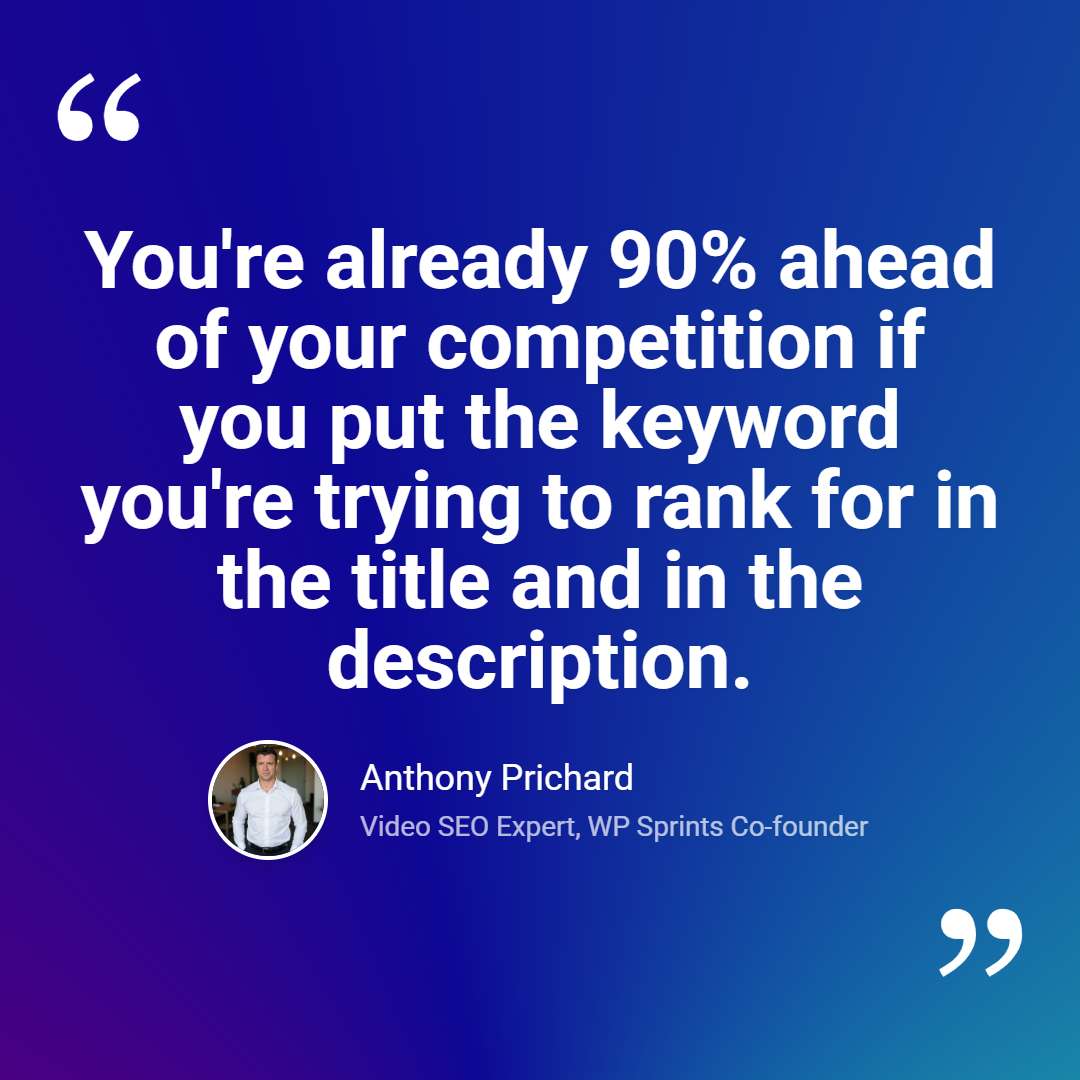
[00:17:11] Speaker B: Yeah, yeah. So you're already 90% ahead your competition. If you put the keyword you're trying to rank for in the title and in the description.
[00:17:21] Speaker A: Yeah.
[00:17:22] Speaker B: The third place, of course, is in the tags or in the meta tags. What does a meta tag stand for? Oh, information about your information.
And it's basically what Google needs to know in order to suggest your content.
[00:17:38] Speaker A: Okay, so I have a question about that so this is me personally and the way I've understand that. So. And when you're seeing tag, you're referring to a hashtag, right?
[00:17:47] Speaker B: No, no, that's another strategy you can use in the descriptions. But there is a section while you're uploading a YouTube video that is meta tags because. Should we pull that up now?
[00:17:58] Speaker A: Yeah.
[00:17:58] Speaker B: Okay.
[00:17:59] Speaker A: Because hashtags like on Facebook and X almost hurt you because they just look tacky and they're outdated and they don't work.
I don't know if that's the case for YouTube in regards to hashtags, you know, with a number or pound sign, Just a random video.
[00:18:18] Speaker B: Are you looking at my screen now? You can see this.
[00:18:21] Speaker A: Yes.
[00:18:22] Speaker B: Okay. So I am a volunteer for the Cherry Creek Chamber of Commerce and they have a local professional speaker come and talk and give a presentation on a personal professional development topic.
And so I publish some of their videos and say this is a handwriting expert. Right.
Oops.
Okay, so we had a handwriting professional come and talk to us and I uploaded this video. I'm not sure if I indexed it properly. Oh, it looks like I did some of this stuff. So we can use this as a good example how capitalizing the first letter of your name can impact its appearance.
And then I want that same keyword to be here in the description.
I think I just have some basic stuff in here, but let me make sure it's in there.
Okay. Then I put in the name, address, phone number, the citation. You're probably familiar with that.
I put in links.
[00:19:45] Speaker A: Let me ask you about that. So for a local business or someone who has a brick and mortar location, they care about having your nap name, address and phone number in there.
[00:19:54] Speaker B: Yeah.
[00:19:54] Speaker A: Is important. Really helps, but yeah, makes sense.
[00:19:58] Speaker B: Yeah.
Then we have links to the social media accounts.
I also put in watch other YouTube videos.
So I might go to our YouTube channel and pick out some other videos that I can place in there. And the reason I do that is because then those videos will be more likely suggested when the video they're watching concludes.
Okay, so here's another expert or overview of a business. And I'm just going to go and paste that in here.
And now that video will be more likely to appear. Now the other thing I can do is put in other resources.
And this is kind of like the gray hat technique. But let me show you what this is. I'm going to go copy this keyword, I'm going to punch it into Google and oops.
Going back to. I was doing some research on his content model there. And I'm going to see what results already show up. Oh, well, I guess this, this video does show up on the first page, but if it didn't, I might go here to Reddit or Quora or this company right here, and I might take this URL and put it here in the description of this video that I'm uploading. And now Google's like, oh, well, look, this URL is already on the first page. This must also be a good result, too.
[00:21:51] Speaker A: Interesting.
[00:21:52] Speaker B: Those are the secrets you came for. Yeah, I know you're wondering, how do I get this to happen? This is one of the reasons.
[00:21:59] Speaker A: Yeah, that's a lot. Like in your articles, linking out and citing.
So if, if you're not linking out to other websites that are credible.
[00:22:10] Speaker B: Right.
[00:22:10] Speaker A: Or just like in, in your research paper back in college, don't cite your sources, you know, or if I make a claim and I don't cite it, you know, that's not that good of a thing.
For numerous reasons.
[00:22:22] Speaker B: Yeah.
So interesting, yet also interesting is that there's no geographical modifier on this keyword. So it's truly a national or an internationally ranked keyword. And, you know, it's long tail and it's going to be very specific for somebody to find it. But you see, the idea this is, this is working. So I'm going to add it to one of my playlists here, and then here at the bottom, I got to click this show more button and then I can get down to the meta tags. Got it.
[00:22:59] Speaker A: What you were talking about.
[00:23:00] Speaker B: This is what I was talking about. Yeah.
[00:23:03] Speaker A: So is this. Do these tags show up publicly on the front end of YouTube? If, like, if I searched this video and I found it, would I see these tags?
[00:23:12] Speaker B: No. No one will see these tags except for you.
[00:23:15] Speaker A: Got it. So this is strictly SEO.
[00:23:18] Speaker B: Yeah, that's. That is baked right into YouTube because their platform is the second most used website in the world.
And it's the number one for people who are looking for to learn something and to do it themselves.
[00:23:35] Speaker A: Oh, yeah, like. Yeah.
So, okay, so recap here so far.
[00:23:42] Speaker B: Yeah, recap on the show more show less button. You've got. Does this contain paid promotion? No.
Is there any altered content, AI stuff? You know, you want to put that in there. They're not opposed to that. They just want to know. Okay, and then you've got some other options here. Key moments, select the language. Definitely fill these out. I say it's like filling out an SAT test.
[00:24:09] Speaker A: Yeah.
[00:24:10] Speaker B: The more. But forms you Fill out the more points you get.
[00:24:14] Speaker A: I mean it's there for a reason. They want to know.
[00:24:16] Speaker B: Yeah, right. So that's really it. It's pretty simple like you said, but it's very effective, very impressive. This particular customer needs to do a one time verification that I cannot do for them. So I'm just waiting until the next time we have coffee so I can walk them through how to do that.
[00:24:35] Speaker A: Yep, totally makes sense. So recap all of this. What you've done on here is you'll take the keyword, make sure it's in the. I'm pointing at my screen like you can all see me.
My camera's up here, my screen's over here.
So your point? Pointing. You're putting the keyword in the headline.
You're here. In this scenario, you copy pasted the entire headline, which is. Can be at times the whole keyword. You put the whole thing in the description.
If you're a brick and mortar, you added the nap name, address, phone number, contact info, other socials, et cetera. The thing that I found was probably the most interesting of everything you've showed so far. Here is the. Yeah, the other resources.
[00:25:18] Speaker B: And you can put up to three URLs in there.
[00:25:22] Speaker A: Oh, okay. I would recommend so and just for clarity or just recapping that portion, the other resources are other videos or pages ranking on Google already possibly above you. Is that right?
[00:25:38] Speaker B: Yes, that's right above you.
[00:25:40] Speaker A: Putting one to three in there and then scrolling back down to the.
Obviously like you said, filling out all the other things, just making sure it's accurate and filled in. But then here.
Yeah. In the tags, which is under the show more of the advanced.
[00:25:57] Speaker B: And I think this was the tag I put in before and then I just put the whole thing in next. But I really do think that because I put this in before just a short version of the longer version.
Right. So let's go out, do another search and just say if instead of how I can just put in capitalizing the first letter of the name, see if that shows up.
[00:26:18] Speaker A: For kicks and giggles.
Try it in incognito if you're able to. Or will it still show?
[00:26:23] Speaker B: Of course, of course. Yeah.
It's not, it's not showing up for that one.
[00:26:29] Speaker A: Okay, cool.
[00:26:30] Speaker B: But you know, it's, it's working its own magic over there.
[00:26:35] Speaker A: Yep, very cool.
Okay, so this is what I would. This sort of stuff I would bucket into the technical SEO or from a traditional SEO perspective, content authority, slash links, technical on page, all that kind of Stuff I would put this in the on page technical sort of bucket.
[00:26:58] Speaker B: Yeah.
[00:27:00] Speaker A: Content wise or. Well, is there anything else that's worth noting in that sort of bucket or, or pre publishing optimization that makes sense to mention?
[00:27:12] Speaker B: Yeah. So for the first three days the platform is going to keep a close eye to see is it a good piece of content or not. So what you want to do is text it to all your close friends, email it to your list if you can.
Those people are always going to be more inclined to watch it all the way through, to give you a thumbs up to comment and to like.
And this will seed the video with a really good foundation.
And I think the next marker in the video is after like three weeks if it maintains that, that good viewership, then you get even more exposure.
So, you know, it pays to get a little seed engagement going.
And then regular posting, as annoying as it is, as pressure anxiety building as it is publishing enough content on the right days every week at the same times.
And you can schedule this now, thank goodness it didn't used to be that way.
Trains the algorithm to, to show your content to the people just like the people who are engaging in it. So, you know, your viewership dictates who your videos get shown to organically. You know, and this is for free. This is what we all want. We want to get free advertising from YouTube.
And I guess my only other piece of advice there is before you go forth, have some videos in the can so that you can give yourself another 30 days to build up some more content.
[00:29:01] Speaker A: Right.
Is there. You mentioned two components. So like, I'm assuming you know who Casey Neistat is.
[00:29:08] Speaker B: Yes. I love Casey.
[00:29:10] Speaker A: I love Casey. He was my. I love Casey. I've watched every single video on his.
[00:29:14] Speaker B: On his great, great energy.
[00:29:16] Speaker A: Right.
And I remember when he was, when he, I was watching him before he started his daily vlog. But then when he started his daily vlog, it was every Monday morning at 9, 8 or 9 Eastern Time and something like that. And it was like, like clockwork.
Like I, I could, I could expect that it was like legit clockwork every day.
And I, I say Monday, it was every day at whatever time.
Yeah, he started his daily vlog posting every Mondays.
Do you get the, do you get the little joke there that accidentally did. Posting his daily vlog every Monday. Yeah, but so he. My point in bringing him up is timing. He did it every day at X time.
How does.
If I'm publishing once. So two questions here. If I'm publishing once a month or Once a week, just not daily or just whatever frequency, but not daily.
What.
Or are their best times of the day to publish? And then two, if I'm publishing once a week or once a month, are there ideal days to publish?
[00:30:34] Speaker B: You know, that's a great question. I think it might be debated until the end of time, but I'm using my instinct on this one. And I'm saying that you're going to know your audience better than Keith or I do, and you kind of know their habits, their behaviors, and when they have that lounge time, that scroll time, and of course when they're using the platform is when you want to publish your content.
So just think about who you're talking to. Don't try to talk to everybody, but give a really good message for that specific demographic and all the things that you baked into your community, your audience, and make a good message just for them. When it comes to regular publishing, we just know we get double the exposure when we do it on a regular basis. And that's compounding.
[00:31:31] Speaker A: Yeah.
So back to the time question real quick. Just to recap there.
It's. Yes, there's probably an ideal time for you, the listener. There's a different ideal time for you, Anthony, than there is going to be for me, Keith. And we have to figure out what that ideal time of the day is for our specific audience.
[00:31:52] Speaker B: Yeah. Let's say maybe you break it down to three. And so for the next three weeks, you publish them on A, B and C times and you see what kind of reaction you get.
[00:32:03] Speaker A: I like that. I like that. So basic marketing 101 test.
All right, Then the timing of the day. Excuse me, the day. Monday through Monday, whatever.
It sounds like it's probably not as important as which day. And part of the answer is probably the same as the time of the day question.
Test it. See which day works best for you and your audience. But it sounds like the frequency is infinitely more important or the cadence is infinitely more important than which day you do it. Sure. Do it every Wednesday at midnight, but just do it every Wednesday at midnight.
[00:32:43] Speaker B: Yeah. And keep doing it.
And give yourself the expectations that you're going to do for three to six months because that's how long it's going to take.
[00:32:52] Speaker A: So just for context, for people listening, my son does Scratch.
It's made by mit. Mit. And it's a block coding software. And you can make games, you can make apps. It's really fun.
And it teaches coding without the coding anyway.
[00:33:10] Speaker B: Yeah.
[00:33:11] Speaker A: And so he teaches how to do how to Scratch stuff. And he published, I think he's on his 13th, he's about to publish his 13th or 14th video.
And now this is over like a nine month period.
And the, and he, he really wanted to be a YouTuber.
My kid, he's 14 and he, for the first like four or five months he couldn't get past 47, 48 people. He would get past 50 subscribers, but then a couple people would unsubscribe or whatever. And he just was just hovering right around 50 and around the 6, 7, 8 month mark because I think we're almost 10 months into it now and he's publishing once a month and his videos are about five to seven minutes and they're okay videos. I mean he's learning. We just got him a computer last March and it was March, April, May, so it was a couple months after that.
And so he's doing very minimal and he's just, he just passed in the last, it started about three months ago now. So right after the six month mark he, everything just started popping off and he's now over 500 subscribers.
[00:34:29] Speaker B: That's amazing.
Such a great case study for what we're talking about. And I mean your son had the intuition at an early age to get in front of this and to share it with the world. And now he's getting rewarded for his initiative and taking action. And that's what a lot of people struggle with. Keith.
[00:34:49] Speaker A: Well, not just the taking action. And we can have a whole conversation on just taking action and initiative, consistency.
But yeah, but so just to encourage people, I say that to encourage people, hey, you're going to do it for X months and you're going to see diddly shit like Gary V. I, I don't mean to quote him all the time, but he has a quote. Zero is one is greater than zero. And you know, it's that one per, that one view that has the potential to completely change your life in so many contexts. Right.
And you should care about the one that each individual person and create for them because as long as you keep doing that, you know, in the beginning, like my son, 50 subscribers and half of them were family and accounts that he created so he can go get his account up.
But then of course, as he kept being consistent, showing up, doing the minimal, I was like, don't go below, below five minutes, you know, at minimum, just doing the basics required. And then all of a sudden it popped off and he's like, dad, how do I make money doing this?
And all these other things.
[00:35:58] Speaker B: Yeah, he's on the road.
[00:36:00] Speaker A: Right. So just for everybody listening. Point is give it time.
[00:36:04] Speaker B: Be patient.
[00:36:05] Speaker A: Be patient.
[00:36:06] Speaker B: Virtue.
[00:36:08] Speaker A: Yes.
All right, so there's. Is there any other pre publishing stuff that it makes sense to bring up before we move on to.
[00:36:17] Speaker B: Well, having a good thumbnail helps quite Keith, because those show up in the suggested videos on the right hand side and they're going to show up for things related to the geography. They're going to show up for things related to the keywords, you know. And the performance of your video has a lot to do with your thumbnail. So try to make it look clear. I mean I should be able to know exactly what that video is going to be about if I look at that thumbnail.
And there are some tools out there to help you build these thumbnails. But a nice impressive thumbnail will also help the performance.
What are your son's thumbnails looking like? I bet they're pretty flat.
[00:37:04] Speaker A: Well they're relatively basic because like if you just Google search in YouTube in any way, how to scratch tutorial, scratch 4.0 tutorial for beginners or whatever, they're all, they have this yellow cat and half the time they're like basic neon text. And now granted most a lot of these people are kids. A lot of them, yeah.
But they're nothing fancy or crazy.
One thing that you were talking about makes me because obviously you know, getting the click on YouTube and Google is royally important. You don't get the click, nothing else works. But you know, there's this over sensationalization, if that's the right way to say it, that Mr. Beast has produced in all these other people where when you look at his yeah, yeah, yeah, that awesome, he's the top dude in all this, this is great.
But when you consider, you know, that thumbnail and you contrast it to a Mr. Beast thumbnail where it's like over processed and all this stuff and how he talks about how the thumbnail is royally important and they'll go through, they'll test and do a bunch of stuff for their headlines and you know, I'm not Mr. Beast. So then like how do I determine what type of headline or not headline, what type of thumbnail design wise and layout etc. Is going to be good for me because one, I'm not Mr. Beast, I'm not trying to play at his level.
But I do want to rank in Google and in YouTube. How do I figure out, or reverse engineer maybe might be the word to figure out what that thumbnail should be.
[00:38:49] Speaker B: Or What a valid question. And we might need to pull in a brand expert to help us with this one. But I do know it should be congruent with your voice.
You should probably have a color guide that you try to stick to and it should be recognizable from one thumbnail to the next.
There should be something that's repeatable.
[00:39:20] Speaker A: Thumbnail, you know, it's Mr. Beast Thumbnail. Yeah, yeah, totally makes sense.
So content wise, because you know, the thumbnail, the pre stuff, as much as important and foundational as a lot of those are and you can't skip them, you know, just an equal piece, an equal important piece of the puzzle is what content you produce, how you produce it, etc. Can.
Whoops. Can the production be as simple as I'm holding up my iPhone and talking like this or do I need to go into, you know, lights, camera, lights, production, action, you know, not necessarily, necessarily the equipment involved, but like to what level does my video need to be produced and how do I figure out what content that video needs to be for said keyword? So for example, yeah, my son scratch tutorial. You know, most of that is going to be a quick thing of him talking with his head and he's going to screen sharing because it's an app on a computer.
[00:40:30] Speaker B: Right.
[00:40:31] Speaker A: Or if I'm speed cubing, I might have a top down camera view of my hands and I'm recording that. Or, or you know, if I'm real estate, I'm going to be walking through a house.
So some of it's halfway obvious and contextual but for the people that are still unsure, because there's still so many questions about that, how do I determine not just the keyword and the title.
[00:40:56] Speaker B: Yeah.
[00:40:56] Speaker A: But how do I determine what should be in that video?
[00:41:00] Speaker B: I've got a little storyboard formula that I could share with you here now, Keith.
[00:41:05] Speaker A: Hell yeah.
[00:41:06] Speaker B: I know you love visuals, but this has really helped unlock that hesitation for a lot of people because it's designed from the perspective of the viewer and it delivers the information in the order that the viewer would prefer to receive it. So at first they need to know why they're going to watch the video and you need to say who the video is for and who it's not for. And usually what that means counterintuitively is that you have to dismiss all the people that it's not designed for. Yeah. So I mean a great opener might be if you just figured out what scratch, you know, programming is and you want to learn more, tune in and then everybody else that has no clue what it's about is going to be like, yeah, that same for me. Thank you very much. You're actually going to build trust with the person who just left because you just saved them time.
And it seems counterintuitive, but there's another component hidden in there, which is the don't tell me what to do. I'm going to learn about this anyways, you know, and they're going to, they're going to stick around too.
[00:42:15] Speaker A: Yeah, almost a don't put your hand in the cookie jar sort of thing.
[00:42:19] Speaker B: Yeah, exactly. And it's subconscious too, so you can stay above board. And, and I, and I love a good hook. Who doesn't love a good hook? I mean, if, if somebody gives me a good hook on a video, man, I'm in there. And, and that is a key performance indicator for any good video is a good hook. And it should only take about five seconds.
[00:42:44] Speaker A: So reading this thing you have here on your screen that I keep pointing at.
[00:42:53] Speaker B: I'm trying to do this. That's what I'm trying to do.
[00:42:56] Speaker A: Oh, perfect, perfect. So the thing you have. So it's hook. Five seconds.
Grab attention or dismiss and dismiss 90% of viewers who this video is not suited for. Okay, So I know that in many contexts is like a good hook in text or a very good clickbaity hook is one thing, but because like you can in video, the annoyingly and beautiful thing is you can have a hook with no audio and like, like complete silence.
So. And that's because you obviously have the visual component because there's a video.
So.
And I know there's. Part of the answer is you gotta know your audience, you gotta be contextual.
Because if you're doing a hook for hey, how to do scratch or speedcubing or whatever else it's. I know it's contextual, but how do you craft a hook in a way that gets them to watch? Because obviously with YouTube and Google, time on site or average view time is royally important. Like heavily on both ends.
[00:44:13] Speaker B: Yeah, I mean, a lot of reasons that people might watch your video is because you're going to show them how to save time or save money.
And I would think a tool like Scratch could help somebody save a lot of money.
[00:44:28] Speaker A: Well, yeah, or for kids anyway, because it's.
An average programmer can't use it because it's block coding and you can't export stuff. I don't think anything.
[00:44:41] Speaker B: So they're going to have fun. Maybe that's the hook. Yeah, they're going to have fun and they're going to learn how to get taken advantage when they grow older.
[00:44:53] Speaker A: So the hook isn't necessarily so obviously the hook isn't just the video component.
The. The hook is as much the copy component. And then that comes back to just basic solid copywriting skills.
[00:45:10] Speaker B: Yeah, yeah, you're right. You got to figure out what motivates people and you gotta maybe give them a little thunderclap. Like, do you want to lose out on a thousand dollars this week?
Yeah, it's just sitting there on the table. Are you gonna pick it up? Are you gonna leave it for the next person to pick up?
[00:45:30] Speaker A: That's funny. It's funny. You say thunderclap and I've been using speedcube as an analogy because like 10 years ago, there's my favorite cube of all time. It's called a thunderclap.
[00:45:39] Speaker B: Oh, wow.
[00:45:40] Speaker A: So it's just like. Oh. Because I've never heard that phrase outside of speedcubing.
[00:45:45] Speaker B: It really grabs attention. Something that really turns your head.
[00:45:49] Speaker A: So are there any copywriting resources or books or anything like that that you've always been a go to or you've always recommended or anything like that?
[00:46:01] Speaker B: I don't. Which ones are you familiar with?
[00:46:05] Speaker A: Well, I mean, like, I really like the 16 word sales letter. I have a friend who's grown two businesses to 20 and 50 million annually.
Ecom businesses. And he swears by the 16 word sales letter. By. Okay, I can't remember whoever another great book is. It's not a copywriting book, but it's a human psychology book which is, you know, that's half the thing with copywriting. And it's cyber. Cyber.
Cyber. Cyber.
[00:46:37] Speaker B: Cybernetics.
[00:46:38] Speaker A: Cyber cybernetics. Yeah.
[00:46:39] Speaker B: Yeah.
[00:46:40] Speaker A: I can't remember the author, but it's.
[00:46:42] Speaker B: It'S a great Anthony Robbins.
[00:46:43] Speaker A: Yes.
Phenomenal book in that regard.
And then of course, the classics. I like referencing a lot of Gary Halbert's sales letters in addition to, you know, the boron letters and you know, the foundational copywriting stuff from him. But I really like looking at his, like I said, his advertisements that he's done.
[00:47:04] Speaker B: Yeah.
[00:47:05] Speaker A: Short and long form.
[00:47:06] Speaker B: I think there's a wealth of knowledge in copywriting. The formula that you're looking at has been used over 600 in the past 10 years. And for me it always works. Keith. So it really answers your question. How am I going to set up my production? Well, you might just have these 25, 15 second snippets memorized so that you can look directly into the camera. You're not trying to read from a teleprompter or look at a piece of paper.
Maybe you have a different wardrobe for each of these sound bites and you have different setting that is congruent with the message.
So, for example, when I'm pointing out the pain, I might have a harsh shadow and I might have a strained face and my wardrobe might be more dark and gloomy, whereas my call to action might be bright and sunny and I have a bright, beautiful blue suit on.
[00:48:10] Speaker A: Yep.
[00:48:11] Speaker B: And so you've taken the viewer on this roller coaster ride. A nice high hook, a slowdown with the brand placement and the animated logo. A pickup, a deepening with the point out. The pain pulling me all the way down and then gradually lifting me up. With the unique service offering and the call to action and finishing on a high note.
[00:48:33] Speaker A: Just. You said something that reminded me of one of my favorite books of all time.
It's called. The book is called Let me Pull it Up. See if I can pull it up real easily.
Oh, it's expensive.
So I used to do magic professionally, like close up magic and part of magic or any stage acting or any acting or anything where you're performing and people are looking at your person is the character that you are personifying or like Russell Brunson says, the attractive character. There's a book by Darwin Ortiz called Strong Magic. And you know, I bought it for 40 something bucks, but you know, on Amazon use, it's 158. Because magic books go up when they're unprinted, especially when they're good. But the whole book is about crafting the Persona of the magician so that way the Persona can flat out keep their attention.
And, you know, it's congruent throughout the whole performance.
And there's, you know, in magic there's the. There's three acts, three stages of any act.
It's been so long since I've thought about that. I can't remember what they are. But that way your story evolves and builds to the final climax or the final prestige of the show.
And that whole character arc keeps them attracted the whole time. And tying into what you said, there was the maybe at the pain point section of your intro, I'm regurgitating in my own words, but your Persona totally changes and you're maybe more serious or like you said, the frowning or whatever. But I definitely can personally speak to, you know, like the book Strong Magic again by Darwin Ortiz and having that Persona, because when I was first learning magic performing, because YouTube is just performing. But you're getting captured, right?
Because when you're performing, there were times I would attract very little crowd. I would be on the streets of Nashville, downtown, on Broadway. And then there were many other times that would. From one performance, unscripted, unplanned, I would walk away with hundreds of dollars in tips as a teenager because, you know, I would have 40, 50 people of a crowd attracted. People are going nuts, jumping, flipping, screaming, because they're like, what is going on? They can't comprehend it. And, and it's the same for any sort of performance, magic or not. If you can invoke said emotion, you know, that's a big piece of what it's about.
So I love that you, you touched on that.
[00:51:29] Speaker B: Well, so many people live from their own perspective, and that's natural. I mean, that's really normal. But when you go to make a video, you're not really making it for yourself, you're making it for your audience.
And so you have to change that perspective and you have to put yourself in the viewer's shoes and, and you have to think about what would give them the absolute best experience possible. And when you start to ask those questions, then you start to understand the right order of information becomes very important for your success.
And, you know, with some of these tips, we just hope that the viewers can apply them and we would love it if you could report back and show us your progress.
[00:52:18] Speaker A: I know for me personally, and so being on the the side of the unknown, I don't know this realm enough. And seeing the questions my son has asked and then, you know, other people, because, like my Cousin, he has 20, something, thousand followers on TikTok teaching how to fix lawn fix and flip lawnmowers for pizza, which I never.
And he's a quiet dude. He's a big gentle giant who is very introverted. And when he told me this, I'm like, you're fucking kidding me, right?
And, you know, and then he had SEO questions and whatnot. And so I think the big takeaway that I know would be valuable for people is if they had to do like, if.
Because we just gave a bunch of people, hopefully a bunch of tactical valuable things that they can walk away from.
At the end of the day, if I gave someone a thousand things to go do, you know, decision paralysis, and it's going to become a clusterfuck in their brain and they're gonna do nothing, right? We don't want that. If someone had to walk away from this call, executing on one to three things that you're like, everything else is important, but it's not as important as these one to three things that you need to go do.
[00:53:31] Speaker B: Yeah.
[00:53:31] Speaker A: Or pay attention to.
[00:53:33] Speaker B: Sure.
[00:53:34] Speaker A: What are those one to three things that you're like?
[00:53:37] Speaker B: Yeah. Well, the one thing I learned that I need to do as a business owner is keep it simple for people. If I've got this information, they are not going to adopt it unless it's dead simple. And so instead of trying to stitch together all these clips, just do a 15 second elevator speech in front of your camera until you're happy with it. You might just even take it into the bathroom. It might take you 20 takes. Okay, that's normal.
[00:54:11] Speaker A: That's a thing.
[00:54:12] Speaker B: That's normal. Until you're happy with the video you've created. Keep taking more takes and don't stop until you get one that you're happy with.
Okay, now you've got a 15 minute complete video and somebody who's typing in the keyword that you're trying to get found for will find you. Okay, you're going to upload it to YouTube the same way we've just talked about in this podcast. You're going to put the title of the keyword and the description and the meta tags. People are going to watch that video and they're going to connect with you as a human because all things equal, somebody will do business with somebody who they know like and trust. And obviously they don't know anybody in your industry because they just sat down to Google and they tried to search it up or YouTube and they found you. Okay. And if you are anywhere near something that they expected to find when they did that search, they will seek you out. You will be able to do business together. You will be able to prove that you're a great solution for somebody that needs this, who's living right down the road. And you just didn't have any other way to connect. Instead of you putting yourself out there, so you really have to put yourself out there too. You got to take this big step, do it, publish it, upload it. It's not that hard. It's a 15 second video and it's a button that says upload.
[00:55:35] Speaker A: Yeah, I love it.
[00:55:39] Speaker B: Yeah. Good.
[00:55:41] Speaker A: So is there anything else that.
So is there anything else that you want to leave the listeners or watchers with in their mind as they, as the podcast is coming to an end?
[00:55:57] Speaker B: Yeah. I'm happy to, to share any, any challenges you might be coming across. So if there's a way to comment in this Podcast is there's some contact information that Keith has led and you're just like, I gave it a try, Anthony, and look, I'm stuck. That's when I want you to call me and say, how can I move forward and I will help you. I will.
[00:56:23] Speaker A: Well that's perfect. Segue into I want you to do a total real quick shameless plug. What you do, what you sell, what people can hire you for and where to find you.
[00:56:34] Speaker B: Okay. Yeah. I have a background in video and video ads but I was never able to make any real progress because I would always run into the website developer who was a gatekeeper and it made me mad. I was losing my mind. And so what I did was I partnered with the most experienced website developer that I had found and he has a team of very highly skilled, low cost laborers in India and we pass the savings along to you. Our offer is $49 quick fix. We will fix any two technical issues on your WordPress website in 24 hours or less or your money back.
And if you're somebody who's more advanced in your advertising, we'll do a free conversion funnel analysis and if you use our GHL affiliate link, we will create your first sales funnel for free.
[00:57:25] Speaker A: Yeah, like all, what I love about all three of those is those are all very non committal, they're very lower ish ticket and very easy for them to get value out of for a very cost effective exchange. Yeah, come hire me for $50,000 a month.
Yeah, which I'm sure you wouldn't be opposed to either.
[00:57:50] Speaker B: I mean I've seen mixed results, Keith, in offering these low no cost options.
You know, over 50% are not actually ending up to be the people that were going to be a good fit. But at least we got the chance to pass the ball back and forth and see if it was going to work. The other one third, we are locked and armed. We are partners to the end and we're making so much more progress because we depend upon each other and we know how to put the ball in the right place so the other person has an easier touch.
And it's that initial introduction that's so difficult to create in this world that the business owner really has to put themselves out there and say I'm willing to extend myself to get to know you totally.
[00:58:38] Speaker A: That's a thing.
So for anybody listening who does anything, you see the, the forty something dollar offer was 48 bucks for a quick.
[00:58:49] Speaker B: Fix on your WordPress website.
[00:58:51] Speaker A: WordPress, yeah. So I can speak from experience that that offer is like gangbusters. Baller. You, if you're on WordPress, I guarantee you you have something wrong with your website that you don't know what you're. Because you. Most people don't know what they're doing. And there's always something that can be optimized, whether it's speed or that's a big one or whatever else.
So definitely hit Anthony up for any of those things.
Anthony definitely knows this stuff, that's for sure. This isn't our first time talking, so definitely hit him up. Awesome. So, Anthony, where can people find you?
[00:59:30] Speaker B: You can just go to my website, Anthony Pritchard.com. there's no T in my last name.
[00:59:35] Speaker A: Can you spell it?
[00:59:36] Speaker B: But you can also just type Anthony Pritchard into Google or YouTube and you can find out all kinds of stuff on how to connect with me.
[00:59:43] Speaker A: So for the people listening, that is Anthony, correct me if I'm wrong, Anthony. P R, I, C, H A R, D.
Perfect. And then for the people watching or seeing this somewhere, this will be in the show notes as well, his link and all that for you to be able to contact him for sure.
[01:00:01] Speaker B: Say goodbye and we'll connect on the flip side.
[01:00:04] Speaker A: Sounds good. I appreciate you, Anthony. Until next time, live longer, prosper.
[01:00:09] Speaker B: Bye.
[01:00:11] Speaker A: All right, everyone, hope that was super valuable for you and check out the show notes. Take care of.