Episode Transcript
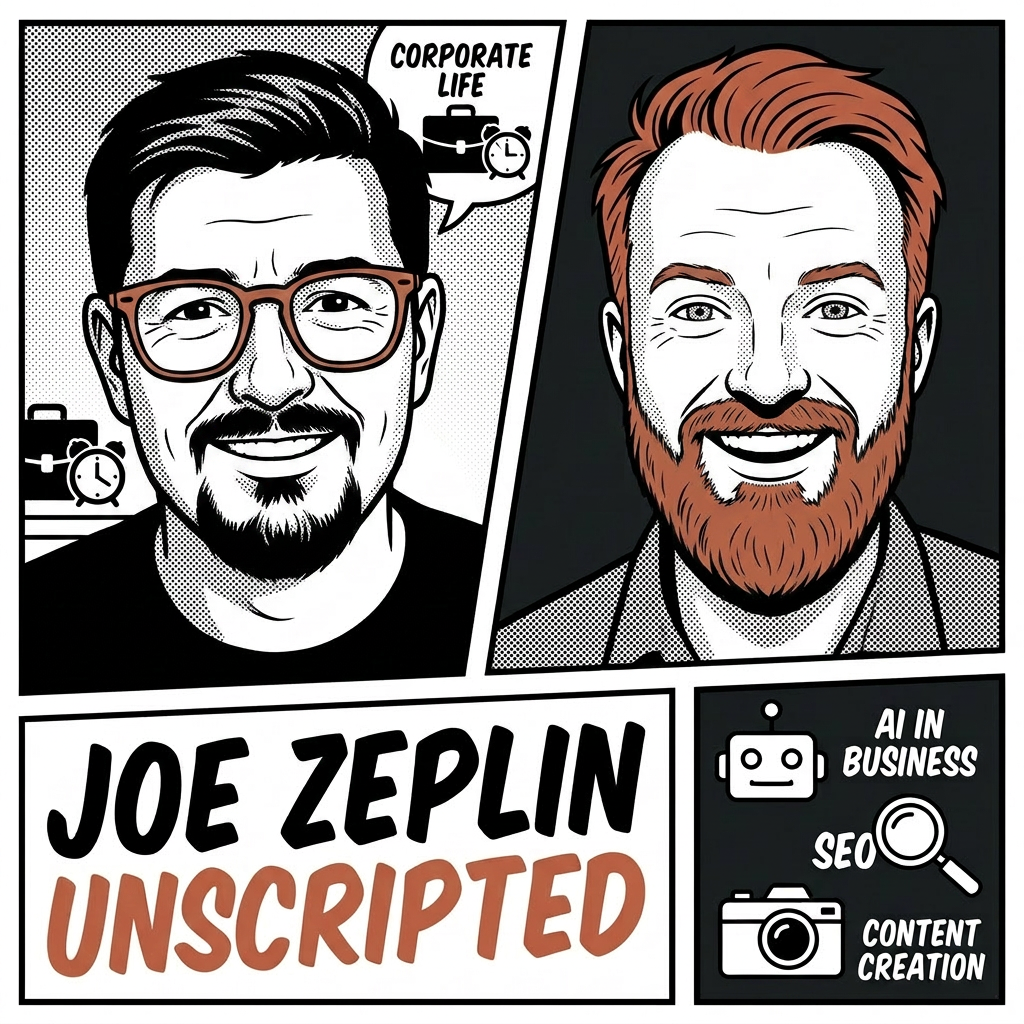
[00:00:01] Speaker A: Hello, I'm Jeremy Rivera, your unscripted small business podcast host. I'm here with Joe Zeppelin, a content creator, a self styled YouTuber. Let's hear from him.
Who do you think you are, Joe?
[00:00:18] Speaker B: Hey Jeremy. I, I'm happy to be here. Who do I think I am? I have claimed the recent title the corporate guy turned YouTuber. So, so that's, that's who I am. I, I went the corporate route for a while and I just jumped to YouTube full time. And so I'm kind of emphasizing that that's possible and so that's, that's who I am.
[00:00:39] Speaker A: I feel you. I, I suffered under the corporate yoke.
It wasn't corporate to start. It was a, a homeowned company with a small owner.
They did customer support for website, they did websites for realtors. So I started in the support department and year got bought out by Dominion Enterprises.
And they are as bad as their name implies. They thought that 2% annual raises were overly generous and would slow walk them three to six months. And by the time you got your raise, inflation had already eaten it and it was just a corporate bureaucratic nightmare world.
So I learned SEO and spread my wings and flew away.
Um, what's. Where did you come from within the corporate stratosphere or structure or dungeon to reach your new icarian heights?
[00:01:41] Speaker B: Yeah, it's cool that you, you made the jump to do your own thing too because you fully, you then control what your raises are which are good and absolutely terrifying.
[00:01:53] Speaker A: It's true, it's true. I don't even think about it that way necessarily anymore.
I almost feel like there's just so much opportunity just at everybody's fingertips. But I remember thinking, how am I going to make it? And the only way I thought that I was going to survive was like, I need to find another job. I needed money, I needed another job. And then you have to wait every two weeks to get paid by somebody else on that structure, the deposit system. You get kind of reliant on that dole out. But it's a terrible like it's inflexible. And you give up so much of your life and you're told that the medical benefits are fantastic when really you're overpaying always. And then the actual payout for what the benefits are, you're like, okay, this dental plan that we fought so hard to have, I still have to pay out the tooth to get anything done anyways I could have like. And then I find out there's cash programs for dental programs like this is cheaper than what I'm paying out. Out, you know, annually for. For dentistry. Anyways, so.
But again, I'm talking more about myself, and I want to hear about you. So you tell me, where did you come from, Joe?
[00:03:12] Speaker B: Yeah. You talked about whether you make it the dungeon or what you call the corporate jump. Right. So I wrote the reason I made the jump is I was doing YouTube on the side for three years, and I worked a really nice corporate job. I'm from Harrisburg, Pennsylvania. I went to school in South Carolina. I've moved to Wisconsin, New York, Florida, Illinois. Not Illinois. Spain then. I'm out of Utah now. And I was traveling for work. So I got, like, really cool experience. Right. Got to see the world. I did a lot of industrial manufacturing. Right. So I was the guy who came into the plan and tried to find a process that could be improved and then rely on the people and try to kind of revamp that. That segment of the business.
Hard hat, steel toes. I loved it. And I did pretty good in that, where I climbed on to leadership roles of one plant, then four plants, and then 104 plants across the United States. So it was a really good, like, quick trajectory, all based on, like, really good sponsors I had, or not sponsors, I would say mentors.
And then, you know, AI is automating a lot of different jobs, you know, and you. You know that. And so if you're in the corporate world and you work on a computer, like I did, essentially project management at that point. Right.
Those type of jobs can be automated really quickly because you can get the transcripts from the meeting, you can get the action takeaways, you can throw it into a software. It can notify everyone.
And so a huge part of the workforce got laid off. My job being one of those. And so I got laid off on a Friday, Saturday morning, I woke up and wrote down, like, why do I not so badly want to go back to another corporate job?
You know, because, like, it's. I didn't like the one I was in.
[00:05:09] Speaker A: Yeah.
[00:05:10] Speaker B: And I wanted to do my own thing, but I was kind of treating it like a hobby. So I wrote essentially, like a giant memoir. But I didn't call it a dungeon. I didn't call it a trap. I called it Alcatraz. Because I was just at Alcatraz recently, and I said, like, hey, I can go. I'm on the brink of the edge of the island, and I can try to make a jump to the coast and swim and see if I can make it doing my own thing or I can go back into my cold, dark cell, and I wrote out this whole thing and said, screw it, I'm making the jump. And so that. That happened about five months ago, four months ago now, and we're still doing it. So it's terrifying.
[00:05:52] Speaker A: I feel like, you know, there's been this unwritten social rule of, like, you know, come work for us, we'll take care of you. You know, we're family.
You know, I don't think that that was ever true, but I feel like the flip side of things, of, yeah, AI can replace your workers now, but now those workers can now replace your company a lot easier.
[00:06:27] Speaker B: Yeah, you're 100% right. Because, like, if you're working for someone else, that's a threat that you're competing with. But if you're working for yourself, those are assets that now you can use to grow your own business. So it makes total sense for more people to double down on themselves during this time, because it's never been easier to build an app, build a website, go, essentially have access to a coach. You know, anytime I don't know how to do something, I ask it. Like, I have a business coach, I have a brand manager coach, I have an email response agent. I made all these little agents that essentially coach me and kind of put me down a direction, help me think through problems.
And SEO, too. SEO is a coach, too.
[00:07:12] Speaker A: Tell me about what are the specific steps? Like, somebody's in small business or they're thinking about launching a small business.
There's an aspect of these AI tools, you know, and I'm learning, adopting. I mean, I'm literally in the background while we're chatting, you know, Claude code right now is updating my Jeremy Rivera SEO SEO consulting site. So I use these tools all the time, but there's one aspect of it that I'm still wrapping my head around, and that's when people use the term agent or agentic. And what is the actual process?
Physical. Like the rote, driest, you know, like, I'm going to turn it into an action item through Claude afterward, trust me. But give me the SOP for, you know, making an agent. Like, what does that look like?
What are your guidelines around that? How do you make it not hallucinate and be useless, but be filled with actually useful context to solve whatever it is you're trying to come up with?
[00:08:22] Speaker B: Yeah, that's. That's a really good question. And, like, there's two in there, right? Like, one is like, where do you start? And then the other one is like how can you then use these tools to help you along that path? And so that, that Saturday morning when I, when I woke up and I wrote out why I was doing it, and I think that's a good place to start. Like, why do you want to do your own thing? Some people might want financial freedom, some people might want personal life freedom, some ego, maybe to make their partner proud. Like whatever it is, right?
I saw, I believe that everyone has a lot of potential when they focus on their passions. And so I wanted to focus on my passions because then it's. If I put in all these crazy hours, it's hours that I would have been doing anyway because I enjoy making YouTube videos, right? Uh, so I think I tried to figure out the why. And then I tried to, then I said, okay, if I was to make the jump, how much money would I have to bring in every month to sustain my life? And I just like I did use Claude, I used Chat GPT, I put in my banks, a little bit of my bank transactions and stuff like that. And I, I got an idea of, okay, here's how money you have to bring in every month. So day one, understand the why. Day two, set a financial goal. Day three, then you have to say, okay, how are you going to achieve that financial goal? And so you either need to sell a product or a service, right? So I would say like design a product. So I made YouTube videos, but I only made YouTube videos for fun. I made them for me, but I realized that people also pay people to make YouTube videos. Like I talk about softwares and if someone makes a software, they want me to talk about their tool. And so I made a little easy media kit where I said if I make a short form video, it'll be this much a long form video, this much, a full playlist, this much. And I would obviously only talk about tools that I, I really enjoyed. Right?
Like we were just talking about potato before this, like potato is a, is a good tool and I trust the development of it.
And then day four, then once you have the product, you have to sell that product. And that's where I, using Claude and using what I call like an agent right now, I used it because I know manufacturing, we talked about me being an industrial engineer, but I, I didn't know how to sell. And so essentially you need to coach these plat, these AIs to first learn as much, at least how I do it. And I'm open to your thoughts too because I'm trying to learn. But I wanted to coach it to learn as much as it could get about my business. So I added like the links to my websites, I scraped all the information from all my social media platforms. I pulled information about industries that I would like to go into and talk about on YouTube and I kind of fed it all this information.
I also never typed to it. I always talk because I tend to ramble. And when you ramble, it gets more context because it's getting more transcripts. And then I asked it to essentially interview me. So I said, hey, my goal is for you to be my full time business coach. I really need to double down in sales based on what you know. I'd like to make a, a framework, 10 steps to go achieve this. But I know that you're probably lacking in information. What information do you need from me? And then it asks me these interviewed questions. And so I'm essentially creating this Persona or this knowledge base that first learns a lot about what I do. But what do you do? Like, how do you get it to learn about what you're trying to accomplish and make sure it has all the right information? Because that's the toughest part because we assume that it knows everything and it doesn't, not until you give it to it.
[00:12:08] Speaker A: So what I've been doing recently, and I know there's a piece that I need to fix and solve on, on the Claude code side for all of my interviews, I opened up Obsidian and added an A, asked it to connect an MCP to that Obsidian so that stores locally chat information, storage the transcripts, and then created a second piece of that that's like a synopsis and information and context for each of those interviews. So there's two files for each interview that I do so that I can ask it, hey, I need an article that references, you know, three or four different previous interviews and I want to make an article about link building and use. And I created a separate I it I ran a separate task where I asked for it to take my anecdotes as a host when I shout out and when I throw down, when I talk about my history and experiences, I had to extract everything that I had said about myself over those 120 episodes and make a thought, a vault in Obsidian to reference my experience. And so that's full of anecdotes, that's full of my voice, that's full of my experiences and insight. So that kind of powers, you know, all of the information about me so I can tap into that as I ask it to in my voice, pull from this and Then reference, you know, these three different guests and give me an article for my SEO podcast agency, you know, and give me, you know, give me this.
It's pretty good. Now I want to do it over in GitHub because I'm only, like, I'm not perfect at this. I'm interviewing AI and automation specialists all the time and learning. Okay. It's funny because, like, when I started with Claude, like, I thought I was pretty good at it, but I didn't even understand what I was doing. Because every time that you put in a normal prompt in the web interface, the temperature, as they call it in the industry, is extremely high because it doesn't know what you're going to ask. But if you save it as a. So the temperature means the variability of the response.
So you'll notice that you're more prone to hallucination when you're using the web interface version versus the desktop version. Because on the web interface version, that dialog box, it's a mathematical call to answer whatever's put in it. But because we're so creative as. As humans, it could be anything. So it needs a high degree of variability in the answers. And that's what they refer to as temperature. Right. In AI terminology.
But if you define exactly what it is that you want to do and save it as a skill in Claude, it reduces the temperature as much as possible so that it's. You can almost always get the exact same results if you run that process. Like, so. Because you'll notice, like, if you run a regular prompt and I would. It was. It was happening a lot because I would put in, you know, my podcast interview and I would want, hey, give me a recap of what this article was. And every time it would. Or ever, 60% of the time it worked. Every time, 60% of the time it felt it gave me a recap. And then I would be skimming through and it would have created a section of text that I know that I didn't say or that a guest didn't say, and that's obviously a problem.
But turning it into a skill and then defining, hey, as a strict editor, you're not allowed to do this. You're not allowed to rewrite whole sections. You can only remove, you know, words, ers, ums, interruptions, change spacing. But you're not allowed to remove whole sections.
Like, there's been like, a whole disaster area of, like, Yeah, I realized that it was, you know, re. Like, I told it to add call to action sections, like, as buttons is what I meant but it was rewriting sections of, of my spoken verbiage to promote my stuff. I'm like, I didn't say that. That's not what I told you. So you have to be very specific about it. But what I found is, you know the normal prompt on the website website version of Claude was very, very, very hallucinogenic. But the desktop version using skills now it's, it's. I haven't, I haven't detected because I added a second process to tell me how well did I follow these those rules. Double check and you know, give me a report of what percentage of content was edited out and if there's anything significant what was left out so that I can like spot check. Oh, you took out my favorite sentence. Well, I'm putting that back in but you know that that's been kind of my journey of making the the AI tools, remember?
And I did an interview with a guy who called created something called Upright Uproot hq. It's supposed to be a memory layer, an application for Apple for OS that does a similar process to Obsidian. I can't use it because I'm still ST Windows and he hasn't released it yet but there are. You can do that. I understand you can also use GitHub and connect it as a repository to store more long term because I am consistently on desktop, running into your chat is too long. I'm compressing this information. Your chat is too long and that means it can't retrieve that older information and retain it and refer to it.
It's weird because it can reference other chats if you tell it to, but it, it seems to not want to behave like that.
[00:18:33] Speaker B: And are you using on the desktop version predominantly Claude code or do you use cowork or chat? What's your split?
[00:18:43] Speaker A: It's mostly so I actually have both open and I do them for. I use Claude code on dangerously skip permissions mode because I'm suicidal apparently but mostly because I have Royal McP connected my WordPress sites and I let it make edits dangerously because I can get so much more done and it asks for fewer like it's less stops Like I've tried it on Claude desktop and it hasn't been as fun because it's constantly. Oh, are you sure you want to do that? Yes. I told you to fix the about page based off of this. So I want it to be aggressive but you know that's not everyone's cup of tea. But yeah, for the most part I use both Chat desktop, Google Claude chat Desktop and then Google Claude code, which actually I needed. Mason McCumber, he's a previous interview. He actually had any desk into my system and actually get it to work correctly. So.
But now I'm using Claude code, at least for a lot of my web projects.
[00:19:58] Speaker B: Yeah, that. That is one that I need to learn more about. I. I went left to right. So I was chat for a while and then I was like, oh, cowork's kind of crazy because of the file referencing. So I was like, okay, this. So this is. I did Claude chat plus projects initially and I would load up the instructions of what I needed it to do and then.
But then I had to always self update those instructions. So I saw, hey, Claude cowork. You can kind of have it go reference files on your computer where it saves memories for topics of discussion. And I'm not, I would say on. On skill set of AI vocabulary, I think.
I mean, I was using, I was using the tools for a while. I mean, I was using ChatGPT in 2022 and I was showing all the people at the plant. I was like, guys, this is crazy. Like it could do your emails. And they were like, this is nuts. And now everyone jumped to. Then the transition came to a layer. Like Claude was on the rise. But the rise of Claude is like predominantly the hype is around Claude code. And I don't know Claude code that well. So I'm kind of forced to. You not forced to, but I'm limiting myself. I know only using these other ones, but also when I talk on YouTube. Right. Like there's an audience for people who only want to watch their very technical Claude code videos. But the. That's not the masses. And I'm not a representative of the massive either. Or I am a representative, I would say, like of the masses. Like know a little bit of computer skills. That'd be dangerous. Let's see what we can do in these other two. But then I hear things that like you just mentioned and I'm like, gosh, I'm limiting myself. Right. So it's a, it's a fun dilemma of how much do you use it to improve your operations of your business. But another time you just have to sit in the operations of your business and kind of like work the funnel. Right. So. But I always want to be designing if I could. Right.
[00:22:05] Speaker A: So I'm curious.
You're living my son's dream life. You know, he's eight, but he says that he wants to be a YouTuber.
I myself, it's funny because I. I'm constantly doing interviews. I did four yesterday, but I cannot recall the last time that I could force myself to sit down and just talk at the screen without somebody else, like, replying. Like, I'm talking to you. Yeah, I'm talking to my computer. You're not actually here. But what is that process? Like. Like, how do you, you know, if you're creating content, is it just a mental game or. Or. Cause there's a lot of content that he.
Well, actually he's on a screen break right now. He's not allowed to watch YouTube for the next few months because his behavior went off the rails. But in general, there's kind of this, you know, this YouTuber voice that I've noticed of like, I was in the. The overworld for 13 days and here's how I survived. And. And then I opened the door and then I went into this next thing and there's like no breath in between and there's this like, YouTuber voice.
Do you guys, like, take a class to learn what the YouTuber voice is? Is it a meme existence? Is it something that, as you try to emulate what are successful videos, you end up just picking up this particular cadence, this vocabulary or the sound where there's a whole, you know, there's a whole class of creators that you really couldn't tell the difference between the two. Two different ones. And they're. They're making, you know, especially in the. The gamer video type genres, I think it feels particularly prone to it. But is there an. Is there a YouTube voice and is it a choice?
[00:23:54] Speaker B: That's actually really funny because you're exactly right. I have the YouTube voice, right? Like, if I. This is my same setup. I use a better camera. My lights are here, got the key lights or other lights in the back, and my things would open up with like, I'll show you how to make this voice. Digital business card. Boom. Then next slide, then next slide, then next slide. Right? And so if I had to ask question where that came from, I think it probably comes from like anything else. There's a lot of different reasons, but for me personally, I initially started making a video on topics that I enjoyed and, well, let's even take it back a step. What type of content do people make? So there's instructional content, there's entertainment content, and there's promotional content. Are you familiar with those, like, three pillars?
[00:24:48] Speaker A: Yeah.
[00:24:49] Speaker B: So like, for people who don't know who are listening, entertainment is where you are watching something and you're willing to trade your Time for something that visually satisfies you. Picture stand up comedy movies, Mr. Beast document videos, they are things that you'll watch because they entertain you. That's entertainment, right? You're trading your time for that satisfaction.
Then there's promotional content. And promotional content is often used for businesses that are already have a product. And that's what you think of general advertising. You think, hey, I'm doing a YouTube video next Friday, or I have one coming out next Monday and I make it an Instagram post saying get excited for the drop that's coming out on Monday. I'm promoting another form of media or another product.
Then there's the one that I do which I find the most value in, which is instructional content.
And instructional content is where you're trading your time watching it for something that teaches you. So think of those are your how to videos, how to make a website, how to make a digital business card, how to use Claude code.
And so I think the voice probably depends on what, what neat, what type of media you're making. But for me, let's imagine I make instructional content. If I make a video, we have a great video on how to make a digital business card. It's almost, it's our most popular video on the channel. We also have a couple on how to schedule social media posts. If I, if someone is researching on their side, how do I schedule social media posts? And, and they see that in my title, they see that in my thumbnail and they click the video and I'm doing anything but showing them how to schedule a social media post, they're gonna drop off right away and that's gonna hurt retention. And then YouTube's not gonna promote that video.
And so what you kind of do with instructional content is you try to show the audience that you are who you say you are and you're gonna show them how to do that thing. So I would say like I'll show you how to schedule posts, automate social media messaging and track your analytics in this detailed step by step tutorial. That's like eight seconds. And while I'm saying that on the screen, I might show a preview of all of those three things. So now they're like, oh, there's a person talking, there's screen recordings, we're going to talk through these three things. And I also make sure that those three things are SEO words. So the one that YouTube takes the transcript, it's more likely to recommend my stuff.
So I think the YouTube word, the
[00:27:32] Speaker A: YouTube,
[00:27:35] Speaker B: I would say, what did you call it? YouTube voice.
I think the YouTube voice is probably people studying their analytics and seeing what keeps the highest retention. But then you also have people who do podcasts and they talk for three hours and there's pauses and there's breaks and it's beautiful.
And I listen to those. Right. So I don't know where that there's an appetite for both.
The correct audience members are going to find you for both. I think you just be consistent and be yourself and then the right audience will probably stick with you. But I tend to be the let's fly through it type guy on the videos. Right.
[00:28:19] Speaker A: So is your objective and what you're doing to make more YouTubers and competition for you or make small business make people who are in corpo structures realize that they don't have to be and can do X, Y, Z, P, dq. Is there a consulting aspect of what you're doing or are you mostly just creating content that to aimed to support the person that's doing those searches. They're on YouTube looking for information to free them from their shackles, so to speak. So where, where as far as like a business plan for yourself, where do you see your services fitting or, or do you see yourself as a, as a service vendor or as just a content creator?
[00:29:13] Speaker B: Yeah, I think definitely the content creator side and I want to satisfy the people who are trying to solve that task. I want to be the video that helps them solve that in the quickest and cheapest way. So almost all the tools I talk about have a free version, right. They all are relatively, really easy to use. And if they're complex but popular, I try to make them simple. I try to make those complex tools simple. I would think if you look at the people watching those videos, right, you might have other small businesses who are really struggling to make their first logo or to figure out how to grow their sales or how to grow their social media. Most of our stuff is on social media management.
They rather be selling coffee. Right. My girlfriend, she runs a coffee shop business. She'd rather be selling coffee but she can't do that because as frequently because she has to run her social media. So how do we make that quicker for her? Right. Some people, we have a lot of videos for students on how to really try to learn the most while they're in school for four years and how to network and stuff like that. Like the goal is progress.
I always like to say my progress is my happiness. And I like to think that people who are searching something about what we make videos for, they're trying to progress in that thing.
So I think that's probably it.
And then as I've started to do it, I realized that there's an audience for everything.
So, like, do you have. What are some of your hobbies outside of podcasting?
[00:30:52] Speaker A: Well, I just picked up karate, started in September and did a couple tournaments. I'm testing this week to graduate to Orange Belt, which isn't that high, but it's definitely been a learning experience.
Let's see. I also am an avid f learning languages.
I'm conversational in German, Japanese, Spanish, and French.
But yeah, I was literally just thinking this morning about starting another podcast of unscripted languages just to interview different.
That'd be so cool. Different podcast, different content creators in the language space to get to learn how they approach learning languages differently.
But yeah, that's. Those are a couple of my other niche. Oh, and board games. 100%. I've got 45 board games on that wall over there that you can't see, so.
[00:31:51] Speaker B: Oh, they're so much fun. Yeah, I saw that. I saw the photo in the back. And then as you talk about it, you design your things in the back. Well, based on your hobbies, right? Because they're all there.
[00:32:04] Speaker A: Yeah. I make these wire flowers. I'm starting the BES bouquet.
Little mini brand of little wire sculptures, Pokemon and dragons that. I've been doing that since I was a teenager. Annoying my wife with my future wife with yet another rose that I made for her. This is nice, Jeremy. And then I show other people, like, oh, that's amazing. Like, I wish my wife appreciated my art as much as you.
[00:32:36] Speaker B: Hey, man, it's. It's all about how frequently, like, exposure. Right? Like, if, like, you and I are create like our deep in AI but if someone came out with a new feature, we still might be like, wow. But if someone had never seen it, they're gonna freak out. Right? Like, that's with everything.
But that's what I mean. Right there.
There would be an audience if you did, like, karate entertainment or in karate, instructional, if you did personal.
Metal work and how to build beautiful things, there's an audience for that. And if you did board games and said, here's your strategies for these great board games, there's an audience for that too. Right. Because people are interested in so many things, and all you have to do is talk about those things and show that you're passionate about it. And so that's what I'm starting to learn from doing YouTube is I initially did it of how can I provide value in something that I'm good in, which is, hey, I'm good in software. Let me teach people these softwares. But just how. You love karate, right? And you're getting your orange belt. I love fishing, right? So I'm rigging up the. I have a little john boat. I'm rigging it up with GoPros on all the sides, and I'm going to do a podcast on a boat where I bring someone out, we go out in nature, we just cruise a little bit, and we talk on the boat. And granted, water, microphones, sound. It's going to be so difficult to figure out, but I know that I enjoy fishing. Other people enjoy fishing. Nature brings long conversations, and there would be an audience for that. So that's what I'm starting to learn, where people can pursue their passions in and sell, but you can also just pursue your passions and document it, and other people who are interested in that stuff will tune into you. And so. And then you can.
Then down the road, you can, like, you can spend your day doing what you like and hopefully find some way to monetize it, right?
And that. That's the next move. Now that I'm realizing that I'm like, oh, crap, what can we. What else. What else would I do with my life if I could just record it all?
[00:34:46] Speaker A: Two. Two questions. I mean, obviously not everybody's meant for. To be in front of the camera. There are people who, like, I tell them, you know, how many podcasts I've recorded, and they're like, that's insane. Like, how many I can. Oh, well, 120 in the last year.
[00:35:04] Speaker B: Let's go.
[00:35:07] Speaker A: It hasn't felt like that much, but I was doing the math. I was like, setting up that Obsidian, you know, database and like, okay, it's. This is taking a long time to calculate how many interviews that I've even processed. And like, oh, okay, well, that's why.
But my question is, on the content creation side, how are you looking to. How. What are the pathways to understand monetization and the platforms that you want to connect for? Or, you know, is it all just waiting for that payout from YouTube and. Or are there. Should you consider, you know, also doing TikTok?
Are there secondary platforms? Is it, you know, you know, looking for additional monetization strategies, looking for sponsorships, like, let's get into the money side of things. Because if you. If you're proposing, you know, anything, you can create content for any niche, but can any niche support the content you're creating from A monetary perspective?
[00:36:18] Speaker B: Yeah, that's a great question. And like, unfortunately I didn't find it out until I was monetized. Right. So I knew like hey, I was going to create YouTube videos for so long.
But you don't. Unless you do good research, you don't. It's really hard to figure out what type of revenue you would be able to bring in until you meet those thresholds. So that will like talk about a couple things. So like what, how do you monetize different social media platforms so people make their money like either through What I call AdSense, which is on Google, Google has YouTube. AdSense. On YouTube you have to have 4,000 watch time hours and a thousand subscribers to monetize. And what that means is when someone clicks on your YouTube video and there's an ad on screen right before the video starts, or maybe there's mid roll ads where there's an ad in the midd of the video before the while you're going through the topic.
An advertiser that you didn't, you didn't choose to represent paid YouTube maybe, I don't know, 10 cents to get that in front of your face, the viewer's face. YouTube splits that revenue 50% with the creator. 50% goes to YouTube right now. So that's one way you meet the minimum thresholds to monetize watch time hours is how many hours your, your videos are on screens across the globe and you have to hit 4,000 in the last 365 days.
Meaning, which was crazy because I had 4,000 hours but I didn't have it in the last time period. Right. So and then the thousand subscribers, you have a thousand people hit the subscribe button. There's other like lower tier ones with like 500 and 3,000. But I'm not, I don't know as much about those. When I surpassed it, I, I made YouTube videos for a little under two years before I was monetized. And so then every day you start maybe you make 4 bucks, 2 bucks, 9 bucks, 20 some dollars. Right, whatever.
But if you really put that out like for me I've been doing it for three years, the YouTube revenue is, I thought was, would be a lot higher. It's really, it's minimal. Right. It's a couple hundred bucks a month. And so that's not enough to live off of. Right. So then you think of what are those other tiers? Well, the second tier is affiliate links. So for instance I, my third video was on Metricool. Metricool is a social media post scheduler I used it when I was starting my YouTube because it was a free tool, free tool.
And I posted across.
You essentially can post there and it automatically goes to YouTube, Instagram, TikTok, Facebook, whatever.
And I used Metricool and the video and I talked about Metricool because I was using it well. The video had done so well that last year Metricool reached out and said, joe, your video did great. Can I pay you to make another YouTube video? I wasn't even anticipating this, right, Because I made a video for free about tools that I like. And now those same companies and some competitors of that company are asking me to, well, sorry, that's not an affiliate link, but they're asking me to talk about their tool. So first one is YouTube AdSense. The ad plays, you get 50% of the revenue. The second one, which I just mentioned, is sponsorships where you own a niche. So, well, like, you talk about karate for so many so long. You talk about SEO that someone who has a really nice GI for karate or someone who built a really nice software for SEO is willing to pay you to talk about their things. And then the third one is affiliate links, meaning I might put a link to Metricool in my description, and anytime someone clicks that and buys a $10 a month plan, I get, I don't know, $3. Right. And those are kind of the makeup of the three different ones in terms of platforms.
I started on YouTube, then I expanded to LinkedIn, then I expanded to Substack. I tried to do all the platforms at the same time. And I realized that's a losing battle because you really have to study your work and study the analytics and it's really difficult to study how your posts are performing across six platforms at the same time. I would take one platform at a time and really try to learn it, then go to the next one.
And I think. And then the platforms that I would use are the ones that are linked that have their own AI model. So like Meta, Meta, AI is Facebook and Instagram.
YouTube is owned by Google. Google has Google Gemini. I think more people are going to search with AI. So you want to have a platform that's linked to where people are searching. So I would do one of those big three, YouTube, Facebook or Instagram.
[00:41:18] Speaker A: That kind of ties in to my next question. It's so my friend Matt Brooks of SEO Tarek says AI is your least informed but most popular customer support representative.
So, and that dovetails with some research from, I think, Lily Ray and a couple of other people that came out this week. Mark Williams Cook in the SEO industry that citations from a tools for YouTube videos is on the rise, a significant percent, a dip down sometime in December as they were measuring it, but now it's back on the rise. Do you think that's, that's like a sustainable trend, that that as, as the answer to more things comes at your fingertips of the easy stuff, that the knowledge domain is going to continue to be in the creator's hands?
[00:42:23] Speaker B: I think exposure to new skills, or like you said, exposure to new skills is going to grow because of AI's ability not only to present you with that information that you're seeking, but also a way to frame that information in a way that you understand.
And if you're more likely to pick up new skills quicker that give you a general understanding of what to do next, then I think you're more likely to then seek out what the next I would say like advanced step is for that skill, whatever the next thing you're supposed to be doing.
And you can either continue to go through AI or you could go search from a influencer who's talking about that.
It's hard for me to say which route people would go, but I think that the person who's talking about technical information might historically only been able to their viewers might have only been extremely technical and they were able to do be extremely technical because they put in the work like you've been doing SEO for two decades. Right. But now other people are going to be able to learn some things a lot quicker that might encourage them to expose themselves to the more technical thing. And I can see that on my side. So I only had a quarter of 1% of my views come from ChatGPT. You can see external and I had a quarter of 1%. Now last time I did a podcast I checked it was two and a half percent. And that was like three months ago.
And the way I did that is I started doing podcasts. Essentially I didn't only want to do self promoted content, but I want you to promote me. I want to promote you. I want to promote Metricool. I want Metricool to put my blog on their website and kind of teach these algorithms that cross promotional backlinks show that we're a better formed, better reference individual. And how did I know that? Well, I asked ChatGPT, I wasn't even, I didn't even know Claude at the time. And I said, how well am I showing up in search results? He said, not well, you only do self promoted content. Here's everything you should do. And then I started doing those things. So I think the exposure to more technical stuff becomes easier as these tools teach you the basics.
[00:44:41] Speaker A: I'm curious about if you've run into Hallucination. I was talking to Nightline Casters, a lawyer in Nashville, and you know, obviously there's some pretty famous court cases right now where, you know, some lawyers are in 100% trouble for having cooked the books and having arguing citations based off of cases that don't exist.
What's the, what's been your run in with Hallucination with these platforms, the error rates and what I call is the. I don't know, it's the laziness or that our willingness as a society to accept a beta test level software societally because the results are so amped.
[00:45:30] Speaker B: Yeah. So using ChatGPT for last four years. Right, right. I never had anything to compare it to because it's the only one that I use. There was Gemini, there was Claude before. I didn't know about him. I didn't know about Claude until like this year. Right. So I don't even know when it like really came out.
But I have recognized a couple things. One is I recognize that ChatGPT started this year always asking me if I wanted one more thing.
So it's say, like I would say, how do I grow my sales? And says, here's the five steps to grow your sales. All the information you need to be successful. Boom, boom, boom, boom, boom gives you all your things.
And then at the end it says, but I can show you the one thing that will really grow your sales. And I'm thinking in my head, like, why didn't you tell me that in the first place? There's something, something in the program was trying to incentivize users to continue to interact with it. So that's one thing that I recognize. And then I also saw that the. I also experienced that my exposure with ChatGPT versus Claude is. ChatGPT does make up a lot of things. Like if you're applying for a job and you're saying, hey, help me write a cover letter for this job. Here's my resume. It'll make you sound like the best person ever. But it just makes up stuff, right?
Like by default, it makes up stuff where Claude. By default, if it's missing information, it asks you for that information.
And so I think if I asked what the color of the sky was today, and I don't know, chat GBT said, hey, it's, it's blue and slightly cloudy. And I kept telling it, no it's storming outside. It's storming. Tell me it's storming. They would tell me that, like, we need Noah's ark, right? And we need.
It's a positive, enforced tool where I was using Claude and I was using a framework, and I said, hey, take me down the five steps of my framework. And it genuinely said, at one point was like, hey, you're getting distracted and moving away from what we built. Do you want to continue to go down this route or do you want to get back to what we were building? And so it kind of course corrected me. And then a couple times I asked to do something and said, like, I cannot do that. And I was like, like, whoa, it's disagreeing with me now. And I.
I was surprised, but it made me trust the tool more. I don't know what your thoughts are.
[00:48:03] Speaker A: No, I. I definitely see the yes man conundrum.
You know, I often use the analogy of ChatGPT is like my dad, he'll tell you a great story about Slobodan Milosevic and how the Mongol invasion connected to that 1990s disaster.
And it sounds really good. It sounds authoritative, has historical sounding references. But when I used it as the basis for my European history report, I failed because none of it was grounded in actual facts, was not accurate in any way, shape or form. It sounded really good and reaffirmed what I thought my suspicions were about it. But no, no, the yes man problem is genuine.
So, yeah, you have to be aware of the platform, its limitations, and aware of its own faults. Even Claude. Claude does. I find that Claude often does give pushback, but it can also lie. Like, I thought that it had connected to my. I thought that the. The web chat interface had also connected to Obsidian, and.
And I thought that they shared it. And so I asked it to do several tasks that I had done in Claude code of making the same article. And then I'm like, wait, this is not at all. You're making stuff up. Like, this isn't what any of these interviews were actually about.
And I had. I checked and it didn't have the same MCP connection, and it had pretended that it had.
So even Claude can make mistakes and can make assumptions.
It said that. Oh, it checked other chats for similar resources to meet the criteria. So it was trying to do what I had asked, but wasn't telling me that it wasn't actually doing what I had asked it to do, how I'd asked to do. So. It's weird, but, yeah, it's definitely kind of the state of, the state of things. You know, like we have, you know, it's not like data from Enterprise, we don't have a true Android with consciousness able to like logically apply these answers.
But we do have a pretty good math machine. You know, if you think of these tools as LLMs and not as quote unquote, AI usually get a little bit further. And knowing that there's math behind the scenes and layers of math and knowing that it's, it's a really good parrot, you know, it's not actually speaking English, it's just based off of the resources that we've given, it can give answers that are closely approximate to what a human might say based off of previous examples. But it's not true knowledge, it's not a true reflection and it can't have experiences, it can't have anecdotes, it can't learn.
It can only be given more knowledge base and like add to that database. But it's not truly experiential how we think about it. And we're seriously limited on bandwidth, context. And you know, if you've ever used Claude for a long period of time, you know that if your chat gets too long then you lose the originating context. So that's where other secondary tools that we were talking about, you know, copilot, obsidian, memory layers, taproot, et cetera, that can help it stabilize and remember things to do more complicated tasks. But you know, it's, it's still in its infancy, thankfully, and hopefully it's not going to rise up and enslave us all.
[00:51:50] Speaker B: Yeah, you never know. I mean, it's, it's certainly more powerful than any singular tool that I have had exposure with, but it doesn't mean it doesn't mess up. And what I think more of the tools enable you to, to identify what you like and what you don't like about it, right? Like if we, if we lived in a farm country where we only ate vegetables and vegetables aren't really sweet fruit or sweet, and then we randomly had a beautiful apple tree come out and we were eating, eating these great bright red apples, they'd be. Or maybe Granny Smith. We were eating Granny Smith apples, right? We'd be like, wow, this is like, this is so good, it's juicy, it's whatever.
But then if we had another type of apple, bright red apple, we'd be like, oh, the Granny Smith is just a little sour, you know, it's, it's better because maybe they're bigger, it's quicker or whatever, but you're only able to compare things that are extremely, I think, helpful when there's multiple ones and you can see how they compare against each other.
[00:52:56] Speaker A: I'm curious.
Last question is, before you came on the show, was there any question that you hoped that I would ask you that I haven't asked yet?
[00:53:09] Speaker B: I was true. I saw your title and I was truly hoping to learn something crazy about SEO that I should be doing that I'm not. And so it wasn't even like something that I was hoping you'd ask, but I was hoping that I could easily show you that you're probably way more versed in the SEO world than I am.
And so I like, for instance, I'm familiar with Vidiq for YouTube. I go ahead and look at the Google Google bar and I put in my topic and I see what it recommends. I do the same thing for YouTube. I use keyword surfer where I go through and see what's the volume behind all these words.
I do the you reference me, I reference you, we cross promote. But is there any other crazy SEO, easy to deploy tip that would help creators like us? Because I know there's gotta be things that I'm not doing.
[00:54:04] Speaker A: Well, I would say this, this interview is going to be about 3,000 to 4,000 words, right? And you know, we're at about 55 minutes worth of content.
The reality is that most people who create video content don't end up leveraging and utilizing that content effectively on their own website.
So anytime that you're creating content, don't forget that you can publish supplemental resources and alternate blog post versions, especially with Claude. Now you can take the transcript from your video and repurpose it. You can turn it into a slide deck. You can turn it into a PDF, a slide deck, an ebook version of that video, and put it behind, you know, an email gate on your website.
And then you can drive your, your email subscription base and drive up a newsletter.
The more you can turn that video content into a handful of articles, and then the more, then you get the topical value of building that resource on your site in text format. You know, go in and add some additional stuff, pull content from other interviews, add your own unique takes.
Claude generates PNGs now, so turn your quotes into quote graphics to drop into it.
You should be able to create at least four or five different content pieces from a half hour piece of video or audio content.
And, and that's part of it. And the other part is understanding. You know, getting rankings in Google for topical content is harder these days. But if you also have a YouTube video, you know it's supplemental to it and if you have a home base to drive those visitors to, to do more, to give them further research, Google will reward, will start rewarding you with additional traffic. And it's how you decide to monetize that is its own game game. Because you, you know, you're used to the algorithm on YouTube deciding winners and losers and who's going to randomly be shown your stuff.
There's a similar process on the other side on, on the SEO side on search engine rankings. You know, Google is deciding who is the most, you know, authoritative as well as the most useful.
And it's not every time. Not everyone wants to see a YouTube video. A lot of people do prefer that for the tutorial training. But there are other people who would prefer just an SOP or a talktorial or a picture based, you know, so you could turn your long form video content into topical content on the site you control.
And use this metaphor twice this week in two different interviews. But it's the Kraken. And if you're creating a brand Google, the more signals you can put out that your brand is a real entity. It doesn't matter if it's, you know, if you call your brand Monkey Monkey Momo, that's great.
But if you establish, you know, a Facebook page for Monkey Monkey Momo, a YouTube channel for monkey Monkey Momo, you know, you get on Quora and a few other places and you start getting mentions of other professionals. Oh, I ran across so and so from Monkey Monkey Moro, you know, Momo, I already forgot my brand. Keep it, keep your brand tight.
Monkey Monkey Momo. And so it's like reaching out into these different channels to pull them back. But your website has to convert, it has to have a reason. Like if as a business you, you want to think of it as the beak that's cracking those tasty mollusks to get at the meat. And so you need a conversion engine, you need a reason, you need a soft and a hard.
So your soft one is you just want their email, their name and their email and you want to give them every excuse in the world to give you their name and their email.
So that's downloadables, that's PDFs, that's slideshows, that's more detailed YouTube videos, that's tutorials, editorials, glossaries, etc. But just behind that email gate, you know, and so have a class of content that's more quality, try to capture that email, but also have that hard sell, you know, whatever it is that you're doing, have the hard sell, but have them next to each other. And let's see, the last one, the one on the right should be in a darker, brighter color. The one on the left is a softer color because you want to bias them and sell. Push to do the more valuable thing, but give them the wimpy, wimpy out Mike. So anytime that you have a cta, have two and one's like, you know, because it won't occur to them, oh, I have an option. Well, they do have a third option. Keep scrolling.
You want them that not to occur to them. Oh, there's a cta. Is this good?
Okay, yeah, I'll sign up for his SEO through podcasting, you know, or I don't need that, but hey, this is pretty good. So you want those and you also want, want.
As you're publishing this content, stop in the middle and have like a call to action of like a downloadable element, you know, something, a PDF associated with that topically.
That that's going to get you a ways down the road. And last but not least is if you're building a repository, if you're publishing content on the regular basis, make sure to go back and create useful categorization for your content.
Like if all of my podcasts fall either in social media, SEO, small business owner. So I created these topical hubs that then link out to the different interviews and posts that I've done. Okay, so when you have a call to action, have two different ones. The other piece of advice is when you're creating that topical content of your blog post, don't forget to tell them to do something further down the funnel.
Like if you think about like they're there for whatever, you know, topically, that thing is you need to have like a medium, like a soft call out of like a related resource that you made that's attached that you can get their email and get them further down the funnel. But don't forget the hard call out at the bottom of like, hey, work with me, pay me to do stuff, buy my stuff. Like, there's so many blogs that I've audited, so many sites that I've audited and I look at their blog posts, I'm like, okay, that's a useful, you know, that's a description of what to do if you have a leaky faucet. But you never said how you can help with my leaky faucet and you didn't have a call out section to start Work with you. Like, so. So there was this phase of time where people just like, oh, I have to blog. I own a website. I have a business. I have to blog. And that just led to the creation of all of this class of fluffy content that never led down the funnel to, like, proving what it is that you do or saying anything genuinely valuable.
The other. The final piece of advice is copy the text off of your homepage, paste it into a blank text document, and ask yourself, based off of this, can I actually tell what I do?
What is my unique selling proposition? What would you say you do here?
Like, office space style, you know, like. Like, just ask. Because I've done it dozens of times where I copied the homepage text, and it's like, we have the best customer service, and, you know, our delivery times are insanely fast, and you'll be super happy. And it sounds good from a sales perspective because then you have the image back behind it of whatever it is they do. But if you read the text, you realize I never said what city I work out of, and I only do services in the city. If you ask them, like, where. Where do you do business? Oh, just in Cookeville, Tennessee.
Okay. Well, you never said where you were located, just that you were, you know, a contractor. Like a general contractor. A house of residential only. A commercial contractor.
You're best in the industry. What industry? You never said it. So there's so many times. Go back to your homepage. Did you clearly say what it is that you do?
Is question one and two. Did you prove that you do it? Well, because it's your site. You can prove it, can't you? If you can't, you got a problem. You need to fix that. Like, go do the work and get the reviews and get the testimonial and get the photos of you building the thing to prove that you can do it, do it well.
So, you know, like, do it. Show that you do it. That's it.
[01:03:25] Speaker B: Yeah. Well, I was checking out your site, Jeremy. You definitely show that you do it, right? I. It's impressive. Your podcast goes up right away, after it's recorded. You have these systems in place, so you're doing it yourself. I'd love to continue to talk to you another time and learn more about this type of stuff, because I want. I work from home. I don't go to conventions. I talk to people there, and I do work here. Right. And so the way I learn is from talking to people like you. So, truly, thanks for sharing all your geniuses with me.
[01:04:00] Speaker A: I'm happy it turned into as much of a dialogue as an interview of you. So give a shout out of your channel.
Hopefully you have a website. If you have a website, the URL.
What's your favorite social channel that people can connect and chat and watch your videos for hours so that you can make some money?
[01:04:19] Speaker B: Yeah, absolutely. So our main channel is YouTube. Our title is the corporate guy turned YouTuber because we've shown that anyone can do their own craft by talking about what they're interested IN Online on LinkedIn, we're Joe Zeppelin. Z E P L I N My friends call me Red Zeppelin because I'm a ginger. Right.
And then on Substack, we are the corporate guy turned YouTuber. Our website is Joe Zeppelin dot com. It actually just has a giant revamp. It's coming out in two weeks. It's going to be awesome.
And it does answer what I do if I just took the text.
But those are our four platforms and then our content is essentially to help small business owners or creators optimize their social media in a way where they can spend more time creating and talking about what they like and having their social media work for them in the background.
[01:05:16] Speaker A: Love it. Thanks so much for the conversation, Joe.
[01:05:19] Speaker B: Yeah. Jeremy, you're the man. Appreciate it.